

 |
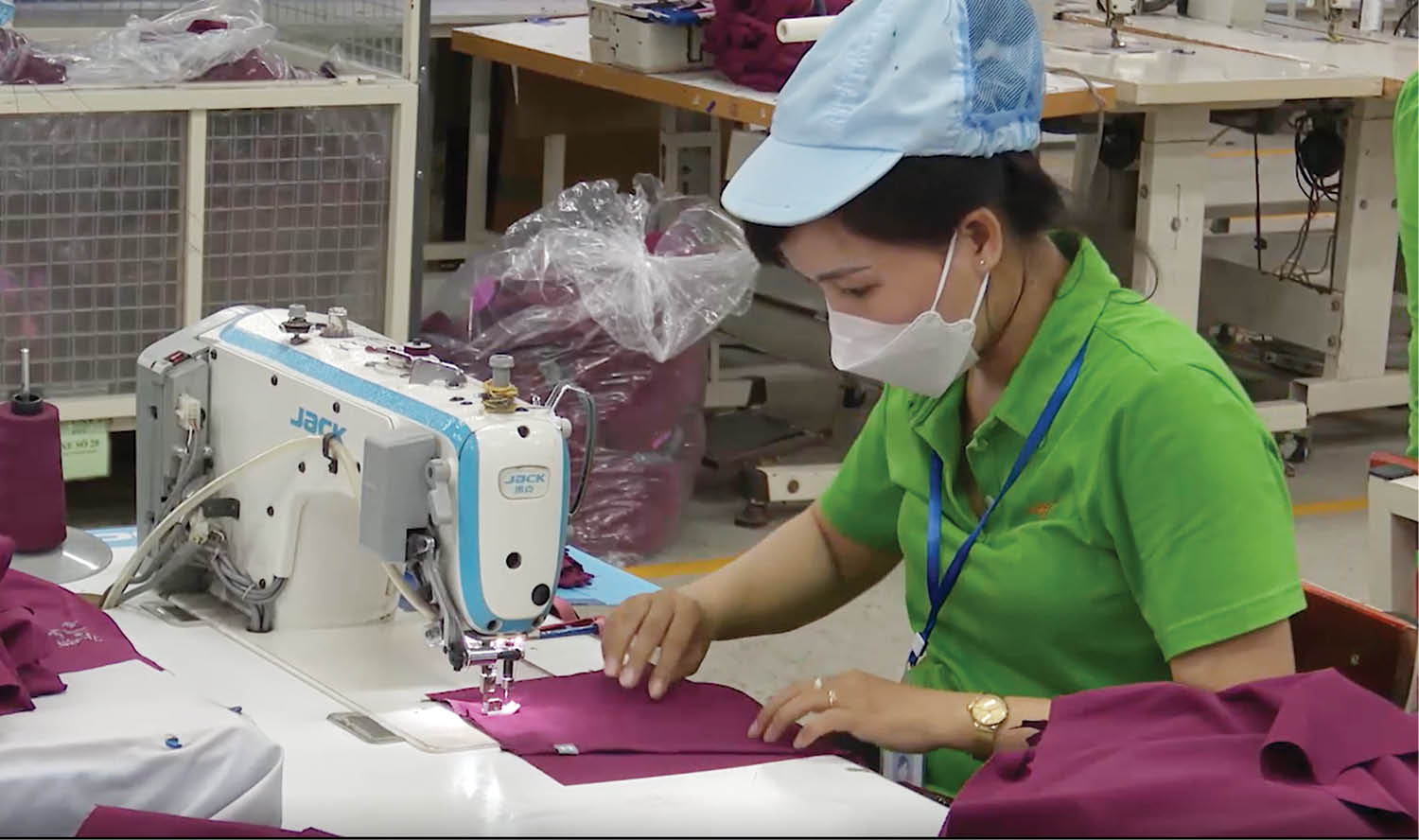
| Production workers at Phu Hoa An Textile and Garment Joint Stock Company |
Government close to businesses
A survey on business satisfaction with the services of state administrative agencies in Hue City in 2026, conducted by the Hue City Business Association, showed that out of 121 participating businesses, 66.9% rated themselves satisfied or very satisfied; 24.8% rated them as average; 5.8% were dissatisfied or very dissatisfied; and 2.5% had no opinion.
Mr. Nguyen Doan Quan, Vice Chairman of the Hue City Business Association, said that the most obvious positive point after the implementation of the two-tiered local government system is the increasingly concrete spirit of service and support for businesses. Many businesses believe that the transparency of information and administrative procedures has become more convenient than before. Not only is regular dialogue maintained with businesses, but the team of officials and civil servants, when receiving and processing applications, also demonstrate a greater sense of responsibility and a better service attitude.
According to Mr. Nguyen Doan Quan, decentralization and delegation of power to local governments have contributed to shortening the gap between the government and businesses. Businesses have the opportunity to directly access local agencies to handle their affairs; some issues are discussed more quickly, reducing intermediaries. When authority is more clearly assigned, responsibilities for resolution are also more specific, making it easier for businesses to provide feedback, make suggestions, and monitor the progress of processing.
 |
| City leaders visit the production process at HBI Hue Company. |
Ms. Le Thi Kim Hang, Vice President of the City's Young Entrepreneurs Association, observed that many procedures related to business registration, taxes, social insurance, online public services, and other administrative procedures have become more convenient than before. The application of information technology helps businesses reduce travel time and easily access necessary processes, forms, and information. However, Ms. Kim Hang also noted that this is still a transitional period with many new regulations, procedures, and operating methods. Some applications require coordination from multiple agencies, so processing times are sometimes not as efficient as desired.
Add support policies
The survey results also show that the most frequently reported difficulties from businesses are not related to service attitudes, but rather to processes, consistency in guidance, and efficiency in handling tasks. Specifically, there were 41 complaints about complicated administrative procedures; 40 complaints about inconsistent guidance; 35 complaints about inconvenient online public service systems; and 34 complaints about lengthy processing times for applications.
The areas that generate the most feedback include land and construction, taxation, fire prevention and fighting, investment, and social insurance. These are all areas that directly impact the costs, time, cash flow, and expansion plans of businesses.
According to Mr. Nguyen Doan Quan, many businesses still face difficulties in accessing land, production and business premises, and credit capital; some procedures related to investment, construction, taxes, fire prevention and fighting, and social insurance still take a long time. Meanwhile, the volatile economic context continues to put pressure on businesses regarding consumer markets, input costs, and the need for digital transformation to enhance competitiveness.
 |
| Production workers at Hue One Food Joint Stock Company |
For small businesses, the pressure also comes from updating and complying with new regulations. Ms. Le Thi Kim Hang believes that not all businesses have sufficient legal resources and specialized personnel to keep up with policy changes. Therefore, businesses urgently need timely and consistent guidance from relevant authorities to ensure compliance from the outset and avoid unnecessary errors. “Businesses fully support strengthening state management and legal compliance. However, in this transitional period, what businesses need is to be inspected and guided to do things correctly, rather than just having mistakes detected and penalized,” Ms. Kim Hang stated.
According to Mr. Truong Cong Le Hoang of HTV Vietnam-China Tourism and Service Company Limited, the major difficulties currently lie not only in procedures but also in the source of tourists and the competitiveness of the destination. "Currently, the Chinese tourist market is very fond of Vietnam, but Hue has not been able to take full advantage of this because there are no direct international flights from major Chinese cities. When developing tours, partners often prioritize destinations with direct flights. Therefore, although Hue has many cultural and heritage values, many tourists only visit for a day and then return to Da Nang, meaning that small travel agencies, hotels, and service providers in Hue have not benefited proportionally," Mr. Hoang shared.
This shows that reforming administrative procedures for businesses is not just about shortening processing times. What businesses also need are policies to open up markets, support promotion, improve transportation connectivity, and provide access to capital and suitable premises to expand their operations.
A more robust coordination mechanism is needed.
Based on survey results and business feedback, the greatest expectation for the coming period is that reforms should focus on more concrete actions. These include reducing the need for repeated document submissions; shortening processing times in areas with high complaint rates; standardizing guidelines across agencies; and linking data so businesses don't have to resubmit declarations.
 |
| Production workers at Hue Leather and Footwear Joint Stock Company |
"The City Business Association hopes that the government will continue to promote administrative procedure reform and enhance the accountability of agencies in handling applications. Along with that, it is necessary to strengthen digital transformation, publicly disclose the progress of application processing; focus on removing difficulties related to land, production and business premises, investment, construction, and access to capital. At the same time, there needs to be a clearly defined and timely point of contact for receiving and processing requests. When a problem involves multiple agencies, businesses should not have to go to each place to ask questions, provide additional information, and explain. The government needs a more closely coordinated inter-agency mechanism, in which the responsibilities for handling and the deadlines for responses are clearly defined," Mr. Nguyen Doan Quan suggested.
For online public services, businesses expect a system that is easier to use and allows for clearer tracking of application status. What businesses need is not just online application submission, but a process that truly reduces effort, time, and costs.
One year of operation of the two-tiered local government system is not a long time, but it is enough for businesses to feel the first changes. Ultimately, reforms for businesses must be measured by concrete results: fewer bureaucratic hurdles, more accessible policies, timely responses to suggestions, and clear accountability in addressing difficulties. When the two-tiered local government system operates smoothly from the city level to the grassroots, businesses will have better conditions to retain jobs, expand markets, and contribute more to the development of Hue city.
Businesses' expectations are set against the backdrop of Hue City's economy continuing to show many positive signs. In the first five months of 2026, the city welcomed nearly 3.6 million tourists, a 32.6% increase compared to the same period; total investment implemented in the area increased by 25.2%; export turnover increased by 21%; and 491 new businesses were established with a total registered capital of over 3,316 billion VND, a 51.5% increase in number compared to the same period. These factors give the business community confidence that the two-tiered local government model is gradually proving effective and will continue to be improved to create a more favorable investment and business environment in the future. |
Source: https://huengaynay.vn/kinh-te/doanh-nghiep-ky-vong-cai-cach-thuc-chat-hon-166336.html






























































![[Video] Sunset at Lap An Lagoon – Where the sun sets over the fishing nets](https://vphoto.vietnam.vn/thumb/1200x675/vietnam/resource/IMAGE/2026/05/31/1780192137701_beach-landscape-sea-water-nature-grass-745871-pxhere-com.jpeg)




































Comment (0)