

According to Mr. Nguyen Nhi, a resident of Xuan Loc commune who has been climbing mountains to pick tea leaves for over 50 years, the Ma Do tea plants remain dormant throughout the winter. Only when the weather warms up in early spring do the tea plants sprout new leaves. This is the best time for people in Xuan Loc to climb to the peaks of mountains 500-700 meters high and pick the fresh, green tea buds.
During Tet (Vietnamese New Year), over cups of Ma Do tea, the elders of Xuan Loc often recount the legend of Nguyen Anh being pursued by the Tay Son army years ago. When he rode over the peak of Cu Mong, both he and his horse were exhausted and had to stop to rest. His horse ate some young leaves and suddenly became very energetic. Seeing this, he ordered his soldiers to pick those leaves, boil them in water, and drink the resulting decoction. He also felt refreshed, invigorated, and healthy.
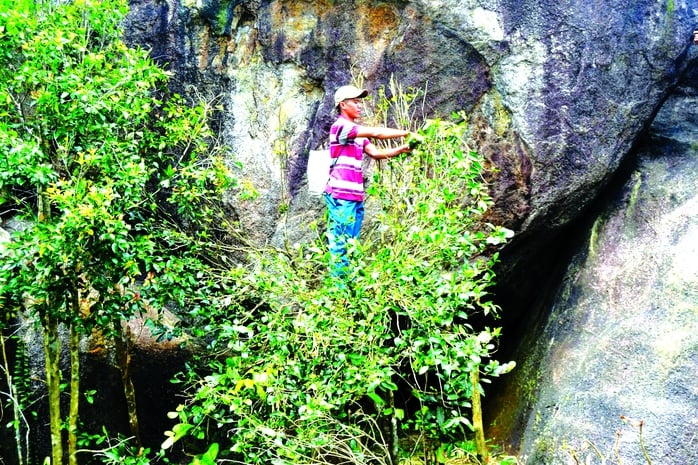
People in Xuan Loc commune, Dak Lak province, climb the mountain to find and pick the young shoots of the Ma Do tea plant.
"As he continued his journey south, Lord Nguyen Anh did not forget to send people to pick those young leaves to take along to drink when he was tired. Later, after ascending the throne, King Gia Long still regularly sent people to the high mountains of Cu Mong in early spring to pick them for use. The name Ma Do - meaning 'stopping the horse' - was also given by him," Mr. Nguyen Nhi recalled the old story.
Meanwhile, according to the Dai Nam Nhat Thong Chi (Comprehensive Gazetteer of Dai Nam), on the Cu Mong mountain range lies the very tall Ma Vu mountain. The mountain's name is derived from its shape – "Ma" means horse, and "Vu" means fog. From afar, Ma Vu mountain resembles a horse galloping swiftly through the fog. A type of tea, called Ma Vu tea, grows on the mountain's summit.
Ma Do tea is also known as Ma Vo, as it's commonly called by the people of Song Cau region. This name comes from the fact that many people notice the mountain in question resembles a dancing horse... Although it has many different names, Ma Do remains the most popular among local residents and those who are passionate about this type of wild tea.

Ma Do tea grows naturally in high mountain areas, so harvesting the young buds for processing is very difficult. People have to climb the towering tea plants, growing precariously on steep cliffs, to pick the buds. Even the most skilled can only harvest about 4 kg of fresh buds per day; after drying and processing, this yields 1 kg of dried tea.
The young, green tea buds are harvested, torn into small pieces, and spread out on a tray to wilt. After 2 hours, the wilted buds are rolled and rubbed until they are crushed, then left to ferment for about 4 hours. Afterward, the tea is taken out again to dry in the gentle morning sun...
All of the above steps are done manually. Despite the laborious process, the high price of Ma Do tea – up to 3 million VND/kg – helps many people earn income at the beginning of the year.
Mã Dọ tea is black in color, but when brewed with boiling water, it turns a beautiful lotus-pink hue. Raising a cup of Mã Dọ tea to your lips, you not only experience the unique blend of subtle mountain aromas, a delicate sweetness with a hint of bitterness on the tip of your tongue, and a lingering, deep sweetness, but you also hear the sound of the legendary hooves of the Nguyễn dynasty's army.
According to the Department of Science, Technology and Environment - Ministry of Agriculture and Environment , Ma Do tea contains many essential amino acids and necessary trace minerals. In addition, Ma Do tea also contains active compounds such as tannins, flavonoid polyphenols, and catechins – which help fight bacteria, protect cells, prevent aging, and prevent cancer. The natural fermentation process of Ma Do tea also increases the content of GABA – a neurotransmitter that helps relax, reduce stress, and improve sleep.
The active ingredients in Ma Do tea are also believed to help purify and eliminate toxins, effectively support liver and lung function, cleanse the intestines, aid digestion, promote microcirculation, and keep the body alert without feeling anxious. Perhaps because it contains so many beneficial active ingredients, despite its exorbitant price, Ma Do tea is still sought after by many people during Tet (Lunar New Year).
To preserve this precious tea variety, many people in Xuan Loc have gone to the high mountains to find and uproot seedlings to plant around their gardens. Many families, like Mr. Nguyen Nhi's, have even managed to cultivate entire gardens of Ma Do tea.
Since 2020, Phu Yen University has successfully conducted a research project on breeding and preserving Ma Do tea. Subsequently, the university transferred the results to the agriculture and environment sector for propagation of this tea in several localities.
Perhaps because it contains many beneficial active ingredients, despite its exorbitant price, Ma Do tea is still sought after by many people during Tet (Lunar New Year).
Source: https://nld.com.vn/doc-dao-tra-ma-do-196260213103955877.htm
![[Photo] Solemn bathing ceremony and Buddha procession in Hue](https://vphoto.vietnam.vn/thumb/1200x675/vietnam/resource/IMAGE/2026/05/31/1780228263543_1-jpg.webp)
![[Photo] The General Secretary, President and his wife begin their state visit to the Philippines.](https://vphoto.vietnam.vn/thumb/1200x675/vietnam/resource/IMAGE/2026/05/31/1780230559452_anh-man-hinh-2026-05-31-luc-19-28-11.png)

![[Image] Hanoi Police officially crowned champions of V-League 2025/2026](https://vphoto.vietnam.vn/thumb/1200x675/vietnam/resource/IMAGE/2026/05/31/1780244769054_ndo_br_039d561b692be875b13a-jpg.webp)

![[Photo] Admire the coral "masterpiece" amidst the million-year-old heritage of Dak Lak province.](https://vphoto.vietnam.vn/thumb/1200x675/vietnam/resource/IMAGE/2026/05/31/1780221235105_anh-man-hinh-2026-05-31-luc-16-53-27.png)

















![[Video] Sunset at Lap An Lagoon – Where the sun sets over the fishing nets](https://vphoto.vietnam.vn/thumb/340x192/vietnam/resource/IMAGE/2026/05/31/1780192137701_beach-landscape-sea-water-nature-grass-745871-pxhere-com.jpeg)







































![[Photo] Admire the coral "masterpiece" amidst the million-year-old heritage of Dak Lak province.](https://vphoto.vietnam.vn/thumb/402x226/vietnam/resource/IMAGE/2026/05/31/1780221235105_anh-man-hinh-2026-05-31-luc-16-53-27.png)































Comment (0)