


Since July 1st, every Wednesday morning, Ms. Tran Thi Ngoc Ha, Secretary of the Youth Union and Head of the Women's Association in Lang Son hamlet, Giong Rieng commune, has been going to the commune's Public Administrative Service Center to assist residents. Her work includes not only guiding people on how to enter numbers but also helping them fill out forms and verifying information before they pay fees online via the VNeID application. “When it was first implemented, the people's ability to use information technology was only about 10%, but now it has increased to about 50-60%. The support is much easier now because people are getting used to using their phones and sharing information with each other to access digital technology ,” Ms. Ha said.

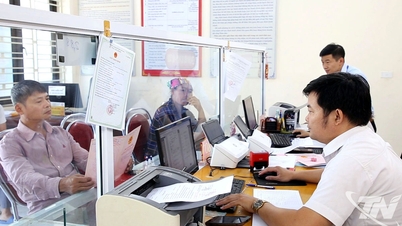
Ms. Tran Thi Ngoc Ha (left) - Secretary of the Youth Union and Head of the Women's Association in Lang Son hamlet, guides residents in filling out job applications on the National Public Service Portal. Photo: DANG LINH
With 45% of households being Khmer ethnic minorities, the use of online public services in Lang Son hamlet is still limited. Most hamlet officials are young, so they take turns assisting residents with procedures such as birth and death registration, and social welfare benefit applications right in the hamlet through the online public service application, eliminating the need to travel far. Mr. Quach Ba Le, a resident of Lang Son hamlet, shared: “When I went to collect the 100,000 dong that the Government gave me on National Day, September 2nd, I took the opportunity to ask the hamlet official for directions to the online public service portal.”
According to Huynh Khai Si, Deputy Director of the Giong Rieng Commune Public Administrative Service Center: “Since the implementation of the two-tiered local government system, the time taken to process procedures has been shortened, and fees are publicly and transparently disclosed. People can track the progress of their applications online, and even choose public postal services to receive results at home.” However, according to Mr. Si, some procedures related to land and taxes are still not standardized, causing people to have to travel back and forth multiple times. Therefore, he suggested that more authority should be granted to the commune level to reduce inconvenience for the people.

Officials in Lang Son hamlet, Giong Rieng commune, guide residents in searching for information on the National Public Service Portal. Photo: DANG LINH
Not only in Giồng Riềng, but also in An Biên commune after the merger, many people have noted that the service spirit of the local officials and civil servants has improved significantly. Mr. Trịnh Công Chính (73 years old), residing in Xẻo Đước 1 hamlet, An Biên commune, shared: “When I was applying for the elderly allowance, seeing that I was still hesitant, the Youth Union officials came to ask questions and provided thorough guidance. Now, the application process is faster, and people don't have to wait like before.”
The situation in Giồng Riềng and An Biên shows that the operation of a two-tiered local government has helped streamline the organizational structure and enhance the responsibility of officials, especially in serving the people. Besides the advantages, after the merger, the concentration of a large population in one location sometimes slows down the processing of documents. Furthermore, for households with difficult circumstances, the elderly, those living alone, and those without transportation, traveling long distances to the public administrative service center becomes even more challenging.
Despite remaining challenges regarding technological infrastructure and the adaptation of some residents, this model is moving in the right direction. While helping his uncle complete the procedures for receiving disability benefits, Mr. Huynh Thanh Son, residing in Xeo Duoc 1 hamlet, happily said: “When going to the commune office to complete procedures for disability benefits or elderly benefits, the officials are always very helpful. Although it's further from my house to the commune office than before, the process is quick and efficient, taking about 30 minutes to complete, with results expected in 10 days.”
Source: https://baoangiang.com.vn/doi-thay-tu-nhung-dieu-gan-dan-a461746.html

































































































Comment (0)