

Emerging from real life, literature is unified but not identical to life. Besides requiring a high level of life experience and talent, the author must also offer a fresh perspective. This perspective is reflected in the narrator's writing style and narrative, and in the characters' unique way of speaking and living. Creating a work with a new model is no easy task. In the last ten years, there have been a series of novels such as "Lost in the Human World," "Friends of Yesteryear," "Flagpole," "Village Stories," "The Season of the Shrimp," and most recently, Pham Quang Long's "Stories of the City" (Vietnam Women's Publishing House, 2024).
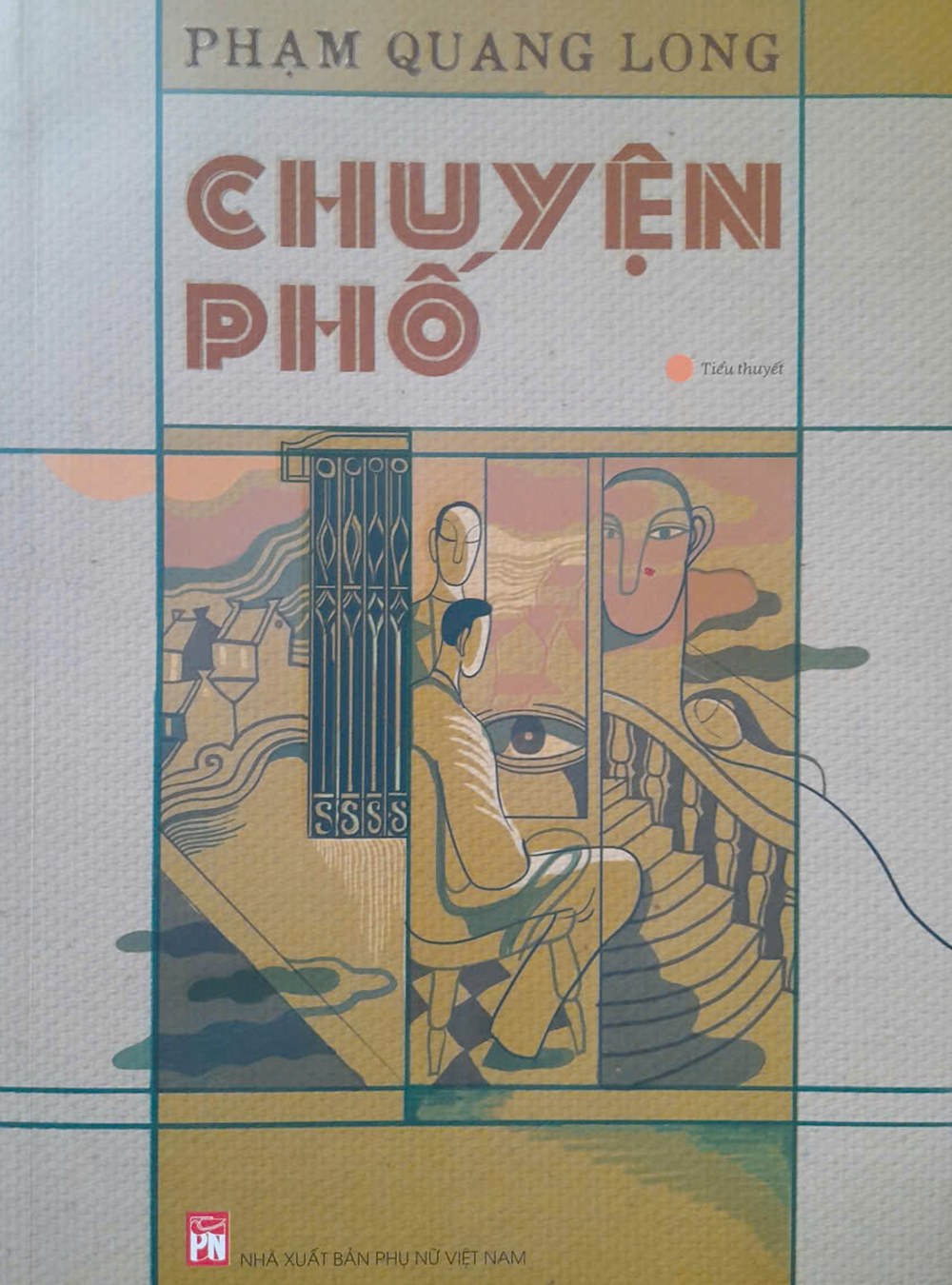 |
| The book cover. |
The story vividly portrays the life of Mr. Mưu's family, a typical Hanoi native, most notably after the Doi Moi (Renovation) period (1986). Despite his talent in business, Mr. Mưu feels somewhat powerless in the face of his children's differing thoughts, beliefs, and relationships; although they live under the same roof, their behavior varies greatly. Life in the market economy seems to confine itself to the vast space of their thousand-square-meter villa in the Old Quarter. There are schemes, tricks, and also acts of nobility and selflessness... These are just the surface aspects. Faced with the conflicting forces of old and new values, the underlying family culture, which has flowed for millennia, now emerges to fight for a "balance" in life.
A recurring dual structure throughout the novel is the story of Tuan, a journalist and veteran who, entering the era of reform, retains his old character—fierce, honest, and straightforward. The story also revolves around Professor Lang, a university lecturer, passionate about research, gentle in his demeanor, and refined in his speech. These two distinct character streams, each with its own perspective, converge within the cultural space of Mr. Muu's family—a space already filled with conflicting and opposing viewpoints. This creates a multitude of voices that both reflect and refract each other, generating compelling debates and questions that invite dialogue with the reader. The novel's appeal lies in its art of creating and inviting dialogue.
Looking at the space of the old house, the reader seems to see the shadow of the ancient "First Capital" era cast upon every antique detail, imagining the people of that time—gentle, meticulous, and also measured, square like the identical, moss-covered windows... Considering the time period, these people are mainly situated at the beginning of the vibrant, chaotic period of reform, with new directions and unprecedented plans for making a living... The novel concludes with Mr. Mưu not dividing the house and garden but giving gold to his four children, 100 taels each. This is a noteworthy cultural code in the novel, as if to say: Gold is very precious but only a means of exchange, so it can be easily divided. But the house and garden are priceless. Because they are identity, tradition that must be worshipped and preserved together.
Author Pham Quang Long has many advantages when writing about "street stories." He is a literary scholar (associate professor, PhD in Literary Theory), a manager (former Deputy Director of Hanoi National University, former Director of the Hanoi Department of Culture, Sports and Tourism), has a wealth of knowledge about rural areas (formerly Thai Binh province), and has gained experience from overseas culture (as a postgraduate student, intern, exchange, and visitor). Having spent a considerable amount of time in the "city" (50 years), he is able to reveal many new, quirky, and interesting aspects; and offer many profound and subtle new interpretations.
The novel "Street Stories" demonstrates a high capacity for generalization, as its narrative space is a condensed microcosm of modern Vietnamese society, encompassing diverse destinies yet still brimming with a bright outlook for the future. The narrator's image, lurking behind the words, appears both surprised and astonished by a discovery, yet also cunning and shrewd, as if knowing every nook and cranny of life and people. This gives the novel a rare tone today: an ambiguous, double-edged voice, both playful and serious.
Source: https://www.qdnd.vn/van-hoa/sach/doi-thoai-trong-chuyen-pho-1010464

![[Photo] The General Secretary works with the Executive Committee of the Hai Phong City Party Committee.](https://vphoto.vietnam.vn/thumb/1200x675/vietnam/resource/IMAGE/2026/03/16/1773629925474_vna-potal-tong-bi-thu-lam-viec-voi-ban-chap-hanh-dang-bo-thanh-pho-hai-phong-8644445-332-jpg.webp)
![[Photo] Prime Minister Pham Minh Chinh receives the Ministers of Foreign Affairs, Defense, and Public Security of China.](https://vphoto.vietnam.vn/thumb/1200x675/vietnam/resource/IMAGE/2026/03/16/1773659638054_ndo_br_dsc-4386-6157-jpg.webp)










































Comment (0)