

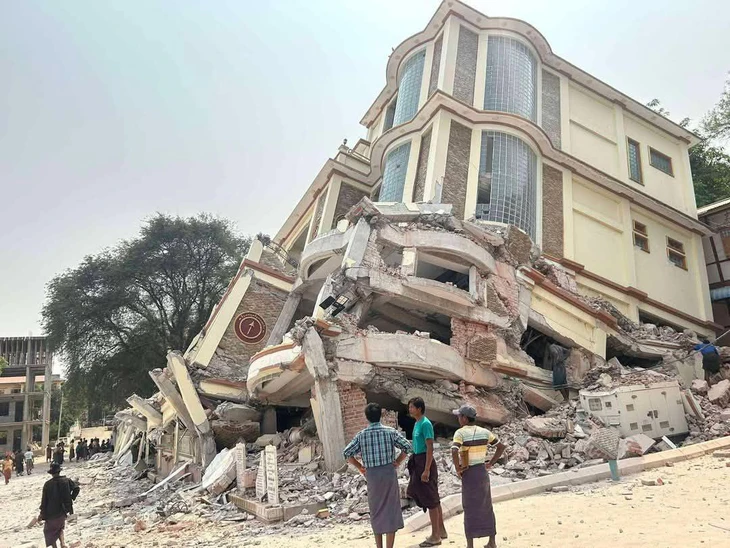
A building in Myanmar damaged by the earthquake - Photo: GLOBAL NEW LIGHT OF MYANMAR
According to the U.S. Geological Survey (USGS), Myanmar experienced a strong earthquake with a magnitude of 7.7 on March 28. The epicenter was located at a depth of 10km, near the city of Sagaing.
Twelve minutes later, Myanmar was shaken again by a strong aftershock measuring 6.4 magnitude. To date, at least 25 people in the country have died as a result of the earthquake.
Sagaing Fault
Myanmar is one of the most seismically active regions in the world . On the Global Seismic Risk Map, Myanmar is in the red zone, meaning it has a moderate to high risk of earthquakes.
The Sagaing Fault is considered the primary cause of earthquake risk in Myanmar. It is a large fault, approximately 1,200 km long, running north-south across Myanmar.
This fault is associated with several major earthquakes in the past, including a 7.7 magnitude earthquake in 1946 and a 6.8 magnitude earthquake in 2012.
According to researcher Shengji Wei from the Singapore Earth Observatory, the March 28 earthquake in Myanmar occurred along a section of the Sagaing fault.
"This area has been quiet for about 200 years. Based on historical studies as well as modern geophysical investigations, we know that this area, this fault line, has the potential to fracture violently and cause a major earthquake in the near future," Wei, who has studied seismic risk in Myanmar for a decade, told CNN.
The researcher said he had informed the Myanmar authorities and local scientists about the risks.
Also speaking to CNN, seismologist James Jackson from the University of Cambridge (UK) said the earthquake was caused by a fault that lasted for a minute, resulting in horizontal displacement on the ground.
"Imagine a piece of paper being torn at a speed of about 2 kilometers per second. This earthquake shifted a fault, like a giant knife cutting into the Earth," he said.
He also noted that Bangkok (Thailand), although not located in an earthquake zone, has tall buildings that make it particularly vulnerable to tremors from afar.
The earthquake in Myanmar also shook Thailand and Vietnam. In Thailand, at least three people were killed and 81 were missing when a building under construction in Bangkok collapsed due to the strong earthquake.
Warning: Aftershocks from the earthquake in Myanmar are still occurring.
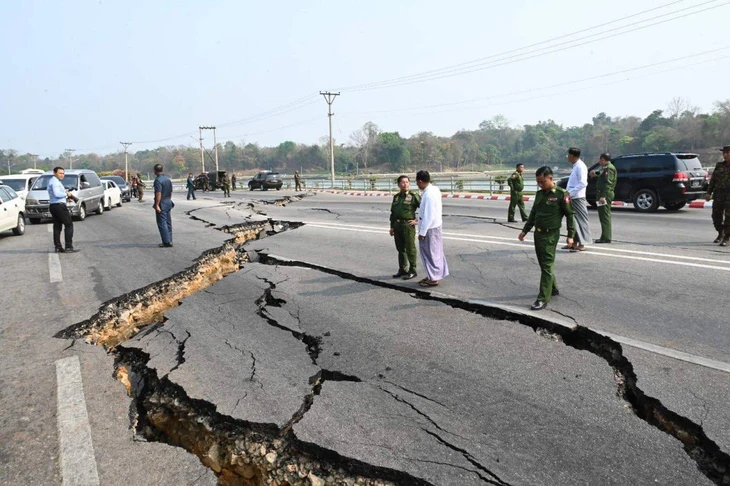
Large cracks appeared on the streets of Myanmar after the earthquake - Photo: MYANMAR NOW
"Myanmar is no stranger to earthquakes. The boundary between the Indian and Eurasian tectonic plates runs north-south, cutting through the middle of the country. These two plates move at different speeds along the transformation boundary," Professor Joanna Faure Walker, an expert in earthquake geology and disaster risk reduction at University College London (UCL), stated, according to the Science Media Centre.
She further explained that although this type of slip earthquake is usually less intense than the largest earthquakes seen in subduction zones, such as in southern Sumatra, they can still reach magnitudes of 7 to 8, causing serious damage, as seen in today's earthquake in Myanmar.
Professor Bill McGuire, emeritus professor of geophysics and climate at UCL, believes this could be the strongest earthquake on land in Myanmar in 75 years. He also suggests that the combination of its size and very shallow depth will increase the level of destruction.
"There has been a major aftershock, and there may be more. These aftershocks threaten to collapse already weakened buildings, making rescue efforts much more difficult," he warned.
Source: https://tuoitre.vn/dong-dat-o-myanmar-nhu-nhat-dao-khong-lo-cat-vao-trai-dat-20250328191018581.htm


























































































Comment (0)