

There, time doesn't seem to rush by as it does down in the lowlands. Everything is slow, slow, like raindrops clinging to the stilt house roofs before trickling down, like smoke from a kitchen hearth. And like the way the villagers prepare for and await a long-standing ritual: the water trough worship ceremony.
Erecting a pole in the middle of a rainy day.
It was already March, but the rain still drizzled over the hills. The courtyard of the community center was packed with people. Ms. Ho Thi Hue, head of Hamlet 4 (Tra Tap Commune), called on a group of young people from village C72 to cut bamboo to make a ceremonial pole.
In this mountainous region, the transition between seasons is both beautiful and incredibly "unpleasant," due to the unpredictable rain and sunshine, and the alternating hot and cold spells. The bamboo forest behind the village seems to sway and bend over in the cold rain.
"Finding a perfectly straight bamboo pole for the ceremonial pole is very difficult. We have to find the smoothest one, bring it back, let it wither, then straighten it out so that the pole will be beautiful and tall," said Huệ, then hurried along with several young men from the village up the mountain behind the village.
After a while, the group carried back three bamboo poles for the village elder to choose from for making the ceremonial pole, along with a bunch of leaves to decorate the gate. The next group brought back smaller bundles of bamboo. They said the smaller bamboo poles would be used to make water channels to carry water from the source to the base of the ceremonial pole.
When offering sacrifices to the water trough, there are two important things that must be prepared carefully and well in advance: the ceremonial pole and the water trough. This is partly because these are the two main components for receiving the water source, and partly because their preparation is quite time-consuming and requires meticulousness and skill.
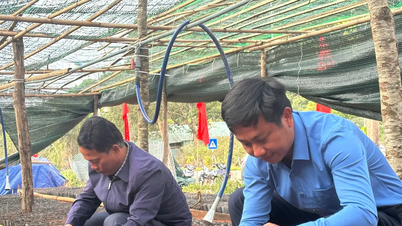
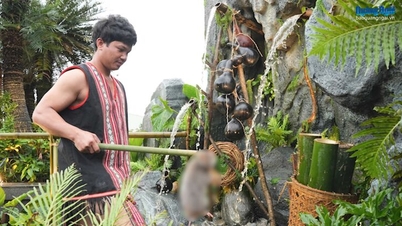
Under the community house, Mr. Ho Van Diep and several other men sat together, carving and shaping bamboo stalks, removing the nodes, and joining them together to form a long channel. Water from the source, about two hundred meters away, would require approximately 40 bamboo stalks to channel all the way to the base of the ceremonial pole.

“Tomorrow we must finish the ceremonial pole, paying attention to making the eagle beautiful, then count the jars, rice wine, and brocade. The drum and gong team should practice again to ensure they are in sync and have a steady rhythm,” Huệ said, standing in the middle of the circle of people, continuing to give instructions.
There was a natural "authority" in the way she spoke, one that no one needed to question. We looked around and saw nods and silent, agreeable glances. Here, the sense of community is present in the way people work together, in the way they anticipate something together. No one needs to speak up to justify themselves.
Ms. Hue said that this year was the first time the village had organized such a large ceremony. The rain continued, and the female head of Hamlet 4 was quite worried. She worried about the slippery roads, about the difficulties faced by the people from other hamlets attending, and even about whether the ceremony would be performed perfectly.
But then she smiled, very quickly. "Rain or shine, the ceremony must still be done properly." There was a hint of the unique determination we had heard and felt in her since arriving in this village. People in the mountains, it seems, are accustomed to accepting the harshness of nature. They always quietly adapt, doing their part, in every way possible.

Water flows from the heart of the mountain.
On the day of the water trough ceremony, the heavy rain continued. Early in the morning, people from all the villages gathered in large numbers, although it was somewhat inconvenient due to the rain. Never before had village C72 been as bustling as this year.
Around noon, as the games drew to a close, the ceremonial pole was erected majestically in the corner of the community center's courtyard.
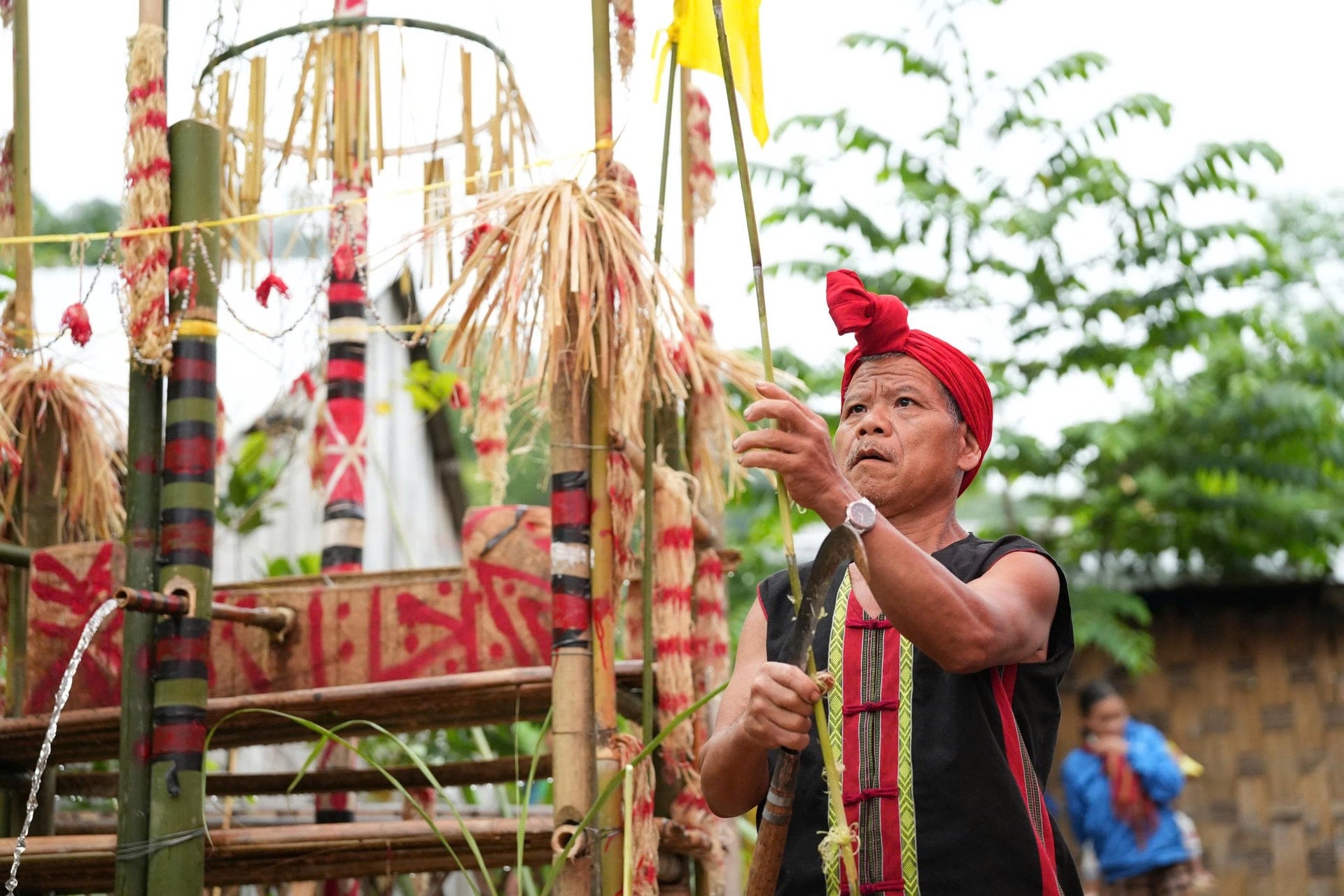
On it, various patterns were painted, strings of beads, bird wings hung dangling, three national flags fluttered atop, and an eagle woven from bamboo fibers was displayed.
“Eagles symbolize good fortune. Our ancestors used to say that whenever the villagers performed the water trough ceremony, eagles would fly from Kiet Cang Mountain to attend and witness it. They said the mountain god transformed into a bird to bestow blessings upon the villagers. Later, when the birds stopped returning, the villagers made a model to symbolize the bird, expressing their devotion to the forest and mountain gods,” Ms. Hue explained in detail, then gestured for the village elder to begin the ceremony.
We looked up at the distant Kiet Cang mountain range, blurred in the rain. We didn't know how much of those stories remained true. But clearly, the villagers' memories and beliefs about the forest's mysteries still lived on.
The rain was gradually subsiding. Two plates of betel leaves shaped like buffalo horns, and a plate of dried tobacco were neatly placed beneath the ceremonial pole. Village elder Ho Van Bien, holding a machete in his right hand and a reed in his left, gazed straight up at the pole, softly praying, then directed the person carrying the betel leaves to offer to the guests.
Once everything was in order, he led a group of people carrying the black pig up to the water source. The small stream nestled beside the cliff, its water clear and cold. The water collected behind a small dam that had been built earlier.
The space there was completely isolated from the area below. It was quiet. Only the sound of flowing water and the occasional rustling of forest leaves in the wind could be heard.
Among the people going to worship the gods, besides the village elder, there were also two young men with red headscarves, which, according to Ms. Hue, symbolized flowers, attracting the gods to hear their prayers.
The village elder recited the Xơ Đăng people's prayers, inviting the spirits and wishing for health and good fortune for the villagers. His voice was even and deep. The prayers, in the Xơ Đăng language, resonated throughout the village. We didn't understand everything, but we could still sense the reverence in each murmur of the elder.
Ms. Hue, along with her younger sister, Ms. Ho Thi Ve, were also standing there. Occasionally, they would step up to stand alongside the village elders and perform a few gestures to pray for good health.
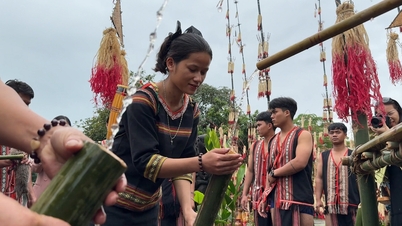
Following the village elder's orders, the young men slaughtered a pig, used its blood to dye the puddle red, and then channeled the water through bamboo pipes. A loud howl echoed from the source. Beneath the ceremonial pole, women held bamboo pipes ready to receive the "blessing."
We stood there, watching the water flow through each section of the pipe. The water was flowing. The journey of the water wasn't just from the source to the village. It passed through every hand, every step, every belief. It was the result of a process in which each villager contributed a small part.
By the time the group returned, the rain had completely stopped. The courtyard gradually dried, revealing the footprints. The sound of gongs and drums echoed through the mountains and forests. The rhythm of the gongs seemed to draw people into the festivities.
Ms. Hue held the drum, a radiant smile on her face. Following her, the gong ensemble and dance group began their familiar rhythm. A child in a traditional brocade dress danced along. Surely, these children didn't need anyone to teach them to dance or sing. They simply needed to live, to immerse themselves in the joy, to be captivated by the magical atmosphere of the festival of their people.

There's no one-size-fits-all formula for festivals. The same is true here. The presence of women throughout the water trough ceremony is unique, especially when compared to the customs and traditions of other festivals in the western mountainous regions of Quang Nam province. Here, however, it's a wonderful balance.
“During the ritual at the water source, the village elder prays for her children and family to have full granaries, thriving livestock, and a prosperous life. Meanwhile, the village elder, representing the community, offers prayers for the entire village to prosper in their businesses, for their children and grandchildren to have good fortune when working far away, to avoid misfortune, and to always remember their roots wherever they go,” Huệ explained.
A man standing next to us whispered, "For the past few years, the rain has always stopped just before the ceremony." Whether it was a coincidence or not, looking up at the newly brightened sky and seeing the water flowing steadily at the foot of the ceremonial pole, we realized that what the villagers were waiting for wasn't the rain stopping.
But it is at this very moment, as the water gradually flows through the bamboo pipes from the source to the village, that everything connects, like the circle of people bustling with drums and gongs outside. A connection between the forest and the people, between the previous generation and the present generation. A continuous stream of life…
Source: https://baodanang.vn/dong-nuoc-goi-mua-3331028.html
![[Photo] National Assembly Chairman Tran Thanh Man working with the Standing Committee of the National Assembly's Ethnic Council](https://vphoto.vietnam.vn/thumb/1200x675/vietnam/resource/IMAGE/2026/05/21/1779337435930_ndo_br_1-jpg.webp)
![[Image] "Journey of Hope" promotes the organ and tissue donation movement in Vietnam.](https://vphoto.vietnam.vn/thumb/1200x675/vietnam/resource/IMAGE/2026/05/20/1779294400833_1-8910-jpg.webp)


































































Comment (0)