

The fishing profession on the Gianh River has given Mr. Tinh the opportunity to rescue many people in distress over the years, which is truly admirable. But here, we want to talk about another story: It seems that fewer and fewer people are working as fishermen on the river, because the development of the industrial and post-industrial economy , along with climate change and environmental pollution, is causing many traditional occupations to gradually disappear. Mr. Cao Huu Tinh will get old, and young Cao Hoang An Duc will surely go to university and work somewhere… If one day no one is working as a fisherman on the river anymore, and unfortunately a boat capsizes, what will happen? What will truly disappear? Not the small boat, the net, or the oar. Not just a means of livelihood. What will leave this world is a relationship between humans and water, between the body and the current, between collective memory and the biological rhythm of nature.
 |
| Cao Huu Tinh and his son Cao Hoang An Duc. Photo: TRAN MINH TU |
The Gianh River. That river existed before any modern occupations. It flowed through war, through poverty, through economic reforms. But throughout its length, there have always been people who lived alongside it: the fishermen. They truly belonged to the river.
When a traditional occupation disappears, we often view it through an economic lens: low income, poor efficiency, market competition, and declining resources. This perspective isn't wrong, but it fails to grasp the ecological and anthropological depth of the issue.
At the ecological level, traditional fishing operates as a dispersed, low-paced exploitation mechanism, tied to natural cycles. Fishermen read the tides, look at the water color to estimate sediment levels, and observe river fish schools according to the seasons. They don't need hydrological models to know when floods are coming. Their bodies are sensors. Their memory is the database.
When fishing communities withdraw from the river, the ecosystem loses a regulatory layer of human-nature interaction. This void is typically filled by two scenarios: either large-scale industrial exploitation, or neglecting the river as a mere water infrastructure. In both cases, the reciprocal relationship weakens. The river becomes merely a resource, no longer a living space.
At the intellectual level, the loss is even more serious. The fishing profession is a system of indigenous knowledge accumulated over generations. It's an "ecological knowledge," a structure of understanding formed through direct interaction with the environment. This knowledge isn't standardized into textbooks, but it has high empirical accuracy. It's ingrained in reflexes. We see this clearly when accidents occur on the river. The reflex to jump into the water, calculate the current, estimate human strength in cold water—these aren't impulsive actions. They are the survival skills of those familiar with the river. When the profession disappears, that collective reflex also disappears. Society becomes completely dependent on professional rescue forces and technological systems. Self-reliance for survival diminishes.
At the socio-economic level, the disappearance of fishing reflects a structural shift from a subsistence economy to a market-dependent one; from riverside communities to urbanization; from land- and water-based livelihoods to migrant labor. Average income may increase, but autonomy decreases. When all food sources must be purchased from the distribution system, people lose a fundamental form of independence.
The issue isn't about resisting modernization. Society can't freeze itself out to preserve every traditional craft. But every transition has an intangible cost. When fishing disappears completely, that cost is the breakdown of collective memory and community knowledge.
At the cultural level, fishermen are not just social figures. They are symbols. Chu Dong Tu, Truong Chi, Yet Kieu… In modern Vietnamese literature, especially through the sea and river landscapes of Nguyen Minh Chau, the image of the fisherman emerges as a resilient, persistent, taciturn individual closely connected to nature. They do not represent power, but perseverance. They do not represent speed, but rhythm.
This symbol is important because it shapes community identity. A society composed solely of engineers, managers, and financial professionals, however efficient, would lose its symbolic diversity. Identity would become monotonous, and urbanization would occur completely. In that case, the river would only be a landscape feature or a transportation route.
On a broader anthropological level, human history is intertwined with rivers. From the Nile to the Ganges, from the Yangtze to the smaller rivers of central Vietnam, rivers are the cradle of civilization. Riverine inhabitants have developed their own belief systems, customs, and social structures.
When residents leave the river, urbanization completes one step: People live more in infrastructure than in nature. They know how to operate the system, but no longer "read" the environment. They understand the charts, but not the flow of water. This shift increases individual safety from risk, but reduces collective biological adaptability.
On a philosophical level, the deeper question isn't "to preserve the fishing profession or not," but rather: To what extent do modern humans still need a direct connection with nature? If all interactions are mediated by technology, how will human identity transform? When the body no longer directly confronts the flow of water, wind, and temperature, we gradually lose a form of sensory perception of the world .
The disappearance of fishing may be an inevitable consequence of development. But if society does not recognize, preserve the knowledge, and transform the value of that profession into cultural and educational heritage, then the loss will be permanent.
A mature community doesn't necessarily have to preserve all its old structures. But it must understand what it has lost by changing. If one day no one fishes anymore, the river will still flow, the fish may still remain. The city may become wealthier. But the memory of a certain type of people who belonged to the river will gradually fade into the past.
And then, the question is no longer about occupation. It becomes a question of identity: are we a society that lives in harmony with nature, or a society that merely uses nature?
The gap between those two choices is the gap between a river teeming with people and a river that is silent and deserted. The probability that Cao Hoang An Duc, a 10th-grade student, will still work as a fisherman on the river like his father is not zero. But that probability decreases with each generation, as education opens up other paths, as the labor market draws young people to urban areas, and as social values are more tied to academic qualifications than to river-related skills. By the time Cao Hoang An Duc's children, grandchildren, and great-grandchildren are around, the profession may only be a family memory.
The issue is not about forcing the continuation of professions. A modern society does not operate on kinship in professions. A more accurate question is: Is it possible to preserve the value of a profession without forcing the preservation of its existing structure? Is it possible to preserve the "river of people" while the economic structure changes?
The answer lies in three transformative approaches: preserving knowledge, institutionalizing memory, and restructuring the human-river relationship.
First, preserving indigenous knowledge as a form of cultural asset is crucial. Skills in reading water, predicting floods, and understanding currents should not remain solely in personal memory. They can be documented, digitized, and incorporated into local education as part of a "community environmental education" program. In many countries, fishermen's knowledge is considered supplementary data for hydrology. Japan, for example, maintains traditional fishing villages as living heritage, where skills are not "museumized" but practiced under controlled conditions.
Secondly, institutionalize memory through cultural spaces. When a profession declines, the community can build a museum dedicated to that profession, organize river festivals, or develop eco-tourism experience programs. The important thing is not to turn fishermen into "tourist actors," but to maintain their role as subjects of knowledge. In the Mekong Delta, cultural spaces associated with rivers and canals have created a unique identity. Characters like Lao Ba Ngu in Doan Gioi's world are not just literary figures, but reflect a real community structure. When that community is recognized as heritage, the profession doesn't completely disappear; it transforms from a purely livelihood into a cultural and educational value.
Thirdly, restructure the relationship between people and rivers towards ecological co-management. Instead of leaving rivers entirely under the control of management agencies or exploitative businesses, riverside residents can participate in community-based river management models. Here, even if they no longer fish regularly, they still play a role in monitoring, warning, and sharing local expertise. The river still has people, not necessarily full-time fishermen, but people who understand and are responsible for it.
The core issue is the distinction between preserving a craft and preserving its values. Preserving a craft in its original state may be impossible in a market economy. However, preserving values, knowledge, memories, symbols, and ecological connections is possible if there is conscious policy and cultural awareness.
If nothing is done, the process will continue by inertia: Young people leave, jobs shrink, and knowledge is lost with each funeral. Then, the river will only be a water management infrastructure or a tourist attraction. A "river without people."
Between those two choices is not nostalgia and progress. It is a choice between development with memory and development without memory. A mature society is not afraid of change, but neither does it accept anonymous loss.
If Cao Hoang An Duc were no longer a fisherman, that wouldn't be a tragedy. The tragedy only arises when, in later generations, no one knows why their ancestors lived alongside the river, understood the color of the silt, and dared to plunge into the raging current to save lives. As long as that memory continues to be recounted, taught, and institutionalized as a community responsibility, that river will remain a river with people living along it.
Source: https://www.qdnd.vn/van-hoa/doi-song/dong-song-co-nguoi-1027407


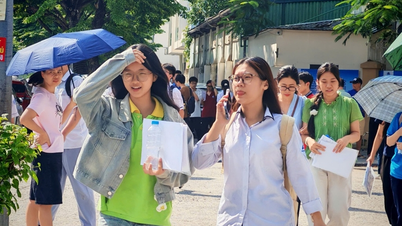
![[Image] Nearly 125,000 Hanoi students completed the Literature exam for the 10th grade entrance exam.](https://vphoto.vietnam.vn/thumb/1200x675/vietnam/resource/IMAGE/2026/05/30/1780117233041_ndo_br_thiet-ke-chua-co-ten-2-png.webp)
























































































Comment (0)