


On the very land that was once neglected and witnessed initial failures, he integrated agriculture , education, and community tourism, creating a model that is highly attractive to Western visitors who love experiential travel.
From long journeys…
Stopping my car in front of the farm's gate, which was decorated quite simply, in the style of a garden house, I was impressed by the pathway made of meticulously arranged bricks, interspersed with lush green rows of myrtle and date palm trees.
At this time, the morning mist had not yet completely dissipated, but the Western visitors were already awake. They came from many different countries, living and working together like members of a family. Those who arrived earlier guided those who came later, and everyone quickly blended into the slow, peaceful rhythm of life on the farm.
A smoothly operating model that provides a very authentic experience for tourists. To achieve this, Tran Thanh Ha participated in training and volunteer programs in agriculture abroad and took advantage of opportunities to travel extensively to experience different lifestyles and cultures. Having visited over 20 countries, he learned that not every model was suitable for domestic conditions. What he brought back most was a new mindset regarding management, operation, and how to integrate agriculture with education and tourism.
“If we simply brought the agricultural model from another country to Vietnam, it would certainly fail due to differences in production conditions, markets, and the need for a huge amount of capital. It's still agriculture, but the greatest value doesn't come from vegetables, fruits, or poultry, but from services through tourism activities. Visitors to the farm don't just come to sightsee; they live with the locals, work alongside them, and share experiences. The Hygge Farm is following that direction,” Mr. Ha shared.
The "Orphanage" Village Attracts Tourists
The farm today was built on his family's own garden, located in an isolated hamlet, far from the residential area, surrounded by vast acacia plantations. More than 20 years ago, this hamlet had seven households. But the desolate and monotonous atmosphere couldn't keep people there, and the families gradually left, including Mr. Ha's family. They only returned during the bean planting or acacia harvesting seasons. The hamlet's name, "Orphan Hamlet," originated from that.
In 2021, Mr. Ha returned to his hometown to start his business amidst the skepticism of his neighbors. He cleared all the acacia trees, improved the land, and gradually created areas for planting trees, growing vegetables, raising cattle, keeping chickens, digging ponds, and building accommodation and outdoor living spaces. The income from tourism over the years has all been reinvested back into the farm.
“Our first guests were volunteers who helped build the farm. After experiencing it and being satisfied, they left many positive reviews on reputable travel websites and social media platforms. Thanks to that, The Hygge Farm gradually became known. In the past four years, more than 1,500 volunteers have come here, both to participate in cultural exchange and to contribute to building the farm,” Mr. Ha said.
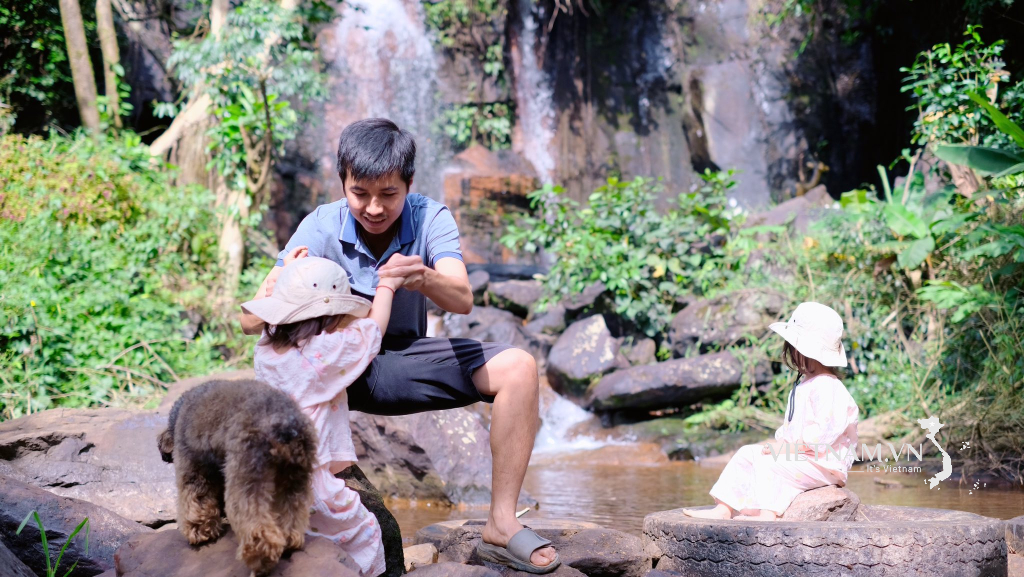
The educational farm that Mr. Ha envisions is a place where visitors live and work like real farmers. They not only enrich their knowledge and understanding of local culture through hands-on farming, animal husbandry, and interaction with local farmers, but also broaden their understanding of other cultures through interaction with volunteers and visitors.
Kirsten Syme, a tourist from New Zealand, said that while researching tourism in Vietnam through websites, she was particularly impressed by the reviews for The Hygge Farm's educational farm model. She quickly arranged a one-week experience there so her son could have the opportunity to travel and broaden his knowledge in an engaging educational environment.
“The current trend in tourism is no longer about booking tours, visiting famous landmarks, taking photos, and staying in hotels, but about experiencing, working, enjoying life, and giving back. The Hygge Farm truly gives my daughter and me that feeling. Here, we easily connect with local people and friends from many countries; we share and learn through the farm environment and cultural exchange activities,” said Syme.
Once the farm was running smoothly, Mr. Tran Thanh Ha began to consider community value. The experience expanded beyond the farm grounds. Visitors could interact and chat more with the farmers, participate in rice planting, bean harvesting, making vermicelli, and preparing cassava pho...
Seeing the satisfied smiles of the Western tourists, the neighbors gradually began to see Mr. Ha's work in a different light. They readily contributed by cleaning the village roads, yards, and production areas, and warmly welcomed guests who kindly offered to visit.
The cook, the grocery store owner, the breakfast vendor – those who interact daily with Western tourists – were taught "broken English" by Mr. Ha and the volunteers to facilitate easier communication. A few simple phrases related to daily work, such as greetings, product introductions, and prices, were initially difficult to pronounce and remember, but with time and practice, they became fluent. Thanks to this "broken English," tourists have a better experience, are more likely to return for purchases, and help the local people earn additional income.
The "Orphanage" village today no longer evokes sadness. People have returned, Western tourists have visited, and stories are shared with smiles and simple, colloquial Vietnamese. Amidst the once-forgotten hills, green shoots are quietly growing, much like the journey home of young Tran Thanh Ha.
Source: https://baodanang.vn/dua-khach-tay-ve-xom-mo-coi-3326119.html
![[Photo] The General Secretary, President and his wife meet with Vietnamese-Chinese friendship leaders.](https://vphoto.vietnam.vn/thumb/1200x675/vietnam/resource/IMAGE/2026/04/15/1776264829725_vna-potal-tong-bi-thu-chu-tich-nuoc-to-lam-gap-mat-nhan-sy-huu-nghi-viet-nam-trung-quoc-8703641-3130-jpg.webp)
![[Photo] National Assembly Chairman Tran Thanh Man arrives in Türkiye to attend IPU-152](https://vphoto.vietnam.vn/thumb/1200x675/vietnam/resource/IMAGE/2026/04/15/1776261003665_tnk10-jpg.webp)
![[Photo] Mrs. Ngo Phuong Ly meets and exchanges views with Mrs. Peng Li Yuan](https://vphoto.vietnam.vn/thumb/1200x675/vietnam/resource/IMAGE/2026/04/16/1776277858080_phu-nhan-1-jpg.webp)
![[Photo] My Son at night: A thousand-year-old heritage site amidst the Milky Way](https://vphoto.vietnam.vn/thumb/1200x675/vietnam/resource/IMAGE/2026/04/15/1776261039184_ndo_br_chon6-jpg.webp)
![[Photo] National Assembly Chairman Tran Thanh Man attends the opening session of IPU-152](https://vphoto.vietnam.vn/thumb/1200x675/vietnam/resource/IMAGE/2026/04/16/1776277863731_ctqh5-jpg.webp)









































Comment (0)