

.jpg)
The Oath to Protect the Forest
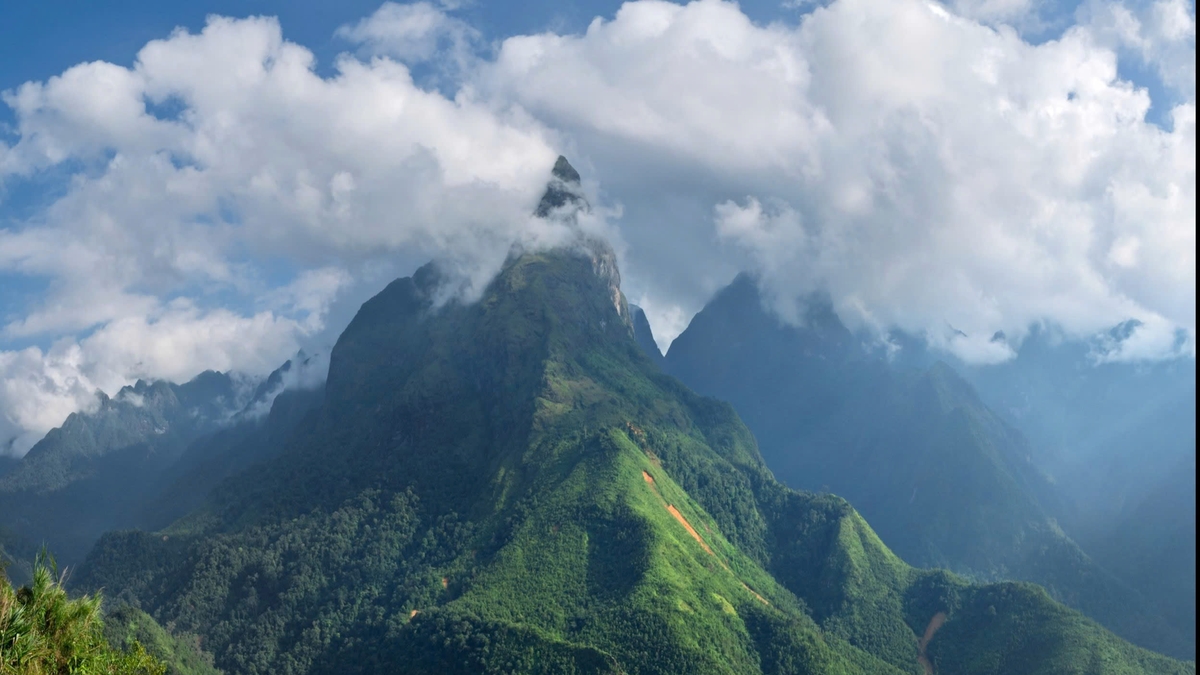
I remember in 2024, I led an expedition to the green cypress forest at Lang River with a team from the Vietnam Association for the Protection of Nature and Environment. Walking amidst the pristine forest canopy, my heart swelled with unwavering belief that the heritage of our ancestors is the "green gold" that will sustain future generations.
Mr. Le Huy Cuong, a member of the Heritage Tree Council (Vietnam Association for the Protection of Nature and Environment), was 83 years old at the time but still determined to walk for more than three hours to visit the ancient ironwood and ebony trees and personally brought a drill to take samples from the trees. He was amazed by a vast green ironwood forest, with a high density of large trees growing closely together on the hills along the Lang River.
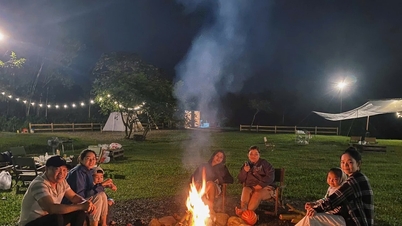
One night, by the hammock of the old makeshift hut built by the villagers of Ta-ri to plant more young ironwood trees on the empty plot of land amidst the vast expanse of green ironwood trees, he offered some good ideas. He suggested that I name the trees according to the Co Tu culture. He said that in the near future, when the cluster of green ironwood and ebony trees is recognized, Tay Giang will have a stronger foundation to develop unique tourism products based on the cultural values of the village and the heritage forest ecosystem.
Experiential tourism routes such as hiking through thousand-year-old green cypress forests, learning about the "ancient cypress trees" associated with the names and legends of the Co Tu people, combined with the exploitation of local medicinal plants, will create a unique attraction for eco-tourism in this area.
In addition, activities that offer experiences of local life, such as gathering wild vegetables, catching fish, swimming in the Lang River waterfall, listening to stories about protecting the forest and village, or enjoying traditional cuisine in the cool climate of the Zơng area along the river, will contribute to perfecting the eco-cultural tourism product. If managed and exploited scientifically , this will be a highlight for Tay Giang to attract tourists who love nature and are passionate about exploring local culture.
The following day, during the survey, counting, and measuring of the trees, I suggested names with cultural significance from the Co Tu people for the ancient green lim and ebony trees, associating them with the trails so that later, when tourist routes are established, visitors can choose paths to visit trees such as: Jrăng A-va Hồ (the lim tree named after President Ho Chi Minh), Jrăng Kách mạng (the revolutionary lim tree), Jrăng Triing (the lim tree named after the hornbill)..., and then visit the Mun Quyết định (Determined) Mun Đoàn kết (Unity) Mun Thắng thắng (Victory) Mun Hòa bình (Peace) Mun Trường sinh (Eternal Life) Mun...
Names deeply rooted in the spirit of the Co Tu people have been given to the heritage trees, transforming each tree into a cultural witness.
lively.
In 2024, 959 green lim trees were recognized as Vietnamese Heritage Trees, not just as a title, but as a tribute to the forest spirit through the sacred Forest Offering Ceremony (Forest Thanksgiving Ceremony) held every spring.
The philosophy of tourism based on giving back.
To understand the sentiments of the people of Tay Giang, I returned to the village.
Pơr-ning met the village elder Cơlâu Nhấp, the "living history book" of the vast forest. The old man's voice was deep and powerful like a waterfall: "My child, we Cơ Tu people consider the forest the dwelling place of Yàng (the divine beings). Green tourism is not about leading tourists into the forest and collecting money. It would be a crime to let tourists trample on the roots of the lim, mun, and uoi trees, or break branches of rhododendrons. Green tourism in Tây Giang must be 'Tourism of gratitude'."
Visitors come here, they breathe the fresh air of Mother Forest, and they must learn to love the forest as the local community does. When the people preserve the heritage forest, the forest will be happy, it will provide ginseng, water, precious medicinal herbs, firewood for warmth in winter, bamboo for weaving, and sturdy timber to build stilt houses, communal houses, and longhouses, and the pristine beauty for sustainable tourism. The forest is a treasure that no bank can ever hold completely.”
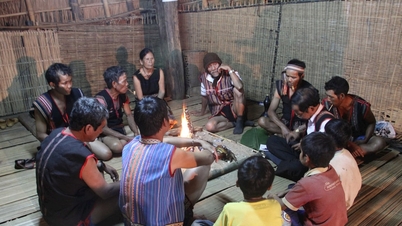
Regarding village culture, Elder Nhap emphasized that the gươl (village communal house) is where the essence of the ancestors converges. A community tourism village that lacks the Cha-gơr, Chiing, Cơ-bhâr, A-bel, and Ân-jưl languages, lacks the Ba-boóch and Bhư-noóch folk songs, lacks the tâng-tung da-dá dance, lacks the soul of weaving, brocade making, and wood carving, lacks the smoke of the sacred hearth, and lacks the cassava wine (rice wine) to entertain honored guests of the village, then that village gươl is just a soulless shell.
"We develop tourism to showcase the beauty and preciousness of Mother Forest and the Co Tu people to the world, not to transform ourselves into someone else to please tourists." The elder's words were like a solemn vow amidst the vast forest, affirming that identity is the root of development.
Leaving the ancient forests, the majestic communal houses in Pơr-ning, Tà-vang, and A-rọ, where many grand festivals have been held and gained widespread recognition, are becoming global connecting points. Thanks to national target programs, traditional stilt houses have been transformed into cozy homestays. There, visitors won't find the luxury of air conditioning, but will experience the elegance of the soul: a fragrant embroidered pillow, a rich bowl of bamboo-cooked soup, and a cup of strong, herbal-fermented Ba-kích wine.
In its tourism development plan for the period 2026-2030, Tay Giang has identified the development of exemplary cultural and eco-tourism village models. Tourists will not only stay but also experience the culture and immerse themselves in the life of a community proudly living off the heritage left by their ancestors.
In the not-too-distant future, when the Lang-Zuoih road (the inter-communal road connecting Tay Giang and Nam Giang) is completed, the Lang River, a river of memories and green aspirations, will gradually be awakened with its potential for hiking, sports tourism, and valuable medicinal plants.
Someday, if you feel overwhelmed by the hustle and bustle of the city, remember that to the west of Quang Nam province lies the deep blue Tay Giang River, waiting for you.
Source: https://baodanang.vn/ve-voi-rung-xanh-3332152.html


![[Video] Sunset at Lap An Lagoon – Where the sun sets over the fishing nets](https://vphoto.vietnam.vn/thumb/1200x675/vietnam/resource/IMAGE/2026/05/31/1780192137701_beach-landscape-sea-water-nature-grass-745871-pxhere-com.jpeg)








![[Video] Sunset at Lap An Lagoon – Where the sun sets over the fishing nets](https://vphoto.vietnam.vn/thumb/800x450/vietnam/resource/IMAGE/2026/05/31/1780192137701_beach-landscape-sea-water-nature-grass-745871-pxhere-com.jpeg)














































![[Video] Sunset at Lap An Lagoon – Where the sun sets over the fishing nets](https://vphoto.vietnam.vn/thumb/402x226/vietnam/resource/IMAGE/2026/05/31/1780192137701_beach-landscape-sea-water-nature-grass-745871-pxhere-com.jpeg)





























Comment (0)