

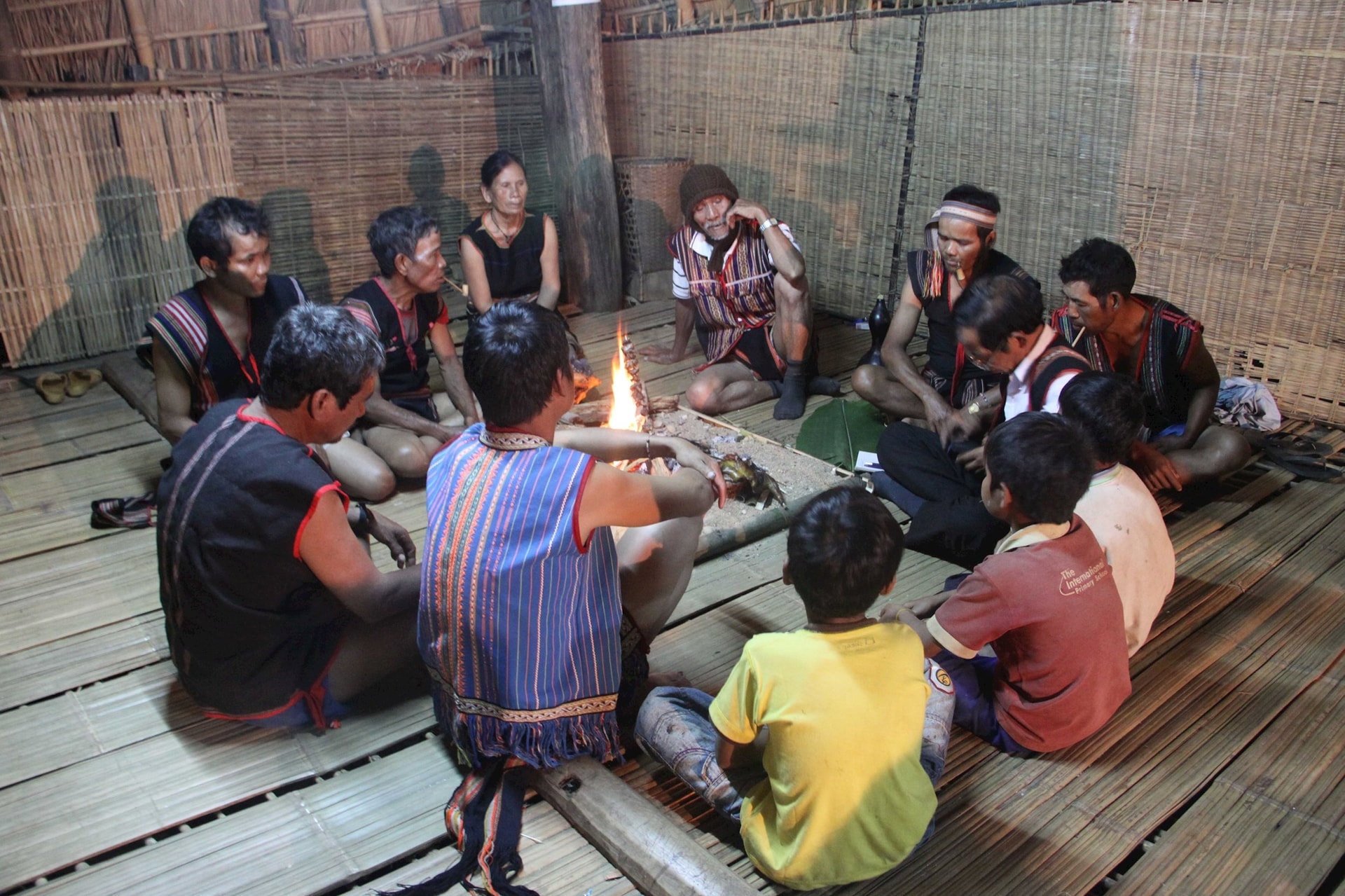
There, the hearth is the center of life, where the community recreates history and nurtures mythical imagination. In the rhythmic, undulating narrative, the character of Dam San emerges as a literary hero, a symbol of the forest civilization.
Before names like Dam San, Xinh Nha, Kinh Ru, and Dang Di reached readers outside the Central Highlands through collected works and written texts, the indigenous people had lived alongside these characters from generation to generation. These epic heroes were present as a part of life, emerging from stories and remaining with the community. And where the epics began, where they were passed down, was none other than the hearth of the stilt house.
In 1929, a French ethnologist collected the epic poem Dam San, bringing the epic of the Central Highlands to the world . At that time, the epic verses gave readers a feeling of innocence, closeness, rich heroism and romance, like a gateway to the "herbal civilization" of the basalt land.
Epics are born from a vibrant world.
Throughout the history of traditional matriarchal society in the Central Highlands, the image of the woman has always been present as the pillar: both the guardian of the home and the keeper of the fire. Ethnographers have called this a forest civilization, a space where humans live as an integral part of nature. There, myth sometimes replaces everyday life.
The Ede people once believed that where there are rivers, there are male rivers, female rivers, husband rivers, and wife rivers. These names are not merely personifications of nature, but expressions of a profound concept: nature has a soul, relationships, and a life like that of humans. Therefore, the epics of the Central Highlands are not simply products of imagination. They are the culmination of a life in which humans and the mountains and forests commune, where spirits are present in every change of the earth and sky.
According to Ede legend, their ancestors migrated from the eastern mountain slopes through a hole called Andrenh to reach a vast and rich new land. Within this cultural context, the figure of Dam San emerges as a valiant warrior traversing the vast forests, living in a world inhabited by mountain gods, river gods, rain gods, wind gods, sun gods, moon gods, and animals that can speak human language.
It is the world of epics, the world between earth and sky.
Forests - spaces for deciphering legends
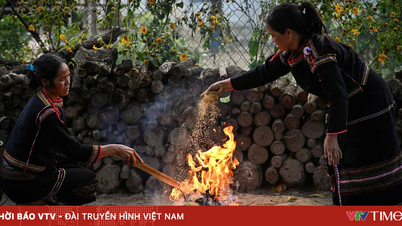
For the indigenous people of the Central Highlands, the forest is the most suitable setting to "decipher" historical tales and to transmit heroic images to their descendants. During the rainy season, amidst the swirling wind around the stilt houses, by the glowing fire, stories unfold in a vast space of imagination: ancient celestial beings, battles, conquests, and the yearning for love.
Although few people today still maintain the tradition of reciting epics by the fire, the warmth of the fire and the legends still evoke a shimmering world, connected to real life, because the communal life of the Central Highlands has blended with epics. Epics served as a way of recording history, a form of oral transmission through rhyming stories, before being recorded in writing. What we know today is only a modest fraction of the vast treasure trove of Central Highlands epics.
In the collective memory, traces of epics are always present in daily life. The Ede people believe that the large rocks rising from the grassy hills or lying prostrate in the rice fields are the embodiment of Dam San's herd of elephants from ancient times. From these beliefs, the nature of the Central Highlands appears as a vibrant, mythical space. A land perfectly suited for creating epic poems. Every hill, every riverbank can become a dwelling place for spirits.
Epic poetry in the aspirations of everyday life.
The epics of the Central Highlands not only recount heroic deeds, but also embody the aspirations for life. The everyday aspirations of couples are not unlike the aspirations of the legendary Dam San when he demanded to marry the Sun Goddess.
In the Goddess's dialogue, the epic world emerges as a sacred boundary: "I want to stay in the homeland of my grandparents, in the place where my ancestors gave birth to the sun and moon gods. I want to stay in my land, the boundary between heaven and earth." These words are not merely literary details; they reflect the Central Highlands people's conception of the realm, of the sacred, of the space "between heaven and earth" that humans can reach through their imagination.
Today, the rapid changes of modern life have gradually eroded the pure concepts of traditional herbal civilization. There are not many traditional stilt houses left, and among the few remaining, there are few hearths where people would gather on rainy nights to recount heroic tales. Fieldwork and research have also become more difficult. Many oral traditions have faded from everyday life.
But even with the shrinking performance environment, the epics of the Central Highlands remain in the hearts of the indigenous people, in the landscapes they encounter every day. They live on as a balance between reality and dreams, between the tangible and the mystical.
As long as humanity continues to create myths and preserve the imagination derived from them, life will continue to have the potential to reach a more perfect world. The reflection from the world of myths, though lacking a rational basis, can still decipher many mysteries about a community, about a land that was once unfamiliar but now feels close through stories told around the fireplace.
Source: https://baodanang.vn/su-thi-tay-nguyen-ngon-lua-huyen-thoai-3338789.html



![[Image] A brilliant symphony and explosive power in the skies of Da Nang.](https://vphoto.vietnam.vn/thumb/1200x675/vietnam/resource/IMAGE/2026/05/31/1780196945787_anh-man-hinh-2026-05-31-luc-10-08-51.png)














![[Video] Sunset at Lap An Lagoon – Where the sun sets over the fishing nets](https://vphoto.vietnam.vn/thumb/340x192/vietnam/resource/IMAGE/2026/05/31/1780192137701_beach-landscape-sea-water-nature-grass-745871-pxhere-com.jpeg)



























































Comment (0)