

On a weekend afternoon, the children's playground was packed with people. Inside the cool, air-conditioned space were colorful slides, ball pits, and the clear, cheerful laughter of children. This should have been the cleanest and safest place for them.
Yet, in that enclosed space, a man calmly lit a cigarette. The tip glowed red like a small ember. He leaned back in his chair, took a long drag, and slowly exhaled the smoke. The swirling white smoke had nowhere to dissipate, lingering under the light, mingling with the cool air from the air conditioner, and spreading throughout the room.

A man casually smokes a cigarette in a children's playground, in an enclosed, air-conditioned space.
The air was thick with the pungent smell of cigarette smoke mixed with the strong, metallic scent of cigars. The children continued to play carefree amidst this invisible haze. Some would run past, grimacing and covering their noses, while others would cough a few times before resuming their unfinished game.
The adults around saw it but no one said anything; a few silently picked up their children and sat further away. That silence made the cigarette smoke seem even more brazen, as if the children's right to breathe clean air had suddenly become something to be given up.
Stepping outside, I could still smell the cigarette smoke clinging to my clothes. It suddenly occurred to me that adults can choose whether or not to smoke, but the children there have no choice; they only know how to breathe, a natural instinct of a growing being.
During rush hour, amidst the dense traffic on the street, I came across a father carrying two young children. One sat in front, the other nestled behind him.
The man was constantly puffing on his cigarette while driving. Each time he took a long drag, the smoke was instantly blown backward by the wind, enveloping the child's face and hair. The child clung tightly to his father's back. Perhaps he didn't know that what was clinging to him wasn't just smoke. It was also thousands of toxins that his young body had to endure every day.
It's strange to think about it. There are fathers who are willing to brave the sun and rain to take their children to school, willing to stay up all night when their children have a fever. But they unknowingly bring a silent disease back to their children with the very smoke from their fingertips.
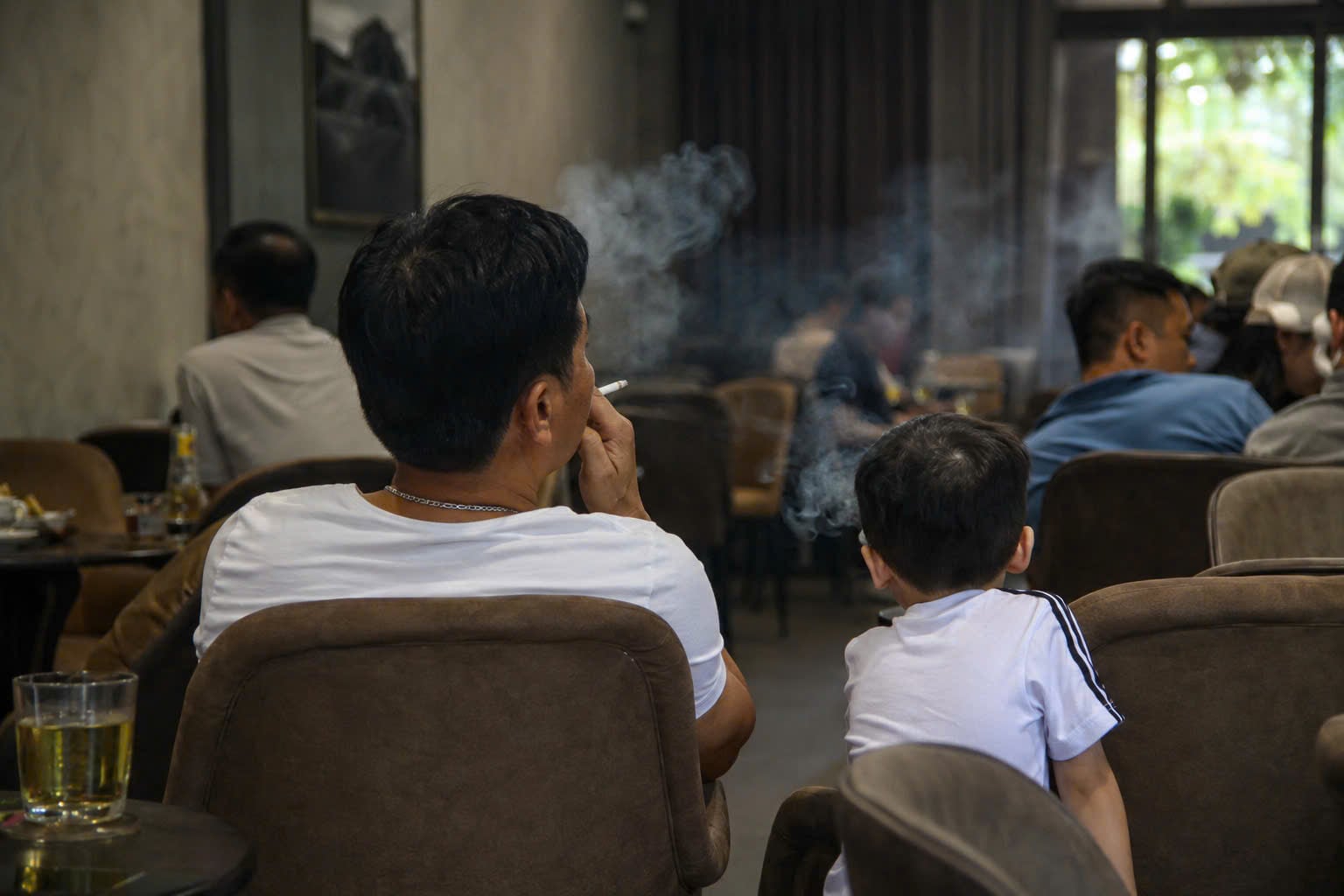
Cigarette smoke silently envelops the space of the cafe, where many children and non-smokers are still subjected to passive smoking every day.
Cigarette smoke isn't just present on the streets. It creeps into cafes, restaurants, and other crowded places. In some corner of a cafe, a few teenagers, still in school, are trying their hand at smoking as a way of showing they're grown up. Adults smoke out of habit, young people smoke to imitate. Cigarette smoke is thus passed down from generation to generation like a sad legacy.
I remember the son of an acquaintance. His father had been smoking since his mother was pregnant. The small house always had a lingering, familiar, pungent smell. When the child was born, he was much lighter than other babies his age, thin and often ill.
In its early years, it suffered from constant bronchitis and pneumonia. Every time the weather changed, the whole family would rush it to the hospital. Its childhood wasn't just filled with toys or afternoons spent playing in the yard; it also included the smell of disinfectant, the sound of nebulizers, and prolonged coughing fits throughout the night.
The father loved his child dearly. Every time his child was hospitalized, he would rush around trying to get every single pill. But it wasn't until he saw his little one lying in the hospital room breathing oxygen that he suddenly realized he might have been partly responsible for his child's illnesses over the years. If only that realization had come sooner.
The most frightening aspect of cigarette smoke isn't the swirling smoke in front of your eyes, but the toxins that cling to the smoker's clothes, bedding, and hands, and then enter the bodies of young children through hugs.
Cigarette smoke never discriminates between the smoker and the person standing nearby. It passes through everyone, the elderly, pregnant women, and growing children.
I once heard a story that has haunted me ever since. One evening, a father sat on his porch, a cigarette flickering in the darkness. His six-year-old son, carrying a notebook, came out, sat beside him, and asked, "Dad, why do you smoke all the time?" The father smiled and replied, "You'll understand when you grow up." The boy was silent for a moment, then asked again, "Do cigarettes taste good, Dad?"
The man paused. The child bent down, fiddling with his slippers: "If it doesn't taste good, Dad, don't smoke anymore. I don't like hearing you cough." The words were as light as a leaf falling to the ground. The father sat there, the cigarette burning slowly between his fingers. For the first time in years, he didn't know how to answer his child. It turned out that what children longed for wasn't new toys or long trips; sometimes, all they needed was a healthy father to be with them longer.
The smoke will eventually dissipate into the air, but what it leaves in a child's lungs is not easily erased. Childhood should be filled with the scent of milk, sunshine, and a mother's hair after a long day. Let's not allow the memories of these children to retain a different scent... the smell of cigarette smoke on their heads.
Source: https://baoangiang.com.vn/dung-thoi-khoi-len-mai-dau-con-tre-a487352.html


![[Image] A brilliant symphony and explosive power in the skies of Da Nang.](https://vphoto.vietnam.vn/thumb/1200x675/vietnam/resource/IMAGE/2026/05/31/1780196945787_anh-man-hinh-2026-05-31-luc-10-08-51.png)


















![[Video] Sunset at Lap An Lagoon – Where the sun sets over the fishing nets](https://vphoto.vietnam.vn/thumb/340x192/vietnam/resource/IMAGE/2026/05/31/1780192137701_beach-landscape-sea-water-nature-grass-745871-pxhere-com.jpeg)








































































Comment (0)