

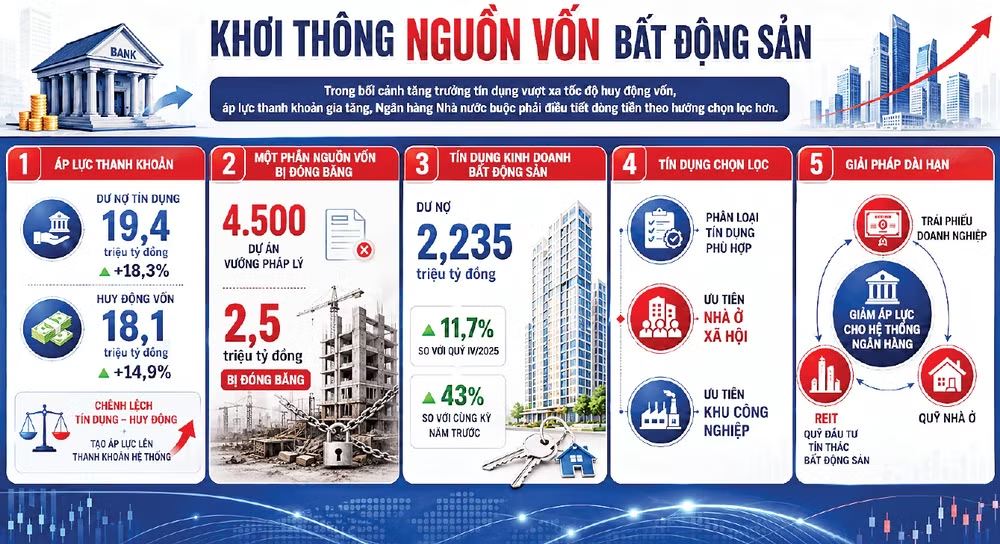
Graphics: HONG ANH
However, many economic experts argue that instead of equating all real estate segments with risks, it is necessary to design separate credit mechanisms for segments serving genuine housing needs, while also opening up more medium and long-term capital channels to reduce dependence on bank credit.
Selective real estate investment flows
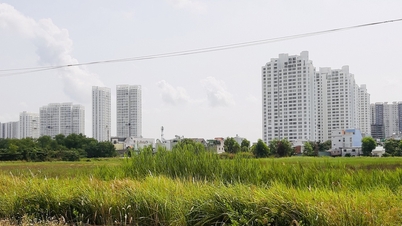
The Vietnamese real estate market is showing signs of recovery after a long period of stagnation. Transactions are gradually improving, housing demand is increasing again, and accelerated infrastructure investment has led to a significant demand for capital from both businesses and homebuyers. However, unlike the previous period, credit flows are no longer being released indiscriminately, but are being more tightly regulated, prioritizing safe segments with real demand.
According to Nguyen Phi Lan, Director of the Forecasting and Statistics Department and Monetary and Financial Stability Director (State Bank of Vietnam), as of May 14th, outstanding credit in the entire system reached approximately VND 19.4 million billion, an increase of 18.3% compared to the same period last year, while capital mobilization increased by about 14.9%, reaching approximately VND 18.1 million billion. The large gap between credit and capital mobilization is creating significant pressure on the liquidity of the banking system. In this context, the State Bank of Vietnam continues to direct capital flows into production and business sectors, priority industries, and new growth drivers such as digital transformation, green transformation, circular economy, and science and technology.
Regarding real estate, credit is still being maintained but with stricter risk control. Mr. Lan emphasized that regulatory agencies must regulate capital flows appropriately across industries and sectors because over-prioritizing any one sector will make it difficult for many other sectors, especially small, medium, and micro-enterprises, to access capital.
According to Vietcombank Securities (VCBS), real estate credit in 2026 is likely to continue growing, but at a slower and more selective pace compared to 2025, due to the State Bank of Vietnam's strict control over credit extended to high-risk sectors. From the beginning of 2026, the regulatory authority has required credit institutions to ensure that real estate credit growth does not exceed the overall credit growth rate of the entire banking system.
According to Vietcombank Securities (VCBS), real estate credit in 2026 is likely to continue growing, but at a slower and more selective pace compared to 2025, due to the State Bank of Vietnam's strict control over credit extended to high-risk sectors. From the beginning of 2026, the regulatory authority has required credit institutions to ensure that real estate credit growth does not exceed the overall credit growth rate of the entire banking system.
In fact, the State Bank of Vietnam continues to facilitate access to capital for the real estate sector, as evidenced by the continued strong growth in real estate credit. According to the Ministry of Construction, as of February 28th, the total outstanding credit for real estate business activities reached approximately 2,235 trillion VND, an increase of 11.7% compared to the fourth quarter of 2025 and a significant increase of 43% compared to the same period last year. However, many businesses report that accessing capital is significantly more difficult during this time.
Chairman of the Ho Chi Minh City Real Estate Association (HoREA), Le Hoang Chau, shared that the credit growth plan for 2026 is around 15%, lower than the 19.1% of the previous year, while the market's capital demand remains very high. This poses considerable pressure.
Besides credit pressure, rising interest rates are also adding to the burden on the market. Although nominal interest rates tend to decrease, the actual cost of capital for real estate businesses remains high due to tightened access to capital. Mr. Phan Duy Hung, a senior analyst at Vietnam Investment Credit Rating Joint Stock Company, also warned that the risk of refinancing is present for resort real estate developers or those facing legal issues.
Credit cannot be applied uniformly.
One of the most discussed issues today is the allocation of credit to the real estate market. According to experts, applying a relatively uniform credit mechanism to all real estate segments is creating major problems, making it difficult for many projects serving genuine housing needs to access capital. OBC Holding's General Director, Tran Van Hieu, argues that grouping all real estate segments into a single credit basket has distorted capital costs and directly affected people's access to housing.
Social housing or affordable housing serving real housing needs cannot withstand the same interest rates and credit limits as speculative or high-end resort real estate. “A uniform credit policy not only creates an imbalance in capital costs but ultimately adds directly to the selling price, making the dream of home ownership increasingly out of reach,” Mr. Hieu further shared. Sharing the same view, Mr. Chau also argued that real estate should be categorized to provide appropriate credit instead of equating all segments as risky. Social housing has a safety level of up to 99%, while affordable housing and industrial real estate also belong to the low-risk group.
Currently, the State Bank of Vietnam is reviewing proposals related to real estate classification to develop more appropriate credit mechanisms in the future. During a meeting with the State Bank of Vietnam at the end of April 2026, Prime Minister Le Minh Hung requested the banking sector to research and classify each type of real estate to apply appropriate credit limits, while also encouraging the development of social housing and industrial zones.
Many commercial bank leaders also emphasized the "selective" element in real estate lending. VPBank Chairman Ngo Chi Dung stated that the important thing is not whether or not to invest in real estate, but to choose the right segment. VPBank prioritizes capital for housing projects that meet real needs, especially social housing and the mid-range segment, while limiting funding for resort projects or high-end speculative segments.
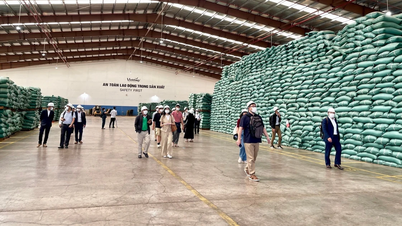
Techcombank Chairman Ho Hung Anh also stated that the bank only chooses to finance projects with good liquidity, complete legal documentation, and clients with clear financial capacity. Meanwhile, SHB Chairman Do Quang Hien emphasized that SHB's capital is currently focused on infrastructure projects, social housing, housing for young people, and industrial real estate – segments considered to have real demand and good absorption capacity.
Bank credit is seen as a crucial "pillar" for the real estate market. However, many argue that over-reliance on bank loans is making the market vulnerable to fluctuations in interest rates and monetary policy.
Bank credit is seen as a crucial "pillar" for the real estate market. However, many argue that over-reliance on bank loans is making the market vulnerable to fluctuations in interest rates and monetary policy. Dr. Can Van Luc, Chief Economist of BIDV, suggests that in the long term, it is necessary to develop other capital mobilization channels such as corporate bonds, real estate investment trusts (REITs), and housing funds to reduce pressure on the banking system.
The current challenge for the real estate market is not just about loosening credit, but more importantly, allocating capital selectively, prioritizing segments that serve real needs, while simultaneously promoting institutional reforms and resolving legal issues hindering projects. In fact, according to HoREA statistics, there are still approximately 4,500 projects nationwide facing legal obstacles, "freezing" over 2.5 trillion VND in investment capital.
According to Nhan Dan newspaper
Source: https://baoangiang.com.vn/phan-luong-von-cho-bat-dong-san-a487337.html



![[Video] Sunset at Lap An Lagoon – Where the sun sets over the fishing nets](https://vphoto.vietnam.vn/thumb/1200x675/vietnam/resource/IMAGE/2026/05/31/1780192137701_beach-landscape-sea-water-nature-grass-745871-pxhere-com.jpeg)



















![[Video] Sunset at Lap An Lagoon – Where the sun sets over the fishing nets](https://vphoto.vietnam.vn/thumb/800x450/vietnam/resource/IMAGE/2026/05/31/1780192137701_beach-landscape-sea-water-nature-grass-745871-pxhere-com.jpeg)
















































![[Video] Sunset at Lap An Lagoon – Where the sun sets over the fishing nets](https://vphoto.vietnam.vn/thumb/402x226/vietnam/resource/IMAGE/2026/05/31/1780192137701_beach-landscape-sea-water-nature-grass-745871-pxhere-com.jpeg)


































Comment (0)