

To sell the project, they have to bend the law.
According to Mr. Le Hoang Chau, Chairman of the Vietnam Real Estate Association, the entire political system is currently very determined to remove obstacles for projects. However, the regulation requiring projects to fulfill their financial obligations before being transferred entirely or partially is causing difficulties for businesses.
Because acquiring clean land requires a huge investment from businesses. By the time they start implementation, many investors run out of money because the law requires that projects must have land ownership certificates to be eligible for loans. Therefore, many investors are forced to sell their projects prematurely.
However, when project transfers encounter difficulties, businesses circumvent the rules by transferring company shares. At that point, the "core" of the business changes, and the new owner is essentially the buyer of the project. This loophole isn't inherently wrong because the law doesn't prohibit transferring company shares, but it does carry some risks later on.

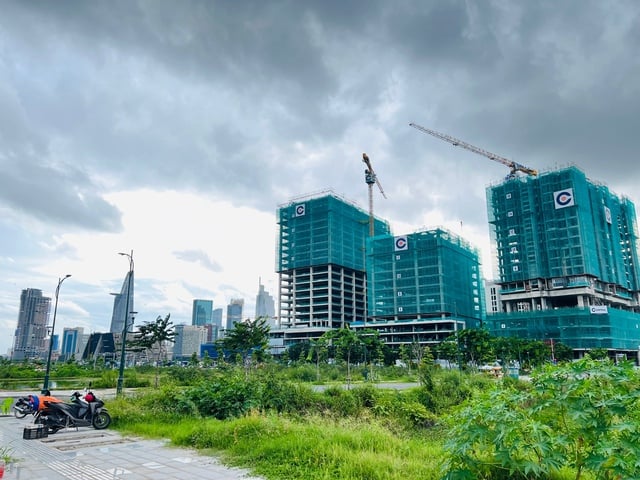
Currently, many projects cannot be transferred due to overly strict regulations.
PHOTO: DINH SON
According to Dr. Ho Trung Phuoc, former member of the Standing Committee of the Binh Thuan Provincial Party Committee, Ho Chi Minh City alone currently has over 100 projects facing legal obstacles and not meeting the conditions for transfer, with hundreds of thousands of billions of dong tied up. This makes it impossible for those who want to sell to do so, and impossible for those who want to buy to do so as well.
The root cause stems from conflicts within the legal "matrix." Specifically, the Investment Law allows transfers upon approval of the investment plan, while the Real Estate Business Law and the 2024 Land Law require the fulfillment of financial obligations. This creates a legal "grey area": investment is permitted, but land access is hampered.
The law also requires the completion of new infrastructure before land can be transferred, but the percentage is not specified. Furthermore, there is a bottleneck in land valuation, with the land appraisal process dragging on indefinitely and a lack of flexible market-based pricing mechanisms, causing capital to be tied up and projects to be stalled.
The buyer pays the land use fee instead.
Given this situation, lawyer Truong Anh Tu, Chairman of TAT Law Firm, argues that real estate M&A is no longer simply a transfer of assets, but in many cases has become a transfer of the entire "legal memory" of the project. This is also the reason why legal aspects are becoming the first filter for capital flows.
"Previously, credit institutions were primarily interested in the value of collateral, but now they want to know how the land use rights were acquired, to what extent financial obligations have been fulfilled, whether the project involves public assets, and whether those property rights are capable of maintaining stability in the event of changes in the legal environment," said lawyer Truong Anh Tu.
When these questions become central to the due diligence process, legal risks begin to be directly reflected in the value of the transaction. A project with a complex legal history will be subject to a deeper discount. A project with incomplete financial obligations will take longer to access funding. A project with an unclear legal history will undergo a more rigorous and lengthy due diligence process.
In other words, legal risk today is no longer contained in lawyers' reports but is being translated into monetary terms through the cost of capital, disbursement conditions, loan-to-value ratio, and valuation of the project itself.
At a deeper level, according to Mr. Truong Anh Tu, what the market is currently lacking is not necessarily land or cash flow. Investors are only truly ready for the long term when they clearly understand their rights, their obligations, and whether those rights will still be protected after many years.
That's also why the biggest story in the real estate M&A market is no longer about the race to own more land, but about building more transparent, stable, and reliable property rights. That's the most profound change currently taking place in the Vietnamese real estate market.
To overcome these difficulties, many solutions have been proposed.
PHOTO: DINH SON
To resolve the obstacles facing these projects, Dr. Bui Dang Dung, Vice Chairman of the National Assembly 's Finance and Budget Committee, proposed studying a mechanism that would allow credit institutions to provide guarantees or establish escrow accounts. Accordingly, funds from the buyer could be directly used to pay land-related financial obligations to the State on behalf of the seller. This solution would help unblock projects currently stalled due to the previous investor's inability to pay taxes, while ensuring the State collects taxes correctly and completely.
It is necessary to quickly finalize the legal framework for the development of real estate investment trusts (REITs) and private equity funds. These will provide a solid financial foundation, acting as professional buyers to consolidate fragmented projects through equity transfers, reducing excessive reliance on bank credit.
Simultaneously, detailed and consistent guidelines on land valuation methods under the new Land Law should be issued. Clear land valuation will help businesses accurately determine opportunity costs, thereby quickly valuing M&A transactions and reducing lengthy negotiation times.
"Administrative procedures after the transfer need to be simplified. The process of changing the investor on the investment certificate and land ownership certificate should be implemented through a one-stop mechanism, shortening the waiting time so that capital can flow into the project's reconstruction sooner," Mr. Bui Dang Dung suggested.
Source: https://thanhnien.vn/chuyen-nhuong-du-an-van-tac-185260530163152982.htm

![[Image] Nearly 125,000 Hanoi students completed the Literature exam for the 10th grade entrance exam.](https://vphoto.vietnam.vn/thumb/1200x675/vietnam/resource/IMAGE/2026/05/30/1780117233041_ndo_br_thiet-ke-chua-co-ten-2-png.webp)





























































































Comment (0)