


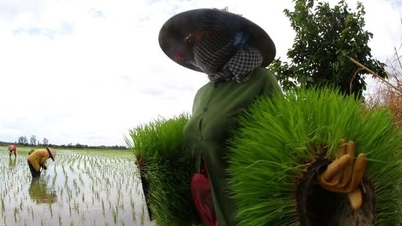
Rice and shrimp farming fields in Ca Mau - Photo: QUANG DINH
But if we view this land solely through the lens of production, we may inadvertently overlook a resource even greater than alluvial soil and freshwater: the collective knowledge, indigenous culture, natural adaptability, and creative spirit of the people living in this riverine region.
In the new context, as localities expand their development space through regional linkages, digital transformation, green economy , and innovation, the emergence of startup and innovation centers in many localities should not be viewed as a model exclusive to large cities or high-tech zones.
More importantly, we must ask: how will these centers contribute to changing the future of the region?
Many places nowadays talk a lot about innovative startups, but not a few models remain limited to a few idea competitions, workshops, or a co-working space for startups.
These activities are necessary but do not touch upon the essence of innovation. Because innovation does not begin with a presentation of project ideas or products, but rather with the ability to see local problems and dare to experiment with new solutions.
A successful innovation center should not be measured by the number of events it organizes each year, but by the real changes it brings to people's lives.
That's when young people want to stay in their hometowns to start their careers. When cooperatives know how to manage data from raw material areas. When farmers can use artificial intelligence (AI) to identify pests and diseases, forecast weather, or connect to markets.
When a traditional craft village knows how to tell its cultural story on digital platforms. And when local products enter the global market not just with low prices, but with cultural value, traceability, and consumer trust.
It is crucial that these centers carry the "land DNA" of the place where they are located.
A common mistake today is the mindset of trying to mechanically copy the models of Silicon Valley, Singapore, or Shenzhen, forgetting that each locality has its own unique "development gene."
The Mekong Delta may not be the strongest in semiconductor chips or core technologies, but it possesses resources that the world is increasingly interested in: tropical agriculture , bioeconomy, fisheries, renewable energy, circular economy, riverine culture, and community ecosystems.
If we know how to connect technology with agriculture, logistics with seaports, education with the community, data with life, and culture with creative tourism, then a rice field, a fish pond, an orchard, or a traditional craft village can become a center for creating new value.
At that point, innovation would no longer be a distant concept confined within glass buildings, but would be present right in the fields, on the riverbanks, and in the livelihoods of the people.
In this approach, the startup and innovation center should be seen as a "connecting node" of the entire regional development ecosystem. It should not only support technology startups but also connect universities with cooperatives, scientists with businesses, artists with local communities, data with governance, and AI with rural life.
Without those connections, these centers can easily become a beautiful "architectural shell" lacking inner vitality.
Another crucial task is to translate major policies on science and technology, digital transformation, AI, and the green economy from written documents into practical application. Many cooperatives still don't understand the value of data.
Many small businesses don't know where to begin their digital transformation. Many local officials still view AI as something only big tech corporations can handle. Meanwhile, what the community needs is not just hear announcements about resolutions, but training, practical experience, and support.
Therefore, these centers need to act as "institutional transformation stations," where seemingly grand concepts are transformed into concrete development tools for the people. It's not just about talking about AI as a global trend, but about helping farmers use AI to manage their crops.
It's not just about talking about digital transformation; we need to help cooperatives learn how to sell on e-commerce platforms, trace product origins, and build digital brands for local products.
The center also needs to become a place to promote a "digital literacy movement" in the new era.
While literacy programs in the past helped people learn to read and write, today we need to popularize digital skills, data skills, e-commerce, AI applications, and the ability to tell stories on digital platforms.
And from that, a new perspective emerged. The "field" of the future will not only produce rice or seafood, but also generate data, carbon credits, scientific research, experiential tourism, STEM education, digital content, and circular economy models.
A field is measured not only by its yield, but also by the amount of knowledge accumulated within it. A cooperative is not just a place for organizing production, but can also become a community learning center for technology and innovation.
The core of this model is to view innovation not as the sole concern of laboratories or technology companies, but as a developmental capacity of the entire society.
Therefore, these centers need to operate on an open platform model, connecting universities, research institutes, businesses, start-ups, artisans, local communities, investors, and a global network of Vietnamese experts.
In the 20th century, the Mekong Delta was considered the rice granary of the country. In the future, this region has the potential to become a "field of knowledge" for Vietnam's green economy, circular economy, and innovation.
At that time, startup and innovation centers will not only be places to support startups but also places to integrate institutions into daily life, where technology meets the community, where AI meets farmers, where education connects with the fields, and where young people find their aspirations for development right in their own hometowns.
Source: https://tuoitre.vn/canh-dong-tri-thuc-o-dong-bang-song-cuu-long-20260529085647782.htm





















































































Comment (0)