

 |
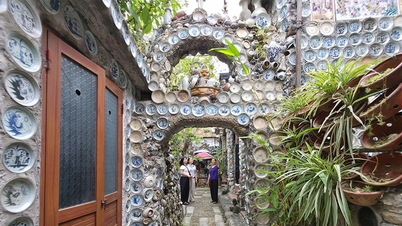
| Phuoc Tich pottery products attract tourists. |
It has a foundation, but it's not strong enough yet.
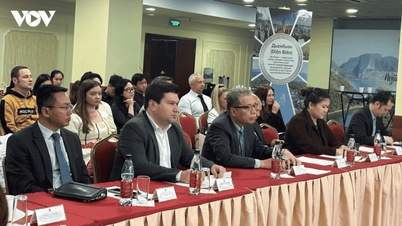
At the first session of the 9th term of the City People's Council, the City People's Committee's report showed that, during the 2020-2025 period, the implementation of policies supporting community tourism has initially yielded positive results. Many community tourism models have been formed in craft villages, cultural villages, and suburban ecological areas, gradually creating new destinations that complement heritage tourism, which is a strength of Hue.
However, after reviewing the report from the City People's Committee, Mr. Tran Gia Cong, Head of the Economic and Budget Committee of the City People's Council, stated that these results are only the beginning and do not yet reflect the local potential. In reality, many community tourism destinations still operate on a small scale, lacking linkages and failing to form a complete product chain. Many models are spontaneous, lacking long-term direction, leading to duplicated products and a lack of competitiveness. Infrastructure in some areas does not meet the increasingly high demands of tourists, especially international visitors.
From a management perspective, representatives of the local tourism industry believe that the organizational, operational, and market access capabilities of the local community are still limited. While the people have advantages in terms of local resources, they lack professional tourism skills, from welcoming and serving guests to developing experiential tourism products. Furthermore, promotional and marketing efforts have not kept pace with practical demands. Many destinations with potential remain largely unknown and lack connections with travel agencies, leading to unstable visitor numbers.
Expectations from the new policy
The drafting and adoption of the Resolution on policies to support community tourism development for the period 2026-2030 at the first session of the 9th City People's Council is considered a necessary step to create a boost for a new development phase. The Resolution not only inherits the achievements already made but also adds many groundbreaking policies that are in line with practical requirements.
Notably, the level of support has been increased in several key areas such as investment in transportation infrastructure, construction of accommodation facilities, development of tourism products, and promotional activities. The total estimated budget is approximately 105 billion VND, with a clear allocation structure between investment capital and operational funds.
According to the assessment of the Economic and Budget Committee of the City People's Council, increasing the support level is necessary in the context of rising investment costs, while also meeting the requirements for improving the quality of tourism services; supplementing new policies such as supporting the construction of tourist boats, landscape beautification, waste treatment, or the development of media products also opens up many development opportunities for localities.
In its long-term development strategy, Hue aims to become a heritage, cultural, ecological, and smart city. Community-based tourism, characterized by its close connection with nature and local life, is perfectly aligned with this orientation. However, alongside supportive policies, a mechanism for closely monitoring and evaluating implementation effectiveness is needed to ensure resources are used effectively. The new resolution sets a target of developing 20-30 community-based tourism destinations, striving for this type of tourism to account for approximately 30% of the total number of tourists visiting Hue by 2030. This is an ambitious goal, requiring the concerted efforts of the entire political system, businesses, and the people.
According to Vice Chairman of the Hue City People's Committee Tran Huu Thuy Giang, the Hue City People's Committee has issued Plan No. 188/KH-UBND on the development of ecotourism and community tourism for the period 2026-2027. The goal is to develop tourism in a green and sustainable direction, improve product quality, and create stable livelihoods for the people.
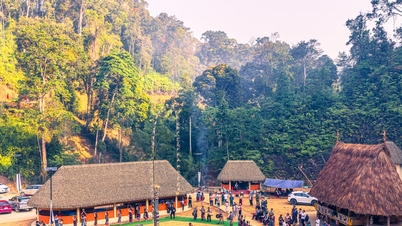
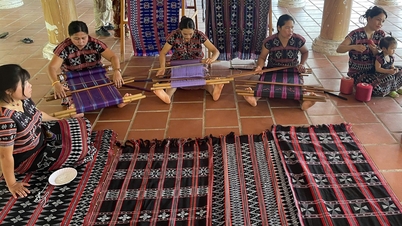
Accordingly, the city has defined four distinct experiential spaces: the heritage area - Perfume River - traditional craft villages; the coastal area - Tam Giang lagoon; the mountainous ecological area - indigenous culture; and the ecological agricultural area associated with OCOP products.
During the period 2026-2027, it is expected that 10-12 localities with potential will be selected for investment, and 8-10 model tourism destinations will be developed to meet standards in infrastructure, environment, and tourism capacity. Simultaneously, efforts will focus on standardizing tourism products, developing destination narratives, and training human resources, with the goal of providing professional training to approximately 50% of households involved in tourism.
Source: https://huengaynay.vn/du-lich/mo-loi-cho-du-lich-cong-dong-164641.html


![[Video] Sunset at Lap An Lagoon – Where the sun sets over the fishing nets](https://vphoto.vietnam.vn/thumb/1200x675/vietnam/resource/IMAGE/2026/05/31/1780192137701_beach-landscape-sea-water-nature-grass-745871-pxhere-com.jpeg)










![[Video] Sunset at Lap An Lagoon – Where the sun sets over the fishing nets](https://vphoto.vietnam.vn/thumb/800x450/vietnam/resource/IMAGE/2026/05/31/1780192137701_beach-landscape-sea-water-nature-grass-745871-pxhere-com.jpeg)



































![[Video] Sunset at Lap An Lagoon – Where the sun sets over the fishing nets](https://vphoto.vietnam.vn/thumb/402x226/vietnam/resource/IMAGE/2026/05/31/1780192137701_beach-landscape-sea-water-nature-grass-745871-pxhere-com.jpeg)




























Comment (0)