

When stepping onto the international stage, the work not only carries local elements but also opens a journey to bring Vietnamese identity closer to the world .
Creativity stemming from cultural depth.
In contemporary art, not many artists choose to start over by erasing their own creative legacy. However, for painter Le Huu Hieu, this is not an extreme act, but rather an existential turning point, opening up a new direction for his creative journey.
Realizing that his previous works lacked the depth of national culture, he proactively restructured his entire creative foundation, from materials and methods to artistic approach. No longer limited by personal emotions, he strived to approach history as a living entity.
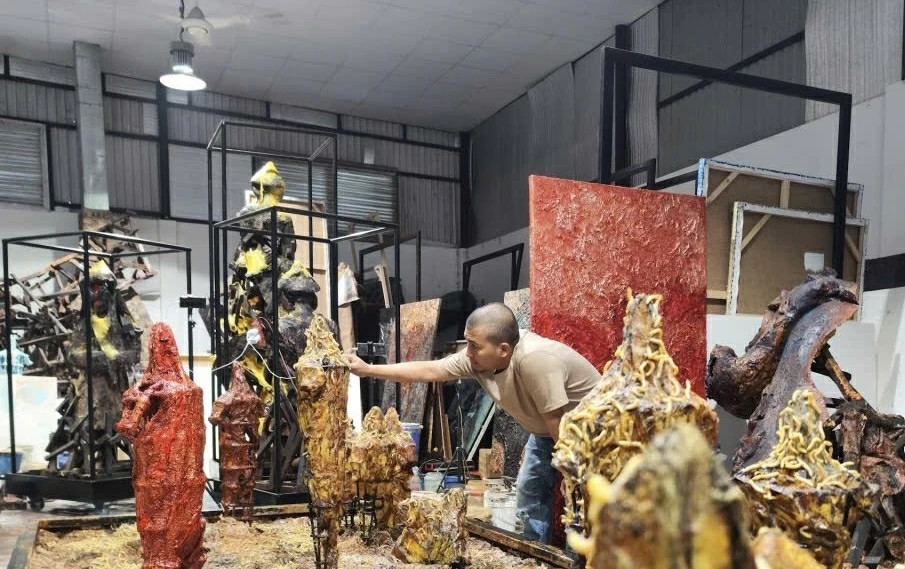 |
| Artist Le Huu Hieu meticulously observes the silkworm spinning process in his artwork. (Photo courtesy of the artist) |
A crucial turning point in Le Huu Hieu's journey came from his fieldwork. This was not simply a matter of collecting materials, but a journey of experiencing knowledge. Through his travels across Vietnam, from traditional craft villages to religious sites, he gradually formed a new perspective on history.
While history was previously approached as a system of events and figures, it now appears as a continuous flow, existing within everyday life.
The artist emphasized: "History does not lie dormant in books, but continues to exist and breathe every day in people's lives."
This realization led to a shift in artistic thinking from the history of "those who are named" to the history of "the anonymous." It is from this perspective that "Silkworm" establishes its overarching thought axis, where the subjects of history are no longer exceptional individuals, but rather the community—people who silently preserve and recreate culture through generations.
"Silkworm" - An ontological metaphor for the Vietnamese people.
The central concept of "Silkworm" did not originate from a random choice, but was formed through a long process of contemplation by artist Le Huu Hieu. During a field trip to a silkworm farming village, he realized a special symbolic structure in the silkworm's life cycle: closed but constantly regenerating.
"I chose the silkworm because I see in it an image that is very close to the history and people of Vietnam," the artist shared.
On the surface, the silkworm is associated with agricultural civilization and traditional crafts, important pillars of Vietnamese culture. But at a deeper level, it becomes a metaphor for history: a continuous flow, woven from countless "silk threads" representing the silent contributions of anonymous individuals.
Therefore, "Silkworm" not only tells the story of a living organism or a traditional craft, but expands into a story about the enduring vitality of Vietnamese culture: its ability to protect itself, regenerate, and continue to evolve through the many vicissitudes of history.
Notably, in "Silkworm," materials are not merely a means of form creation, but become part of the discourse. The consistent use of traditional materials such as jackfruit wood, lacquer, resin, or silk is not a purely aesthetic choice, but carries epistemological significance, treating materials as "entities carrying memory."
He shared: "When I touch them, I don't feel like I'm just working with materials, but rather touching what our ancestors left behind—the techniques, knowledge, and a way of life that has existed for generations."
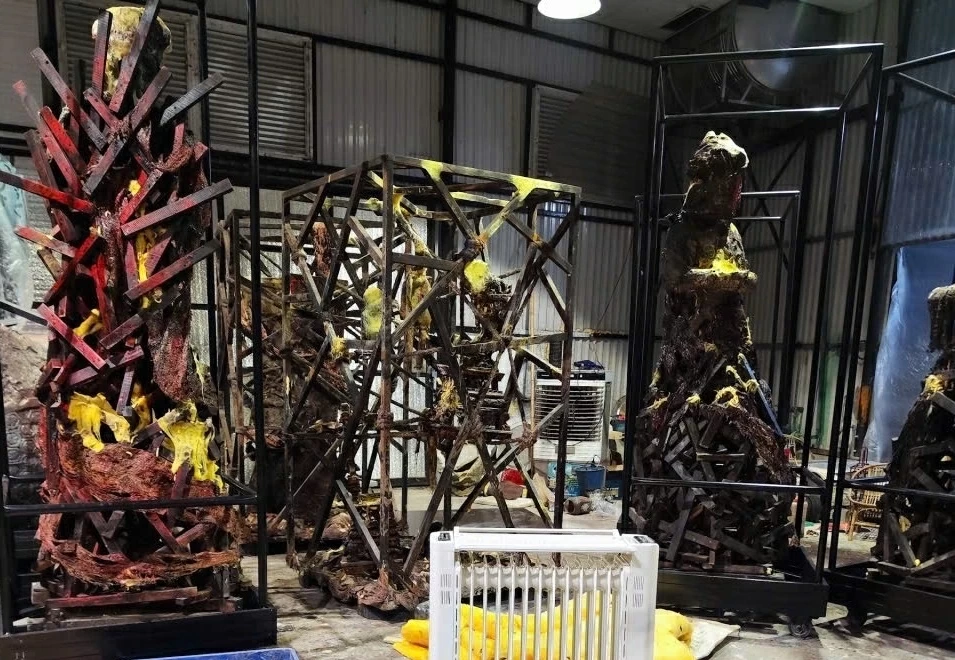 |
| An artwork in progress by the artist. (Photo courtesy of the artist) |
From the artist's perspective, each material carries its own history. Jackfruit wood evokes images of ancient architecture, temple and pagoda sculptures, and the living spaces and beliefs of the Vietnamese people. Lacquer embodies the depth of time with its meticulous layering, curing, and polishing process. Lac resin, beyond its role as a coating, is also a testament to an ancient technique that has contributed to the durability and beauty of traditional structures for centuries.
Therefore, when choosing these materials, the artist is not only selecting a means of expression, but also selecting the history, memory, and spirit of life hidden within them.
In particular, the direct involvement of live silkworms in the creative process fundamentally changed the role of the artist. The artwork was no longer the product of an absolutely controlling subject, but became the result of a symbiotic process between humans and nature.
“An artist’s dream is to reach a point where they no longer have complete control over their work. When they reach that state, in my opinion, the work truly becomes a work of art. With ‘Silkworm,’ I did a part, and the silkworm continued to complete the rest; that’s a beautiful result,” he shared.
If the "silkworm" is the symbolic axis, then "House" is the spatial axis of the entire arrangement. In Le Huu Hieu's thinking, "House" is not just a physical structure, but a cultural foundation, where family, community, and, more broadly, national relationships converge.
The simultaneous reconstruction and restructuring of the traditional Northern Vietnamese house within the exhibition space demonstrates a dialogue-rich approach, not recreating the past as a static entity, but interpreting it as an open structure capable of connecting with the present.
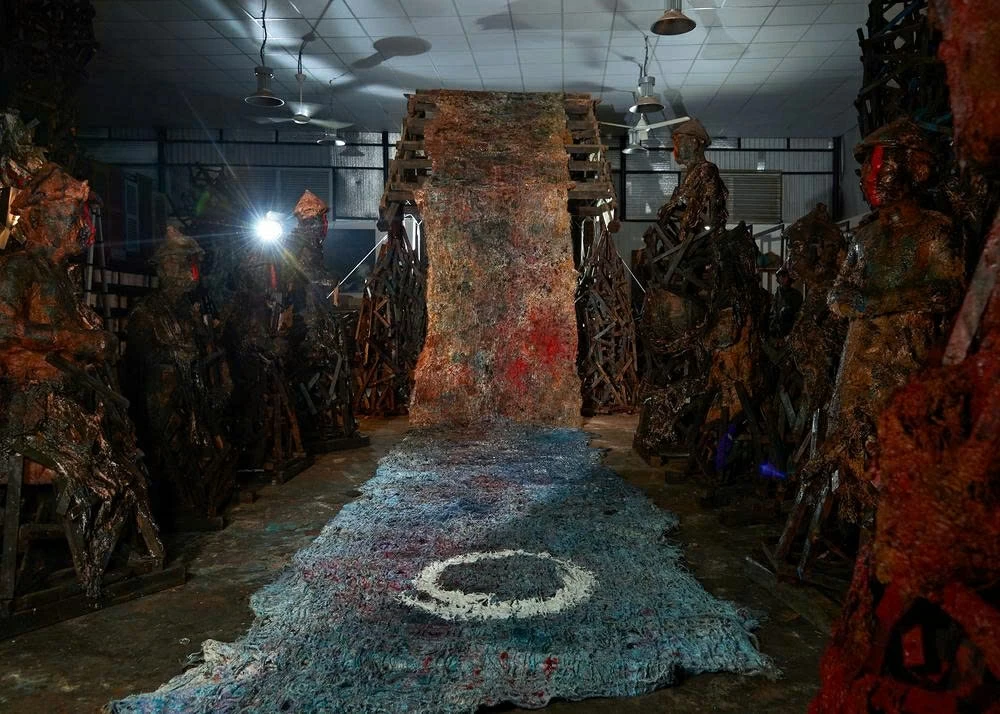 |
| The installation artwork "Silkworm" by artist Le Huu Hieu. (Photo courtesy of the artist) |
Vietnamese culture becomes a global language of dialogue.
When "Silkworm" was present at the Venice Art Biennale 2026 – one of Italy's most prestigious contemporary art spaces – the artwork not only transcended geographical boundaries but also participated in a multi-dimensional dialogue between cultures.
"I was there as a creative individual, but more deeply, I was aware that I was carrying a stream of Vietnamese culture out into the world," he said.
It is this unwavering commitment that allows "Silkworm" to transcend the boundaries of a national representative work, becoming an open discourse. There, international audiences approach it not through pre-existing frames of reference, but through direct experience and personal perception.
For Le Huu Hieu, this is just one stage in a longer journey into the depths of Vietnam's cultural heritage: "I am sitting on a 'gold mine' of Vietnam's history and heritage spanning over 4,000 years, and there is still so much for me to continue exploring . Therefore, I think, after 'Silkworm', I will move on to other heritage values."
The artist believes that art is the shortest and best way to preserve culture, and expresses his desire to contribute a small part to spreading the country's cultural values to future generations and to friends around the world.
Born in 1982 in Ha Tinh province and currently living and working in Hanoi, Le Huu Hieu gained attention in Europe with his solo exhibition "Soul Energy" in Venice in 2021. In 2025, Le Huu Hieu's installation exhibition "From the Battle of Bach Dang to the Great Victory of April 30, 1975" will open on Nguyen Hue Walking Street (Ho Chi Minh City) to commemorate the 50th anniversary of the Liberation of the South and the reunification of the country. At the Venice Art Biennale 2026, he marked a milestone as Vietnam participated for the first time with an independent project in its own space. This is considered an important step forward for Vietnamese art on the international contemporary art map. |
Source: https://baoquocte.vn/dua-tam-den-khong-gian-nghe-thuat-quoc-te-384309.html









































































Comment (0)