

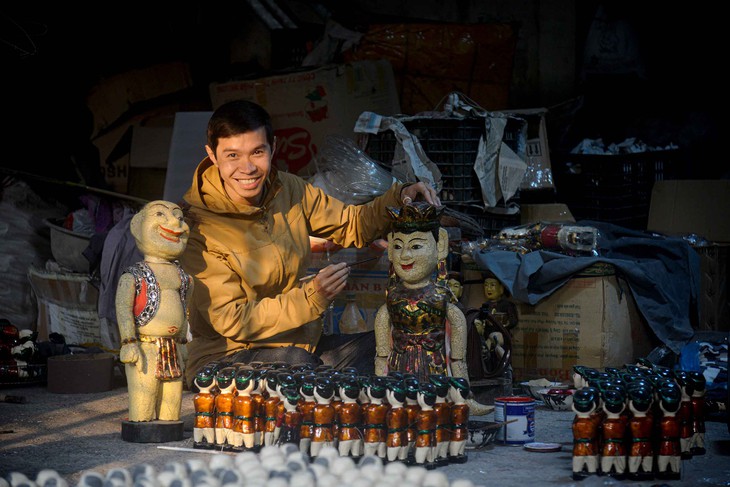
Ngo Quy Duc with his puppet designs in water puppetry.
In Hue during the transitional seasons, inside the Imperial Garden (Xuan 68 Street), Ngo Quy Duc (40 years old) regularly updates information with young people in Thanh Lieu woodblock printing village, Hai Phong (formerly Hai Duong) to exchange, adjust, and finalize a project for the ancient capital city.
A fading heritage
The project that Duc and his colleagues are working on is to revive the folk painting style: Chuon village couplets. This is a very famous painting style in Hue , but over time, it has completely disappeared.
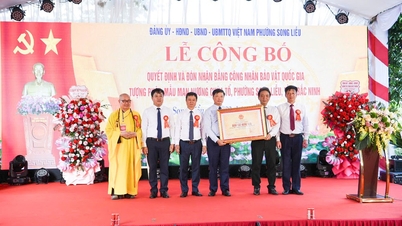
In early January 2026, the set of Chuon village's woodblock prints will be officially launched in the presence of cultural figures, government officials, and especially the people of Chuon village - the place where this art form originated, survived, and eventually faded away.
The successful launch of the Chuồn village ceramic jar marks another milestone in Đức's journey to rediscover, revive, and continue traditional craft villages across the country.
In 2006, Duc graduated from university with a degree in information technology, which had nothing to do with traditional crafts or cultural heritage. But for him, it proved extremely useful in helping to digitize, search, store, and reconstruct many details.
As a child, Duc had the opportunity to see and touch items made by artisans in traditional craft villages. He was fascinated and curious about the process of creating these products.
The desire to explore the heritage and products of traditional craft villages has always been in his mind.
After graduating from university, Duc worked for a friend for about three months before quitting. His first project was building an online information library about Hanoi . There, Duc stored information about its culture, history, geography, people, festivals, and more.
During the library construction process, he visited traditional craft villages and encountered products he had seen as a child. However, upon closer examination, Duc realized that fewer people were practicing the craft now, the products had little market demand, and they were gradually disappearing.
When he quit his job to work on cultural heritage, his family seemed unhappy, but no one said anything. Duc didn't explain it to anyone either. He wanted them to understand and support him when he succeeded.
In traditional craft villages, one often sees a small, slender young man, always carrying a bag, wandering around, taking notes. They don't know what he's doing.
Duc has been involved with traditional craft villages for nearly 20 years. Years ago, he approached a village in Hanoi that made papier-mâché masks. Like many other traditional craft villages, they were reluctant to pass on their skills to outsiders. If there was no one in the family to continue the craft, they were prepared to let it disappear.
Understanding that he couldn't approach traditional craftspeople in the usual way, Duc chose to approach them by experiencing their daily lives first, observing their routines, and then gradually learning about their crafts. He believed that this way, he could connect with the artisans as if they were family.
"Once we connect, sharing becomes easy. They'll confide in us about everyday life issues, making ends meet, career matters, the lack of a successor, and then we'll have a direction," Duc said.
He didn't directly ask his aunts and uncles to pass on their skills to him. Instead, he worked alongside them, sharing the values of the craft, so they would see his dedication to preserving traditional crafts. He wanted them to understand that losing these crafts would mean the hard work of their ancestors and his aunts and uncles would be wasted.
"Only when people truly understand the craft will they genuinely want to pass it on to me," Duc believes. For seven long years, Duc traveled back and forth, living and talking with the last two artisans of the papier-mâché mask-making craft.
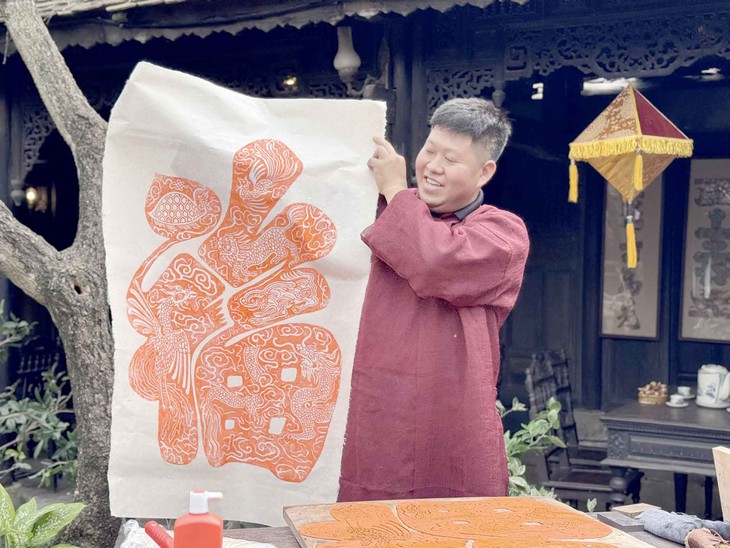
The Chuồn village censer was successfully launched after Đức's journey of researching and reconstructing the original text.
Extending the "life" of traditional craft villages.
When the two artisans from the papier-mâché mask-making village decided to pass on their craft to Duc, he couldn't hold back his emotions. Their children were also very happy that someone was carrying on the tradition...
In 2025, Duc decided to go to Hue to carry out a project to restore the folk paintings of Chuon village. There is not much documentation left for this project.
The village of Chuồn, where this type of painting originated, is now deserted. When asked, almost no one in the village knows anything about it. The elderly only remember, from memory, that "the village used to have this craft."
The couplets from Chuồn village consist of a large character (representing Happiness, Prosperity, and Longevity) in the center and pairs of couplets on either side, decorated with traditional motifs such as dragons, unicorns, turtles, and phoenixes.
The only remaining trace of the couplet is in the ancestral hall of the Doan family's ancestral temple. Even then, the descendants didn't make it; they simply bought it to hang up. The entire set of wooden printing blocks has been lost.
Duc searched for information online and luckily found some articles about this type of painting, but the photos were blurry. He applied the science and technology he had learned to restore the details and improve the image quality. Thanks to his interactions with many people who make woodblock prints from North to South Vietnam, Duc knew that the couplets from Chuon village would also have similar characteristics.
Once he had accurately depicted the details and text on the computer and compared them with the remaining couplets in the church that he had previously seen, he felt more confident. The images were then sent to Thanh Lieu woodblock printing village, where young people printed and carved them onto a wooden board made of persimmon wood.
When the woodblock prints from Chuon village were successfully restored and printed with sharp, bold lines on paper, Hue cultural researcher Nguyen Xuan Hoa, former Director of the Department of Culture and Information of Thua Thien Hue, was quite surprised.
As he himself stated: "This collection of paintings is fading away, and I don't think we can restore it. I also didn't expect you to have accomplished this in such a short time."
He recounted that back then, the couplets were just simple pieces of paper with the word "fortune" printed on them, along with two couplets. They weren't elaborate or made of fine paper like the ones you've restored now.
"The Chuon village couplets were a type of painting for the poor. People often bought them during Tet (Lunar New Year). Back then, houses were still made of bamboo and thatch, so they would paste these paintings right in the middle of the altar to cover the bamboo screen," Mr. Hoa recalled.
Regarding the folk paintings from Chuon village, Duc believes they possess unique characteristics and distinct cultural values that make them worthy of being recognized as cultural products, rather than just being displayed.
"This series of paintings is excellent because it includes couplets that highlight the tradition of studiousness, depicts the beauty of spring, and speaks of education, learning, and morality. For now, I'll just do it first, so they understand the values our ancestors left behind; once they understand, who knows, some might come back," Duc confided.
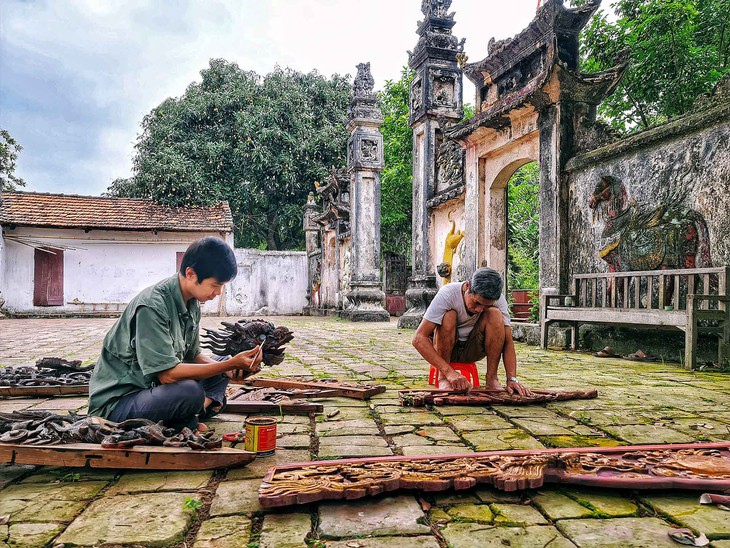
For nearly 20 years, Duc traveled extensively throughout traditional craft villages from North to South Vietnam to learn about, restore, and continue the craft - Photo: Provided by the interviewee.
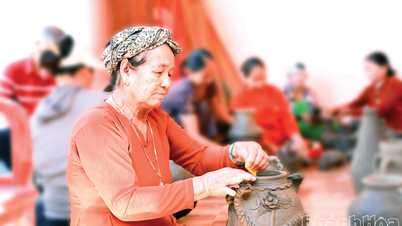
The traditional craft of making papier-mâché masks continues with the two remaining artisans and the help of Duc. He says that if those two stop doing it in the future, he will take over the business. Duc believes the market is easier now than it used to be, with schools and organizations holding workshops related to traditional crafts, so folk toys will be more attractive.
For nearly 20 years, Duc has traveled back and forth, reaching almost 1,000 traditional craft villages across the country. He has successfully revived many of these villages that had disappeared. Duc's journey continues as many projects are currently being developed.
Why are traditional craft villages in Vietnam declining and gradually disappearing? According to Duc, it could be due to unfavorable living conditions and the burden of making ends meet, forcing them to abandon their crafts and seek other jobs to earn a living.
Source: https://tuoitre.vn/dua-con-nuoi-cua-nhung-lang-nghe-2026052210051243.htm
























































































Comment (0)