

A recent groundbreaking international study not only helps decipher the mechanisms that automatically prevent the spread of major earthquakes, but also opens up a completely new approach to predicting and mitigating seismic risks on a global scale.
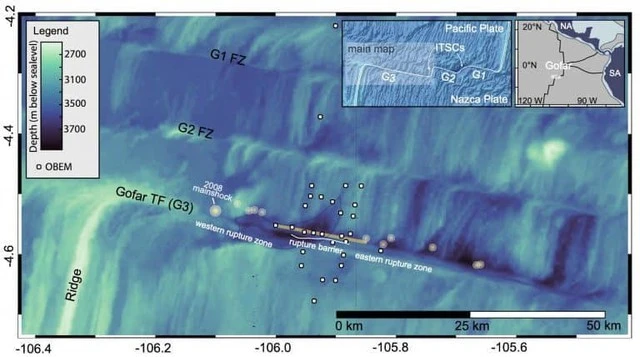
The focus of the research is the Gofar Fault, a fault on the Pacific Ocean floor located about 1,600 km off the coast of Ecuador. For the past 30 years, this area has been a strange phenomenon that has baffled scientists .
Earthquakes are generally unpredictable and difficult to foresee. However, at the Gofar Fault, magnitude 6 earthquakes occur regularly in a cycle of 5 to 6 years, with almost identical locations and intensities.
To find the answer, an international research team led by Dr. Jianhua Gong from Indiana University (USA) conducted an in-depth analysis and published the results in the prestigious scientific journal Science .
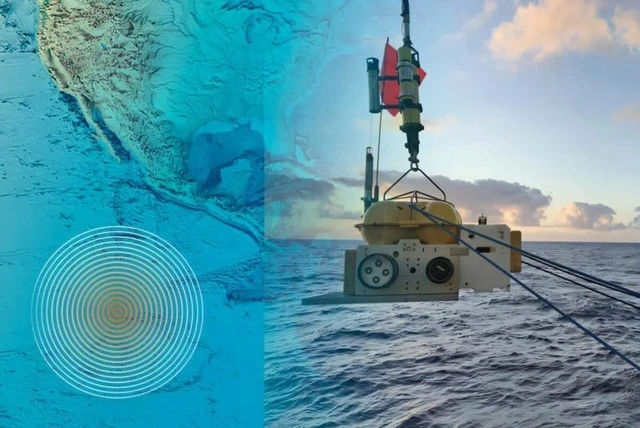
To collect detailed data, scientists conducted two large-scale experiments by placing seismometers on the seabed in 2008 and again between 2019 and 2022. Through these experiments, they successfully recorded information on tens of thousands of small tremors occurring around two major earthquake cycles.
Analysis reveals that interspersed between frequently seismically active fault lines are highly specific "barrier zones." Before a major earthquake erupts, these barrier zones are highly active, producing a series of small, successive tremors.
However, immediately after the main earthquake ended, they became almost completely quiet. This phenomenon repeated consistently over two cycles separated by 12 years, helping researchers determine their true operating mechanism.
According to the study, these barrier regions are not solid, monolithic blocks of rock, but rather a complex fault system. Here, the main fault splits into many smaller branches with horizontal deviations ranging from 100 to 400 meters.
This unique structure allows seawater to penetrate deep into the porous fracture system. When fault waves from a major earthquake strike, the fluid pressure within the rock drops abruptly, triggering a physical process called "expansionary consolidation" that temporarily hardens the rock.
This effect acts as a natural "braking system," halting the propagation of seismic faults before they can develop into a more devastating disaster. Dr. Gong shared that while scientists have long known about the existence of these barriers, their true structure and why they reliably prevent earthquakes across cycles have only recently been clarified.
Geologically, the Gofar Fault lies right on the boundary between the Pacific and Nazca tectonic plates, where the two plates slide past each other at a rate of about 14 cm per year. Although far from land and posing little direct risk to humans, this discovery holds immense scientific significance on a global scale.
Deformation faults with similar characteristics to Gofar are present in many other ocean regions around the world . Understanding this natural "braking" mechanism helps explain why many underwater earthquakes often stop at a certain limit without reaching the maximum scale that geological conditions allow.

Funded by the U.S. National Science Foundation and the Canadian Council for Natural Sciences and Engineering Research, this research marks a significant leap forward for Earth science in unraveling one of nature's longest-standing mysteries.
In the future, researchers hope these results will significantly improve earthquake prediction models, especially in fault zones located near densely populated coastal areas.
Source: https://baolaocai.vn/tim-ra-he-thong-phanh-tu-nhien-giup-ngan-cac-tran-dong-dat-lon-post900196.html




![[Image] Close-up view of the interchange connecting the two expressways and Long Thanh Airport.](https://vphoto.vietnam.vn/thumb/1200x675/vietnam/resource/IMAGE/2026/05/25/1779703378210_ndo_br_z7863716673926-224453a31600126cce10622af6290afd-4549-jpg.webp)
![[Image] Hanoi's urban life under the challenge of a "scorching hot" environment](https://vphoto.vietnam.vn/thumb/1200x675/vietnam/resource/IMAGE/2026/05/25/1779706979265_nang-nong-t5-2026-minh-duy-7-4636-jpg.webp)

























































































Comment (0)