

Our Party has always affirmed that political theory education is not only a process of transmitting knowledge, but also a process of forming a scientific worldview and methodology, fostering political acumen and practical capabilities for cadres and Party members. Currently, the world and domestic situations are undergoing rapid and complex changes; hostile forces are intensifying their subversive activities on the ideological and theoretical fronts. This creates an urgent need to innovate the teaching of political theory in a way that connects theory with practice and promptly updates the Party's new viewpoints.
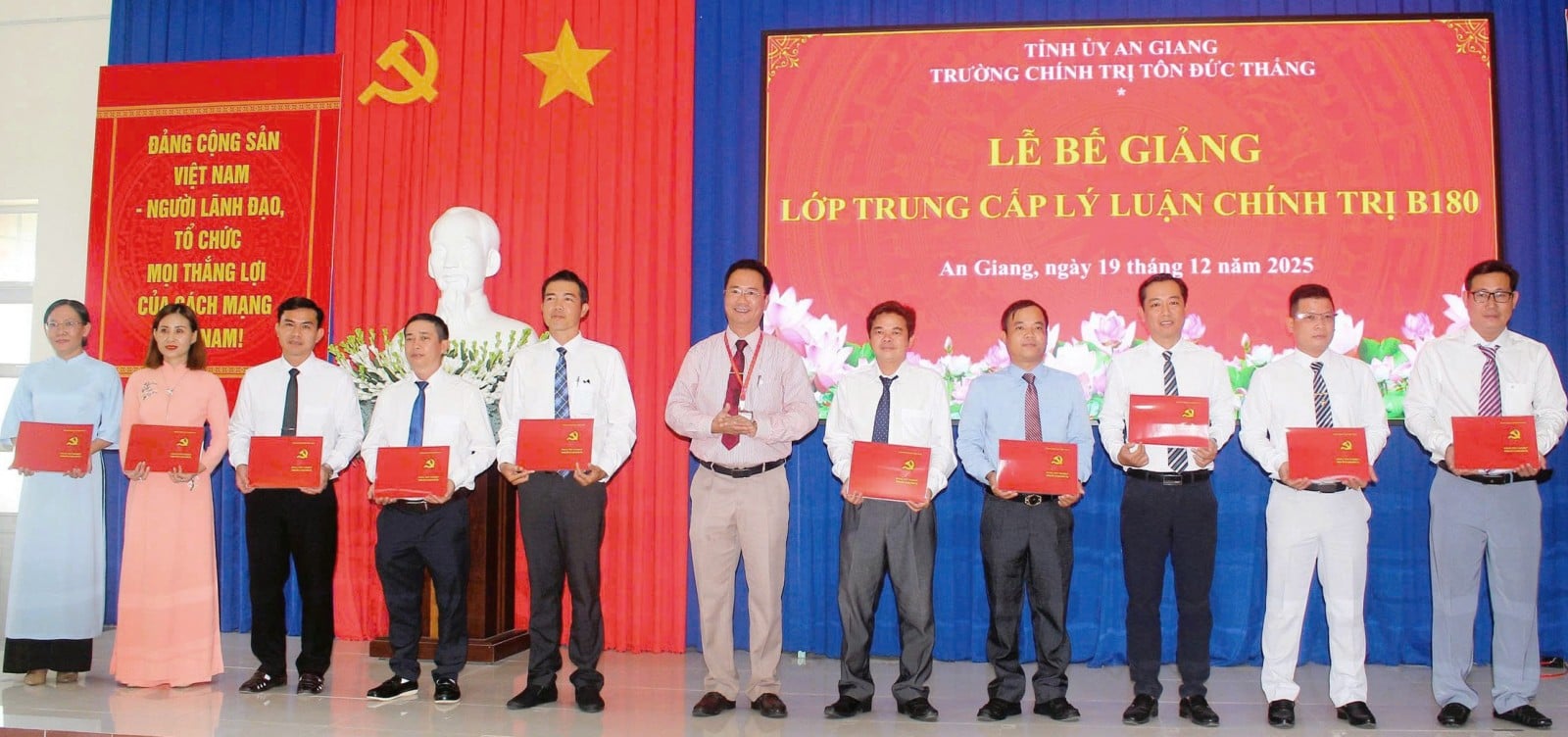
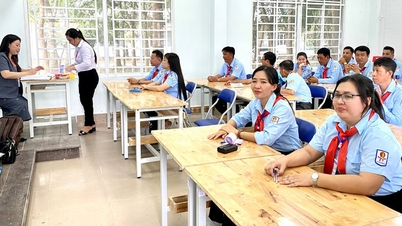
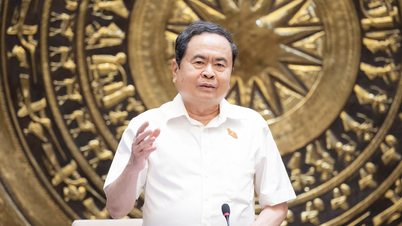
Ton Duc Thang Political School holds closing ceremony for the B180 intermediate-level political theory course. Photo: Phuong Lan.
According to Dr. Chu Van Huong, Vice Principal of Ton Duc Thang Political School, despite the achievements, the teaching methods of political theory at the school have sometimes been slow to innovate. The connection to local realities has not been truly profound or vivid. For a locality with many unique characteristics like An Giang, teaching needs to be closely linked to the practical development of the border economy , ethnic and religious affairs, and the current demands of digital transformation. This requires that teaching political theory not only stop at transmitting theory, but must also be closely linked to practice, aiming to enhance critical thinking skills and the ability to apply theory to solve specific problems at the grassroots level. Through this, students will not only "understand" but also "apply" the knowledge, meeting the requirements of their tasks in the new situation.
In response to that need, the Ton Duc Thang Political School recently organized a school-level scientific conference on the topic: "Applying the viewpoints of the 14th National Congress of the Party and the documents of the An Giang Provincial Party Congress in teaching the current intermediate-level political theory program." The conference focused on clarifying the consistency between the Central Committee's guiding principles and local realities; evaluating the current state of applying these documents in teaching; and proposing solutions to innovate the content and methods of training to improve the quality of political theory learning.
The delegates focused on analyzing three key issues: the theoretical and practical value of the Party Congress documents; the consistency between the Central Committee's policies and the requirements of local development; and the integration of content on combating erroneous and hostile viewpoints into political theory teaching. One issue of particular interest to many delegates was the innovation of teaching methods aimed at promoting student initiative and creativity. According to Ms. Duong Thi Bich Thuy, Deputy Head of the Party Building Department at Ton Duc Thang Political School, lecturers need to promote student initiative and creativity by reducing one-way lectures and increasing active learning methods. Group discussions, policy analysis, and problem-based learning will help students develop independent thinking skills. In particular, case study methods should be prioritized, transforming the classroom into a place to simulate practical situations in state management or local socio-economic development.
Incorporating "real-life scenarios" from An Giang province into lectures is considered a crucial solution to enhance training effectiveness. These scenarios could include issues related to border trade development, exploiting marine economic advantages, regional linkages after administrative unit mergers; building a comprehensive national defense posture in border areas; developing cultural and spiritual tourism linked to ecological conservation; or implementing sustainable agricultural programs. "Through analyzing practical situations, trainees will better understand how to apply the Party's policies to solve specific problems in leadership and management at the grassroots level. This makes political theory lectures more lively, practical, and relevant to reality," said Ms. Duong Thi Bich Thuy.
Closely linking theory with practice not only helps improve the quality of cadre training but also contributes to quickly putting the Party's resolutions into practice, creating a transformation in the awareness and actions of cadres and Party members at the grassroots level.
PHUONG LAN
Source: https://baoangiang.com.vn/dua-thuc-tien-vao-bai-giang-ly-luan-a485942.html
































































Comment (0)