

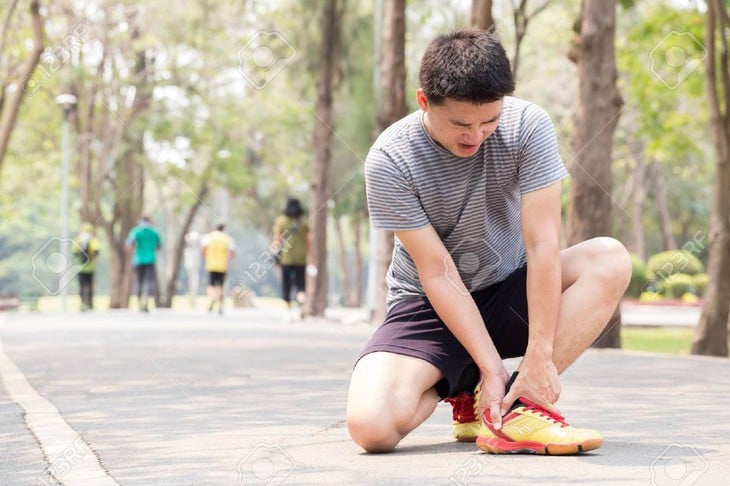
The road surface is very important for the performance of running and walking workouts - Photo: TK
The journal Foot & Ankle Specialists offers advice on choosing the right running surface. From a scientific perspective, different surfaces affect the body as follows:
Hardness and force absorption: Hard surfaces like concrete or asphalt absorb less force, resulting in greater stress on muscles and joints upon landing. Conversely, softer surfaces like grass or natural dirt trails absorb force better, reducing pressure on muscles and joints.
Stability and Injury Risk: Uneven or slippery surfaces can increase the risk of injury due to loss of balance or falls. Therefore, choosing a flat, stable surface with appropriate friction is essential to ensure safety.
Sensory feedback and performance: The road surface affects the feel of landing and force feedback, thereby impacting running or walking performance. Some athletes prefer hard surfaces because they provide better force feedback, helping to increase speed, while others prefer soft surfaces to reduce stress on muscles and joints.
According to an article on Runner's World , choosing the right running surface can help reduce the risk of injury and improve the training experience.
However, no single surface is perfect for everyone. Varying and combining different surfaces during training can help the body adapt and reduce the risk of repetition injuries.
Users should consider factors such as the firmness, stability, and tactile feedback of the surface, and listen to their bodies to make adjustments accordingly.
However, paved sidewalks are still not the ideal surface for jogging due to several drawbacks from a scientific perspective:
1. High stiffness - Increases the risk of injury
Paving bricks are typically laid on a concrete or cement base, which is highly rigid and has poor shock absorption.
When running on this surface, the impact force from the feet on the ground is reflected more strongly, increasing pressure on the knees, ankles, and spine. The risk of injury due to overuse is increased, especially when running long distances or at high intensity.
2. Unstable friction - Prone to slipping.
When it rains or the surface is wet, paving stones can become slippery, increasing the risk of slips and falls on sidewalks. Some types of paving stones have smooth or moss-covered surfaces that can cause loss of control upon landing.

Running on paved sidewalks or cobblestone streets can easily lead to injuries - Photo: TTO
3. Uneven - Causes imbalance
Sidewalk paving stones aren't always perfectly smooth; they can become uneven, cracked, or misaligned over time. Running on a rough surface increases the risk of sprains, dislocations, or loss of balance while running.
If there are no other options, you can jog on paved sidewalks, but be careful, choose shoes with good shock-absorbing soles, and avoid overly slippery areas. Softer surfaces like dirt roads, grass, or rubber are better for your joints and muscles.


![[Photo] Prime Minister Pham Minh Chinh attends the Conference on the Implementation of Tasks for 2026 of the Industry and Trade Sector](/_next/image?url=https%3A%2F%2Fvphoto.vietnam.vn%2Fthumb%2F1200x675%2Fvietnam%2Fresource%2FIMAGE%2F2025%2F12%2F19%2F1766159500458_ndo_br_shared31-jpg.webp&w=3840&q=75)






























































































Comment (0)