

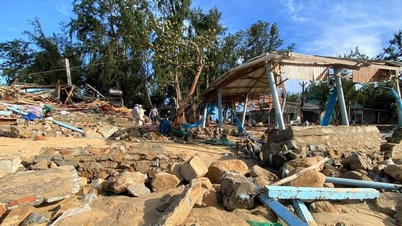
In many sections of road near Ben Loi Bridge (Dong Hoa area), thick mud covers everything, and the erosion marks are deep, like the mouths of a raging stream. But on that layer of soil, one can see the footprints of children imprinted in small streaks.
The children go to school along roads littered with fallen leaves, broken pieces of wood, waterlogged bamboo, and even corrugated iron roofs that have been swept away from somewhere.
Some wore sandals with broken straps, others went barefoot because their small sandals had been swept away by the flood.
The boy in the white shirt had faded to a muddy color, clutching his schoolbag wrapped in a plastic bag, as if it were a fragile treasure.
The children's small figures stood amidst the vast and chaotic space, yet each step they took exuded an extraordinary resilience.
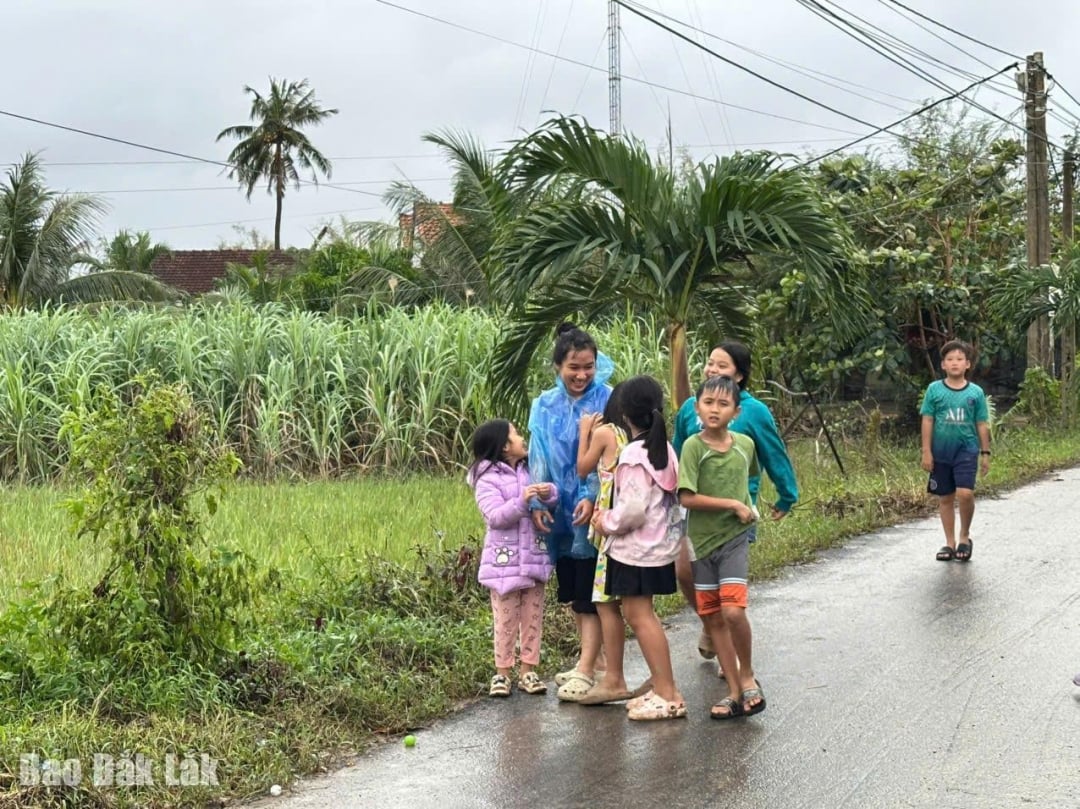 |
| Students from Tay Nguyen University encourage students in flood-affected areas to overcome difficulties and continue their studies. |
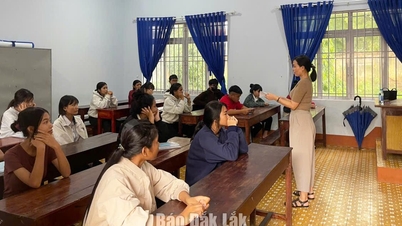
Schools in many places haven't been cleaned up yet; classrooms still have thick layers of mud at the base of the walls, windows covered in moss, and desks and chairs tilted. But the children still come to school. They don't mind that their classrooms aren't clean, the blackboards haven't been wiped, or their books haven't dried after days of sun exposure. They only know that "being able to go to school" after the flood is the most important thing.
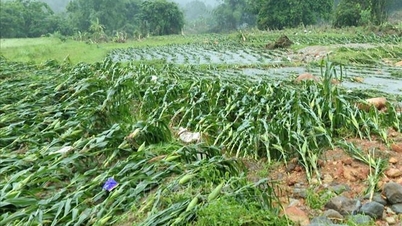
In the western areas of the province, the journey to school after the floods was equally arduous. The road to Cu Pui commune was deeply eroded by the water, resembling a trench, and had to be hastily filled with earth. The section from the center of Krong Bong commune to Hoa Son commune was blocked by rocks rolling down from upstream, forming large mounds. Small streams near Yang Mao commune, which were previously easy to cross, still flowed fiercely. Yet, the children still overcame all obstacles to get to school. Some had to walk along the edge of the rocks, while others took a detour through coffee plantations to arrive in time for class.
As the early winter sun shone on the schoolyard, the still-wet rows of desks and chairs were neatly stacked in the corner by the adults to dry.
Teachers, parents, soldiers, and local militia all sat together, scraping away the grime from the blackboards and gathering up wet notebooks to dry. And then, when the school reopened, those familiar sounds suddenly became the warmest melodies.
The shuffling of sandals on the muddy cement, the crunching of dry leaves underfoot, the rustling of chairs and tables being rearranged, the sounds of teachers organizing new textbooks… all blend together to create a new rhythm of life in a land that has just recovered from storms and floods.
The children, though still haggard after many sleepless nights fighting the flood alongside their parents, sat upright, their eyes shining like stars. They opened their crumpled notebooks and began writing, line by line. If nature could destroy one path, then those very strokes of the pen had opened another – a path of hope and knowledge.
The road to school after the flood is not just a simple journey. It's a return of hope. Every child's footprint on the mud carries the warmth of the future. Areas where houses were swept away, livestock lost, and crops damaged… still stand strong because of children like them – who know how to overcome the mud to find knowledge, who know how to use their innocent eyes to soothe the pain of their families, who know how to make a morning after the flood less burdensome. Therefore, the road to school after the flood is not just a road for children. It is the road of the entire homeland, the heartbeat of life, and proof that even after overcoming danger, there is always a way to start again.
Source: https://baodaklak.vn/xa-hoi/202512/duong-den-truong-sau-lu-58706ce/
![[Photo] Solemn bathing ceremony and Buddha procession in Hue](https://vphoto.vietnam.vn/thumb/1200x675/vietnam/resource/IMAGE/2026/05/31/1780228263543_1-jpg.webp)
![[Photo] The General Secretary, President and his wife begin their state visit to the Philippines.](https://vphoto.vietnam.vn/thumb/1200x675/vietnam/resource/IMAGE/2026/05/31/1780230559452_anh-man-hinh-2026-05-31-luc-19-28-11.png)


![[Photo] Admire the coral "masterpiece" amidst the million-year-old heritage of Dak Lak province.](https://vphoto.vietnam.vn/thumb/1200x675/vietnam/resource/IMAGE/2026/05/31/1780221235105_anh-man-hinh-2026-05-31-luc-16-53-27.png)












![[Video] Sunset at Lap An Lagoon – Where the sun sets over the fishing nets](https://vphoto.vietnam.vn/thumb/340x192/vietnam/resource/IMAGE/2026/05/31/1780192137701_beach-landscape-sea-water-nature-grass-745871-pxhere-com.jpeg)






































![[Photo] Admire the coral "masterpiece" amidst the million-year-old heritage of Dak Lak province.](https://vphoto.vietnam.vn/thumb/402x226/vietnam/resource/IMAGE/2026/05/31/1780221235105_anh-man-hinh-2026-05-31-luc-16-53-27.png)





































Comment (0)