

On April 30, 1975 , the victory of the Ho Chi Minh Campaign ushered in a new era for our nation: the era of independence, unification, and socialist construction. The North focused on overcoming the consequences of war, restoring and developing the economy with many positive results. Meanwhile, in the South, agricultural , industrial, and handicraft production activities were gradually rebuilt, and sectors such as culture, education, and health gradually stabilized. In this context, the Vietnamese oil and gas industry also quickly adapted to a new phase of development. Even before the war ended, Western oil companies had discovered oil and gas on the southern Vietnamese continental shelf. Therefore, immediately after the fighting ceased in Saigon on April 30, 1975, Geological Survey Team B was assigned to take over the General Directorate of Oil and Minerals of the former government administratively. According to Mr. Nguyen Hiep, former Deputy General Director of the Vietnam National Oil and Gas Corporation: “Before the liberation of South Vietnam, oil and gas activities were very small-scale and scattered, under the management of the General Department of Geology and the General Department of Chemicals. After the liberation of South Vietnam, the Government immediately sent experts, including Mr. Ngo Thuong San and Mr. Ho Dac Hoai, who were among the first to go to the South and collect documents left by Westerners about oil and gas exploration activities on the continental shelf of South Vietnam. These documents were quickly compiled and reported to the leadership.” On August 6, 1975 , the Government of the Democratic Republic of Vietnam issued a declaration promoting oil exploration and exploitation throughout the territory and territorial waters of Vietnam, while calling for cooperation with foreign governments and companies. On August 9, 1975, the Politburo of the Central Committee of the Communist Party of Vietnam adopted Resolution No. 244/NQ-TW, focusing on oil and gas exploration nationwide. This resolution emphasized the strategic importance of Vietnam's oil and gas industry. According to Mr. Nguyen Hiep, just two months after the liberation of South Vietnam on April 30, 1975, the Politburo met to discuss oil and gas issues. Despite facing numerous pressing issues such as security, order, and the livelihoods of tens of millions of people in South Vietnam, the Politburo still paid special attention to the oil and gas sector. Based on available documents, we know that several Western companies, particularly Mobil, had discovered commercially valuable gas and oil on the Vietnamese continental shelf. With a sense of urgency, on August 9th, the Politburo issued a Resolution on oil and gas, creating a "common thread" running throughout the history of the industry's development from then until now.
Source: https://www.pvn.vn/chuyen-muc/tap-doan/tin/4251bb79-e27e-4d29-9ab7-00f1a922f837
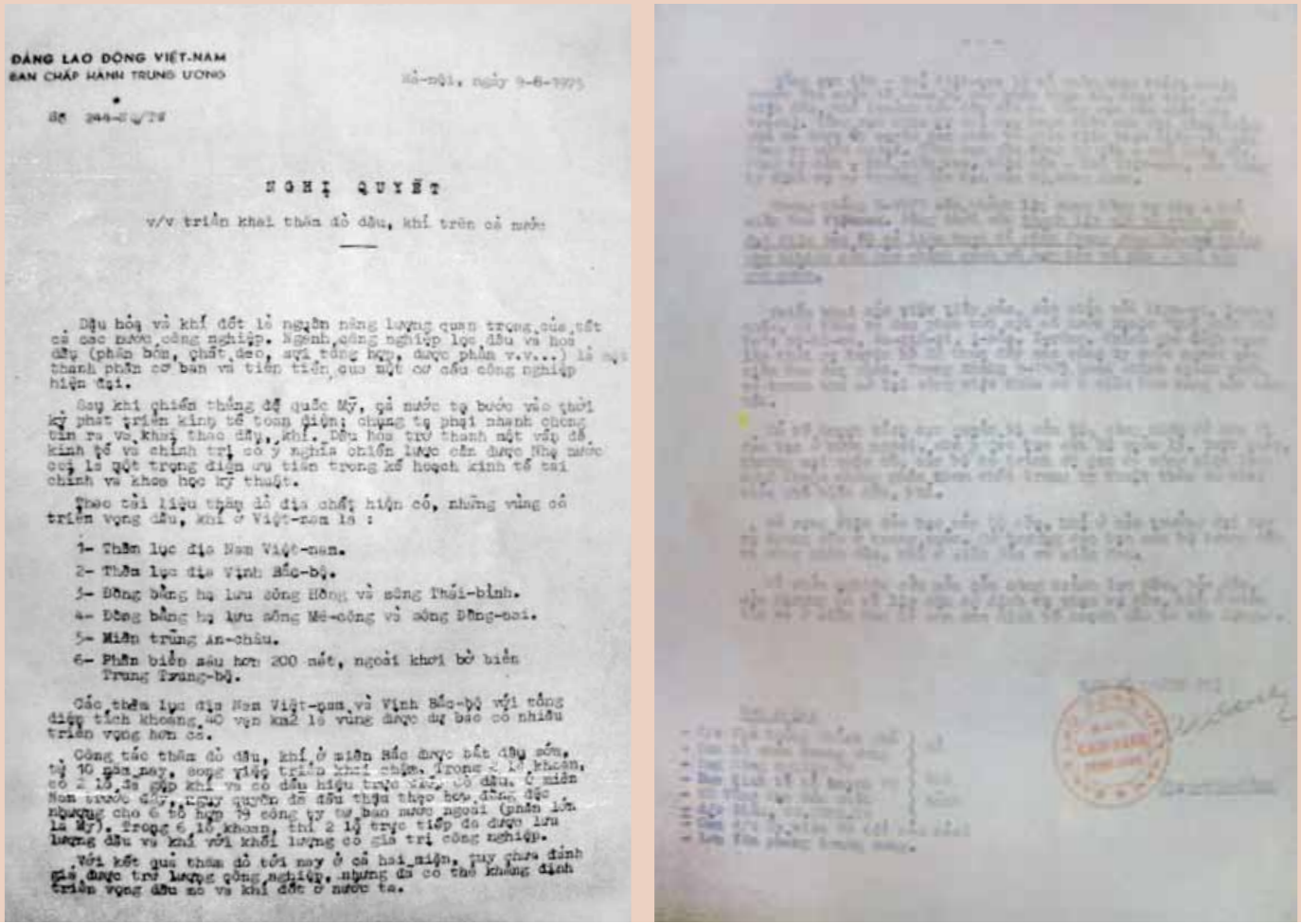
Resolution No. 244-NQ/TW dated August 9, 1975. (Archival photo)
Immediately following the Politburo's resolution, on August 20, 1975 , the Standing Committee of the National Assembly approved Resolution No. 33/NQ-QH-K5, officially establishing the General Department of Oil and Gas of Vietnam. This General Department operated independently of the General Department of Geology and the General Department of Chemicals, undertaking oil and gas exploration nationwide, especially on the southern continental shelf. In September 1975, the General Department of Oil and Gas was established, bringing together oil and gas officials from all units into a single organization. Many, originating from the oil and gas hub of Thai Binh, packed their bags and headed south, towards the sea to seek new energy sources. The first headquarters of the General Department of Oil and Gas was located at 48 Nguyen Thai Hoc Street, Hanoi. For generations of oil and gas workers, the memory of this small building and the image of the pioneers will always live on in their hearts. Initially, the Vietnam National Oil and Gas Corporation (VNPC) signed contracts with three foreign companies: Bow Valley (Canada), Agip (Italy), and Deminex (Germany). From 1978, these companies drilled 12 exploratory wells on the southern continental shelf. Although some wells found oil, they assessed the potential as not significant. Due to Vietnam's embargo at the time, purchasing exploration equipment was difficult, leading to the companies' withdrawal in 1980. Bach Ho is a name very familiar to those working in the oil and gas industry in particular, and to a segment of the Vietnamese population in general. But few know that Bach Ho – the key oil field that determined the success or failure of Vietnam's oil and gas industry – was discovered before April 30, 1975. Looking out over the East Sea, Vietnam has a vast continental shelf, and many were certain that it contained oil and gas resources… As the Vietnam War neared its end, the international oil companies withdrew. The White Tiger (Bạch Hổ) lay dormant at the bottom of the sea for over a decade until it emerged with untold secrets... In mid-April 1980, the idea of establishing a Vietnamese-Soviet joint venture on the basis of equality and loan support for the Vietnamese side was officially announced. On June 19, 1981, in Moscow, Vietnamese Deputy Prime Minister Tran Quynh and Soviet Deputy Chairman of the Council of Ministers KF Katusev signed the "Agreement between the Government of the Socialist Republic of Vietnam and the Government of the Union of Soviet Socialist Republics on the establishment of a Vietnamese-Soviet joint venture to conduct geological exploration and oil and gas exploitation on the southern continental shelf of the Socialist Republic of Vietnam." On November 19, 1981 , the Vietsovpetro joint venture was officially licensed by the Vietnamese Government to operate on the continental shelf and within the exclusive economic zone of the Socialist Republic of Vietnam. This is a very important milestone in the history of the formation and development of Vietsovpetro in particular and the oil and gas industry in general. Recounting this historic moment in 1984, Mr. Dang Cua (former Deputy Head of Federation 36, former Director of Petrovietnam 2 Company, former Deputy General Director of Vietsovpetro Joint Venture) showed us the report letter he sent to the Director General of the General Department of Oil and Gas, Nguyen Hoa, back then, which he still keeps as a memento. “On April 29, 1984, at 7:15 PM, there was a sudden heavy rain and strong winds, reaching 28 gusts. Due to the suddenness, the dynamic anchoring system signaled a drilling halt and the rig had to be pulled up... On April 27, drilling expanded to the sampling section... On April 28, 1984, we waited for the next sample test, which was expected to be more promising... April 27, 1984 was the date the Ekhabi rig began drilling well BH-4. And at 8 PM on April 30, 1984, exactly 9 years after the Liberation of South Vietnam, Vietnamese and Soviet experts on the drilling ship Mikhail Mirchin discovered the oil layer. “I held the oil sample and I was trembling, very trembling, so happy. My life's quest for oil was finally here, the oil was just trickling out, I was so happy, I was shaking all over.” "Comrade Nguyen Hoa reported that during the oil well test on May 21st, oil burst forth, illuminating the entire East Sea, declaring to the world that Vietnam has oil," Mr. Dang Cua said, his voice trembling with emotion, as if suddenly transported back to that historic moment. At 9 PM on May 26, 1984, this oil layer was officially identified as commercially viable, and the first flare ignited off the coast of Vung Tau, bringing good news to the whole country.

On May 24, 1984, the vessel Mikhail Mirchin discovered a commercial oil flow at well BH-5 in the Bach Ho oil field. (Archival photo)
The poet To Huu, then Vice Chairman of the Council of Ministers, while accompanying a delegation to visit the Ekhabi oil rig and witnessing the results of the reservoir testing, wrote a poem about the flame that illuminated the entire Vietnamese economy: " It is said that long ago, in the underwater palace, there was a princess of unparalleled beauty, waiting for her prince to arrive today, magnificent and majestic, a blazing fire ." Through tireless efforts and assistance from the Soviet Union, the oil and gas industry gradually overcame the crisis. Those oil and gas flames burning on the open sea that year became a symbol of the will and determination of the oil and gas workers, opening up a hopeful future for the Vietnamese economy.Tr.L
![[Image] 20 islands in the Spratly Islands special administrative region hold early elections.](https://vphoto.vietnam.vn/thumb/1200x675/vietnam/resource/IMAGE/2026/03/08/1772949669607_img-20260308-112026-90-jpg.webp)

![[Image] Vietnam's diverse colors on its journey of innovation](https://vphoto.vietnam.vn/thumb/1200x675/vietnam/resource/IMAGE/2026/03/09/1773041390813_anh-man-hinh-2026-03-09-luc-14-28-17.png)
















![[Photo] Diary of the photojournalism contest “Vietnam on the journey of innovation”](https://vphoto.vietnam.vn/thumb/1200x675/vietnam/resource/IMAGE/2026/03/09/1773041117692_anh-man-hinh-2026-03-09-luc-14-24-45.png)





























































Comment (0)