

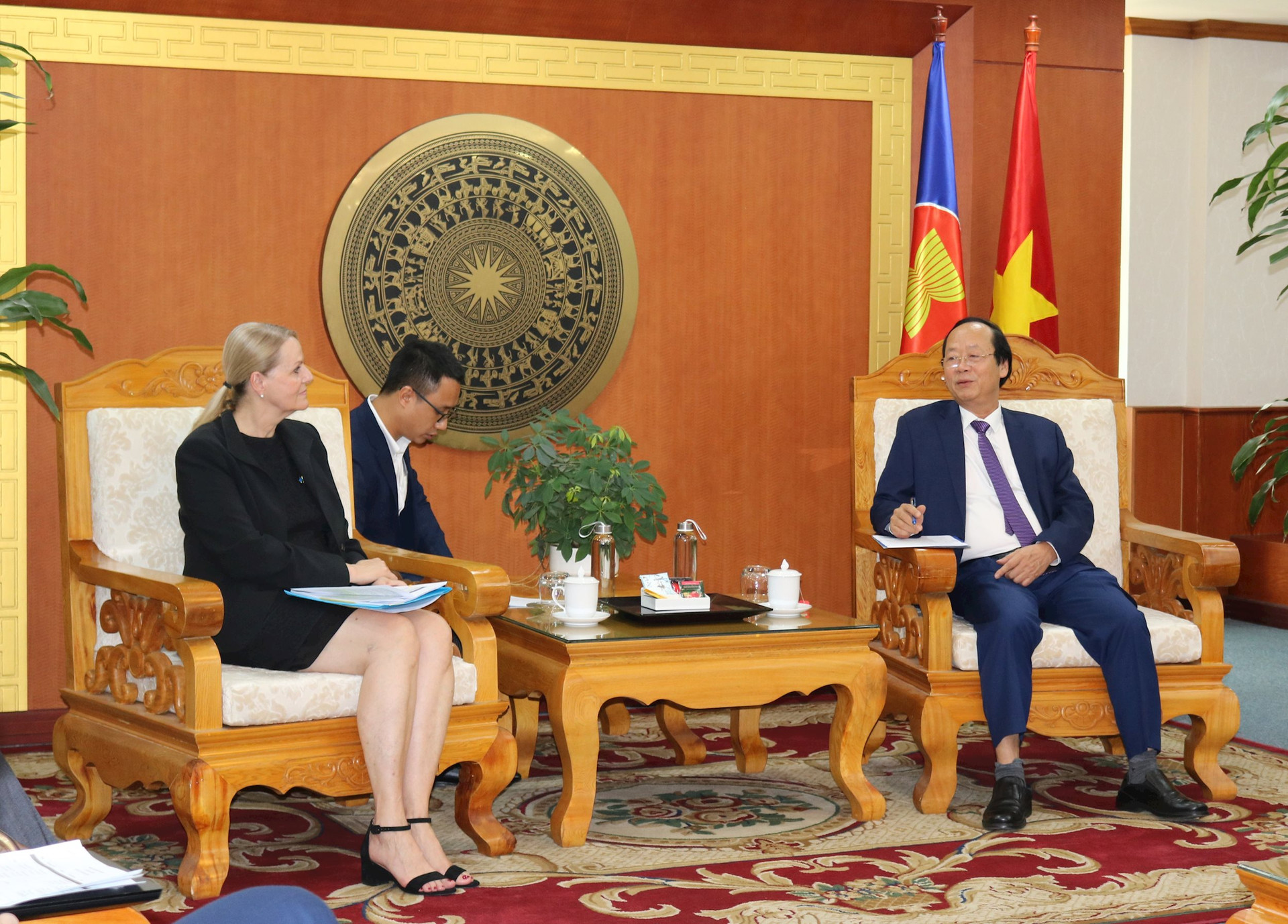
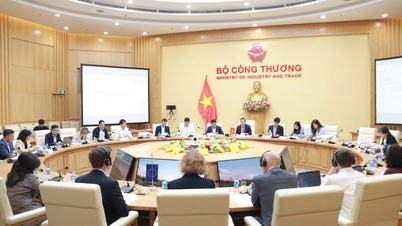
Welcoming Ms. Florika Fink-Hooijer to Vietnam for a visit and working trip, Deputy Minister Vo Tuan Nhan highly appreciated the EU's support for the natural resources and environment sector in recent times, and expressed his hope that the EU and Vietnam would continue to cooperate closely to address common issues such as developing a circular economy , reducing emissions, responding to climate change, and conserving nature and biodiversity.
Vietnam is serious about reducing emissions and transitioning to a green environment.
Regarding specific details, the Deputy Minister stated that the circular economy has been incorporated into domestic law in the 2020 Environmental Protection Law. By June 2022, the Prime Minister approved the Circular Economy Development Plan in Vietnam, with the specific goal of reducing greenhouse gas emission intensity per GDP by at least 15% by 2030 compared to 2014, aiming for net emissions of "zero" by 2050.
To achieve this goal, the Deputy Minister requested the EU's support for Vietnam in accessing knowledge, skills, and resources for developing a circular economy through specific pilot projects on the circular economy; projects on environmentally friendly technologies and services; reviewing and improving the policy and legal framework to create a complete legal environment for the development of the circular economy; and strengthening public-private dialogue on the development of the circular economy.
Along with promoting the circular economy, Vietnam is also seriously implementing emission reduction through green transformation in various sectors, most notably energy transformation. The Deputy Minister stated that the Government's approval of the Power Development Plan VIII, with its strong focus on renewable energy development, clearly demonstrates Vietnam's strong determination to achieve net-zero emissions. The Prime Minister has also decisively directed the Ministry of Natural Resources and Environment to develop a national marine spatial plan to facilitate the development of clean energy sources. The Ministry of Natural Resources and Environment will also issue green criteria for economic sectors; based on these criteria, there will be tools for green finance and green credit... “This is a policy impetus to support businesses in green production and green growth,” the Deputy Minister emphasized.
Sharing about Vietnam's efforts in combating ocean plastic waste, Deputy Minister Vo Tuan Nhan affirmed that, in recent years, Vietnam has always played a pioneering role in committing to and taking decisive action to minimize ocean plastic pollution and is one of the leading countries in supporting the idea and proposal to build a legally binding global agreement to address the issue of plastic waste pollution in general.
It is understood that the future agreement is expected to be a legally binding international instrument. The Ministry of Natural Resources and Environment, as the lead agency assigned by the Prime Minister, is coordinating with relevant ministries and agencies to review current legal documents, develop plans, scenarios, and negotiation perspectives based on the principles of the 2016 Law on International Treaties, ensuring national interests and suitability to the country's development conditions, and taking into account the perspectives of countries with similar conditions and levels of development. These plans will then be submitted to the Prime Minister for approval.
"Regarding this matter, the Ministry of Natural Resources and Environment requests the EU to pay attention to and support Vietnam in establishing a database on plastics, as a foundation for research and analysis of impacts and policies that need to be adjusted when participating in negotiations; and to support the sharing of experiences in building policy mechanisms and transferring technologies related to the treatment and recycling of plastic waste in general and marine plastic waste in particular," the Deputy Minister said.
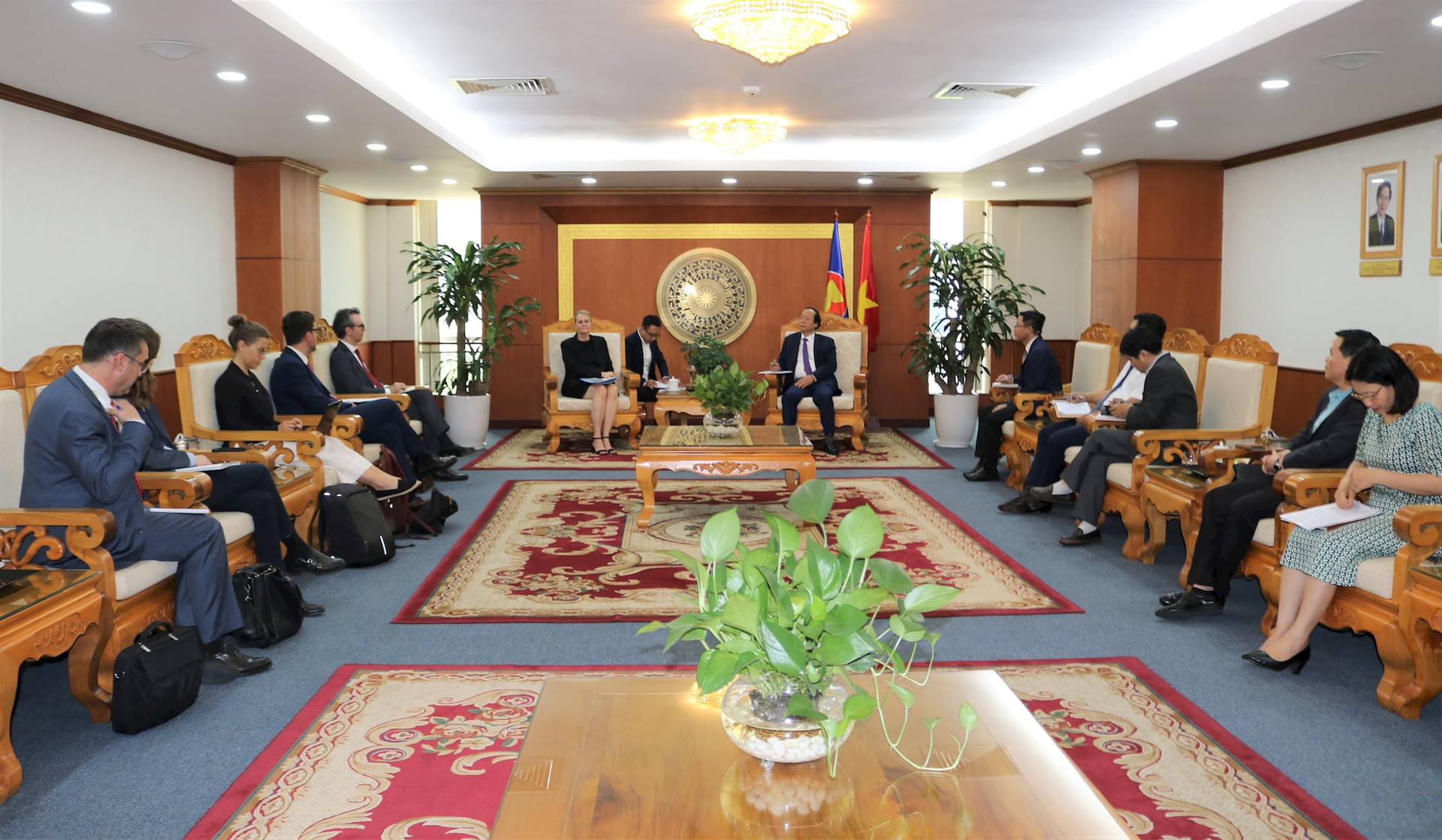
Commitment to international cooperation in biodiversity conservation.
During a discussion with Ms. Florika Fink-Hooijer on biodiversity conservation, Deputy Minister Vo Tuan Nhan stated that Vietnam is one of 12 biodiversity hotspots and one of 16 countries with the highest biodiversity globally, possessing rare and valuable genetic resources. However, like many countries worldwide, Vietnam is facing biodiversity degradation along with other significant challenges such as the Covid-19 pandemic, environmental and water pollution, land degradation, ocean plastic waste, and the extreme impacts of climate change.
In response to these challenges, in January 2022, the Vietnamese Government approved the National Strategy on Biodiversity to 2030, with a vision to 2050, demonstrating the Vietnamese Government's strong determination in the conservation of biodiversity and the restoration of natural ecosystems throughout Vietnam.
Internationally, Vietnam joined and became a full member of the Convention on Biological Diversity in 1994. Notably, at the 15th Conference of Parties to the Convention on Biological Diversity in Canada at the end of 2022, as the Head of the Vietnamese Delegation, the Deputy Minister supported the adoption of the Kunming-Montreal Global Biodiversity Framework.
“The numerous commitments that Vietnam has made and is participating in once again clearly demonstrate the responsibility and determination of the Vietnamese Government in the conservation of biodiversity and the restoration of natural values. However, I believe that to reverse the degradation of biodiversity, in addition to the commitments of our leaders, we need initiatives and fundamental solutions to the challenges we are facing,” Deputy Minister Vo Tuan Nhan expressed.
Based on the information shared by the Deputy Minister, Ms. Florika Fink-Hooijer highly appreciated Vietnam's efforts in environmental protection and climate change adaptation. Ms. Florika Fink-Hooijer affirmed that the EU is always ready to share and cooperate with Vietnam in its green transition. Accordingly, Vietnam needs to promote sustainable business models, improve people's livelihoods, ensure food security, and achieve sustainable development goals.
Source
![[Photo] Prime Minister Pham Minh Chinh presides over the conference announcing the establishment of the International Finance Centre in Vietnam.](/_next/image?url=https%3A%2F%2Fvphoto.vietnam.vn%2Fthumb%2F1200x675%2Fvietnam%2Fresource%2FIMAGE%2F2025%2F12%2F21%2F1766309817714_ndo_br_dsc-3400-jpg.webp&w=3840&q=75)

![[Photo] Prime Minister Pham Minh Chinh presides over a meeting on private sector economic development.](/_next/image?url=https%3A%2F%2Fvphoto.vietnam.vn%2Fthumb%2F1200x675%2Fvietnam%2Fresource%2FIMAGE%2F2025%2F12%2F20%2F1766237501876_thiet-ke-chua-co-ten-40-png.webp&w=3840&q=75)

























































Comment (0)