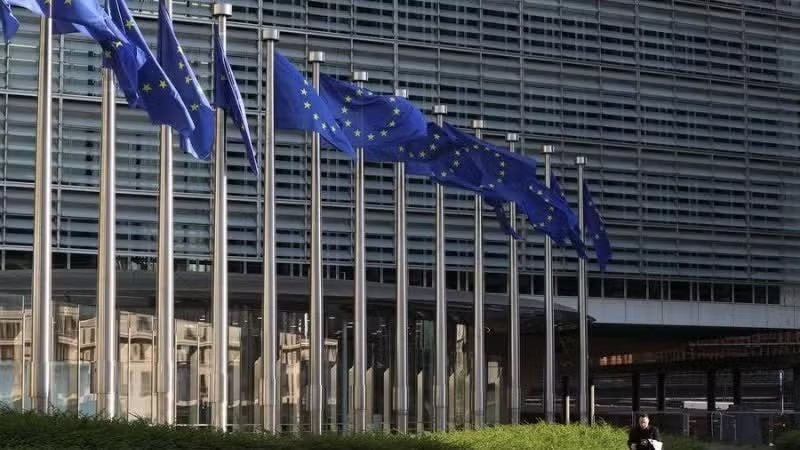
This is a carefully calculated move in the strategy to reshape trade and energy routes connecting Europe with Central Asia, amidst profound shifts in global geopolitics .
The event was announced at a ministerial meeting co-chaired by three European Commissioners: Commissioner for Enlargement Marta Kos, Commissioner for International Partnerships Jozef Síkela, and Commissioner for Sustainable Transport Apostolos Tzitzikostas.
The conference brought together transport ministers and high-ranking representatives from EU member states, as well as Armenia, Kazakhstan, Kyrgyzstan, Moldova, Tajikistan, Turkmenistan, Türkiye, Ukraine, and Uzbekistan, alongside representatives from the G7 and international financial institutions.
The core of this initiative is the Trans-Caspian Transport Corridor – a route seen as a strategic alternative in the context of the conflict in Ukraine, which has disrupted many traditional trade routes passing through Russian territory.

The participating parties agreed to enhance the operational efficiency of this corridor and invited the EC to conduct a comprehensive assessment of its functions, thereby proposing priority actions to improve its competitiveness.
Commissioner Marta Kos stated: "While the conflict is still ongoing, we need reliable trade routes, and the Trans-Caspian Transport Corridor has emerged as precisely that."
Ms. Kos also offered an optimistic forecast, predicting that trade along the route could increase fivefold within the next 15 years. According to her, the new platform will "connect existing projects, fill remaining infrastructure gaps, and link the route from end to end."
Financially, the EC has signed statements of intent with several international financial institutions, planning to raise up to 2 billion euros to invest in transport infrastructure, modernize border crossings, and facilitate trade in the Black Sea and South Caucasus regions.
Commissioner Jozef Síkela emphasized that these investments will directly support the modernization of infrastructure and boost cross-border goods flows. Commissioner Apostolos Tzitzikostas affirmed that a robust transport network is a prerequisite for maintaining economic competitiveness, and stressed that the project will open up new economic opportunities for both the EU and its partners.
The new platform is built on two parallel pillars: on the one hand, creating a framework for participating countries, international financial institutions, and stakeholders to coordinate investment and policy action in the areas of transport, energy, digital connectivity, and trade; on the other hand, helping to minimize dependence on routes passing through the territories of countries deemed "unstable" or "unfriendly"—a clear signal of Brussels' geopolitical orientation.
According to the plan, thematic meetings dedicated to energy connectivity and digital connectivity will be held in the second half of this year, continuing to implement the commitments agreed upon at this conference.
Source: https://nhandan.vn/eu-xay-hanh-lang-thuong-mai-moi-noi-chau-au-voi-trung-a-post971068.html

![[Photo] Prime Minister Le Minh Hung presides over the thematic session on promoting science and technology development and innovation.](https://vphoto.vietnam.vn/thumb/1200x675/vietnam/resource/IMAGE/2026/06/23/1782207872934_ndo_br_dsc-1724-jpg.webp)


















![[Infographic] Cristiano Ronaldo: The first player to score in 6 World Cups](https://vphoto.vietnam.vn/thumb/402x226/vietnam/resource/IMAGE/2026/06/24/1782279244766_chatgpt-image-jun-24-2026-11-56-56-am-jpg.webp)