
Oliver Bearman narrowly escaped death at the Suzuka racetrack (Japan) - Photo: AP
From the life-or-death situation in Oliver Bearman's accident in Japan, to the exhaustion of the drivers, to the retirement threat from champion Max Verstappen.
Legal loopholes
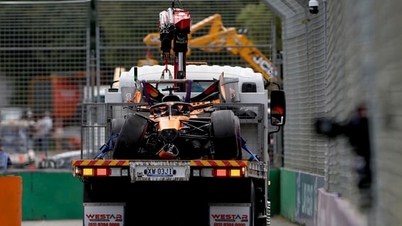
Oliver Bearman's (Haas team) horrific accident at the Suzuka circuit (Japan) was not a personal error but an inevitable consequence of the new 2026 regulations. While speeding at 307 km/h towards the Spoon corner (a high-speed corner at Suzuka), Bearman suddenly collided with Franco Colapinto's Alpine, which was moving very slowly.
The speed difference left Bearman with no choice but to swerve onto the grass and endure a violent crash into the barrier. The car was wrecked, but luckily he escaped unharmed. The cause lay in the new generation hybrid system. The electric motor provided a massive 350kW of power, but the actual braking time on the racetrack was insufficient to recharge the battery (energy recovery).
To overcome this, drivers are forced to deliberately decelerate abruptly in certain sections to recharge (super-clipping). The unpredictable speed difference between a car accelerating and one deliberately slowing down to recharge is a potential risk.
Former F1 technical director Gary Anderson warns that the sport could soon face a real tragedy. Bearman's survival was partly due to the spacious safety zone at Suzuka. But on narrow street circuits, surrounded by thick concrete walls like those in Baku, Singapore, or the upcoming Las Vegas circuits, the consequences will be catastrophic.
The Guardian argues that the new technical regulations of the International Automobile Federation (FIA) are putting drivers in a dangerous position.
The risk of losing the symbol.
Not only are they facing imminent danger, but the current drivers are also being exhausted from within. Physical fitness is no longer the biggest obstacle due to the cars' slower overall speed compared to last year. And mental exhaustion is reaching alarming levels.
Legendary driver Jacques Villeneuve and champion Damon Hill both agree that driving a 2026 F1 car is like "simultaneously rubbing your stomach, patting your head, juggling, and solving mathematical equations."
The drivers were overwhelmed by the constant task of manipulating countless buttons, monitoring the charging system, and calculating energy allocation strategies. Young driver Liam Lawson admitted he was completely "empty and mentally exhausted" after the race in Japan.
Even more concerning, the discontent has reached a peak as world champion Max Verstappen has publicly considered leaving F1 at the end of this year. Finishing eighth in the struggling Red Bull car at Suzuka, he candidly shared that the new regulations are robbing him of the joy of racing.
"Having to deliberately slow down to recover energy makes F1 lose the essence of a pure motorsport ," Verstappen said bitterly. Thanks to the cancellation of the races in Bahrain and Saudi Arabia, F1 was fortunate to have a five-week gap before the next race in Miami (USA) to address this issue.
McLaren team principal Andrea Stella believes that changing the power-to-electric ratio from 50-50 to 70-30 would require redesigning the fuel tank to be larger. However, this risks displeasing major automakers like Audi and Honda, partners who have agreed to return to F1 thanks to its environmentally friendly regulations.
Formula 1 is at a crossroads: stubbornly upholding commercially driven rules or urgently changing them to save safety and retain its top drivers. The FIA's decision in the coming weeks will be historic, determining the success or failure of the world's fastest motorsport.
Why are 2026 Formula 1 cars more prone to accidents?
The problem that makes the 2026 F1 generation dangerous lies in the imbalance of the new engine system, which splits power equally between gasoline and electricity, with 50% going to gasoline and 50% to electricity.
Due to the extremely high power output that was depleted after only about 11 seconds of maximum throttle, and the fact that the natural braking time in corners was too short for the car to recharge the battery, the drivers were put in an ironic situation.
To maintain power for the vehicle, they are forced to release the accelerator and slow down abruptly, even on high-speed straight stretches, so that the system can recharge the battery.
This kind of "emergency" driving inadvertently creates a death trap, because on the same stretch of road, a car speeding at over 300 km/h could suddenly encounter a car driving slowly ahead simply because it was busy charging.
This large and unpredictable speed difference leaves the driver behind with no time to react. It turns the car in front into an extremely dangerous obstacle that could cause a catastrophic accident at any moment.
THANH DINH
Source: https://tuoitre.vn/f1-dung-truc-quyet-dinh-lich-su-20260401073137235.htm


![[Photo] National Assembly Chairman Tran Thanh Man working with the Standing Committee of the Law and Justice Committee](https://vphoto.vietnam.vn/thumb/1200x675/vietnam/resource/IMAGE/2026/05/21/1779378929214_ndo_br_1-4610-jpg.webp)



![[Photo] General Secretary and President To Lam presides over a working session with the Central Policy and Strategy Committee on the development of the materials industry.](https://vphoto.vietnam.vn/thumb/1200x675/vietnam/resource/IMAGE/2026/05/21/1779359935432_a3-bnd-3129-1412-jpg.webp)
























































































Comment (0)