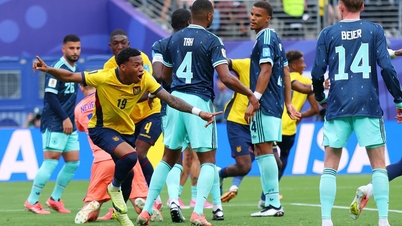
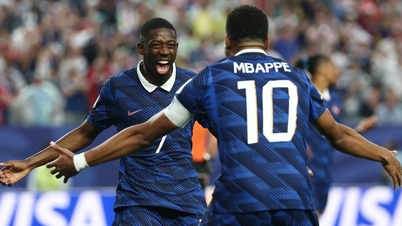
The two goals against Austria not only secured Argentina's place in the knockout round but also brought Messi's total goals at the 2026 World Cup to five after two matches. In a tournament expected to belong to a new generation, a veteran nearing 40 has become the brightest star.
The 2026 World Cup is becoming a special tournament for "time machines" – players who seem immune to the laws of aging. While young talents like Lamine Yamal, Jamal Musiala, and Endrick represent the future of world football, Lionel Messi, Cristiano Ronaldo, Luka Modric, Manuel Neuer, and Guillermo Ochoa are still present, playing and influencing at the highest level.
According to FIFA statistics, this is one of the World Cups with the highest number of players aged 40 and over in history. Craig Gordon of Scotland became the oldest player in the tournament at 43 years old. Cristiano Ronaldo turned 41 but remained the leader of Portugal. Manuel Neuer, Luka Modric, Guillermo Ochoa, and Edin Dzeko have all reached or exceeded 40 years old but are still capable of competing in the world's most demanding tournament.
The World Cup is often seen as a stage for youth. It's where new talents emerge, young stars establish themselves, and the next generation writes a new chapter for world football. However, at the 2026 World Cup, amidst the countless young faces breathing life into the tournament, there are still those who seem to defy the laws of time.
Most notably among them is Cristiano Ronaldo. At 41 years old, the Portuguese captain has become the oldest player ever to start a World Cup match. That record is not simply a number. It reflects the extraordinary journey of a player who has participated in six consecutive World Cups, from Germany in 2006 to North America in 2026.
Like Ronaldo, Lionel Messi is participating in his sixth World Cup. If Ronaldo is a symbol of ageless ambition, then Messi is turning the 2026 World Cup into a final symphony of genius.



Before the tournament began, many believed it would be just a farewell tour for the Argentinian star. But what has unfolded on the pitch is proving otherwise. After two group stage matches, Messi has scored all five of Argentina's goals, including a hat-trick against Algeria and a brace against Austria. He not only secured the defending champions' place in the knockout round but also set an unprecedented milestone in World Cup history by becoming the tournament's top scorer with 18 goals.
While Messi is shining in attack, many other veterans continue to prove their worth in positions that demand experience and composure.
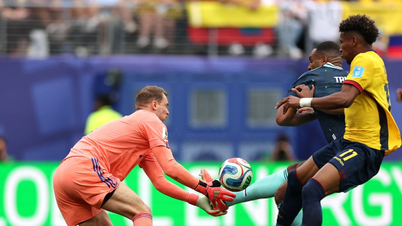
Luka Modric, at 40, remains the mastermind behind Croatia's play. Manuel Neuer continues to be a reliable last line of defense for Germany. Guillermo Ochoa is still present in goal for Mexico in his sixth World Cup appearance. Craig Gordon, now 43, has even become the oldest player to feature in this year's tournament.
The common thread among these players is not just their age. They represent a generation of footballers who have extended their careers to unprecedented levels. While previously, playing at the highest level at 35 was considered a feat, now players nearing or past 40 are still capable of competing in the world's most demanding league.
 |
| Messi surpasses other players, setting a new goalscoring record at the World Cup - Photo: OneFootball |
Modern sports science , rigorous nutrition, recovery technology, and professional lifestyles have completely changed the concept of a footballer's career lifespan. Ronaldo is famous for his grueling physical training. Messi scientifically controls his exercise load. Modric maintains incredible fitness through a personalized training regimen over many years. Their success is not a miracle, but the result of thousands of days of persistent hard work.
In a short tournament like the World Cup, where pressure can crush any young player, experience becomes an invaluable asset. Messi, Ronaldo, Modric, and Neuer have played hundreds of top-level matches, experiencing both victories and defeats. They know how to control their emotions, when to accelerate, and when to maintain the team's rhythm. Therefore, the 2026 World Cup is not only a showcase for the new generation but also a confirmation that time is not always an enemy of legends. And while this may be the last World Cup for many legends, before the curtain closes, they are proving that age is sometimes just a number, as these "time machines" are still running powerfully.


Early tomorrow morning, football fans will have another chance to witness the "time machines" of world football take to the field at the 2026 World Cup. The spotlight will be on superstar Cristiano Ronaldo's performance as Portugal faces Uzbekistan at midnight on June 24th. Three hours later, England will take on Ghana in a crucial match that will significantly impact Group L. At 6 AM, all eyes will be on the clash between Croatia and Panama, where veteran Luka Modrić continues his World Cup quest at the age of 40.
Dang Trieu
Source: https://baodaklak.vn/van-hoa-xa-hoi/the-thao/202606/fifa-world-cup-2026-nhung-co-may-thoi-gian-57e7096/
![[Image] Schools organize meetings and introduce teaching models to students admitted to grade 10.](https://vphoto.vietnam.vn/thumb/1200x675/vietnam/resource/IMAGE/2026/06/25/1782368077271_ndo_br_z7970052192242-1ec8daeb77a6eed1a4e9f58c564ddd3e-jpg.webp)

![[Image] Ho Chi Minh City: Ma Lang area, Chicken-Rice Market about to change its appearance](https://vphoto.vietnam.vn/thumb/1200x675/vietnam/resource/IMAGE/2026/06/25/1782377698627_ndo_br_m1-jpg.webp)
![[Photo] General Secretary and President To Lam receives Palestinian Ambassador Saadi Salama](https://vphoto.vietnam.vn/thumb/1200x675/vietnam/resource/IMAGE/2026/06/25/1782365384740_a1-bnd-9423-8322-jpg.webp)