In 1992, along with many other households, Mr. Ly Hong Dien, residing in Kinh Nam hamlet, was allocated 4 hectares of land in the buffer zone by the government for cultivation. “Back then, this area was covered in reeds and thick vines, requiring a lot of time and effort to clear. However, after clearing the land, it became acidic and saline, making rice cultivation ineffective. Many households couldn't make it and either left or moved elsewhere. Gradually, later on, the government dredged more canals to remove the acidity and salinity, making cultivation easier,” Mr. Dien said.
Mr. Danh Chênh, residing in Công Sự hamlet, recounted: “When we first received the land, most of the men set up temporary shelters by the canal to live in and cultivate the land. Every month, we would paddle back home to resupply with food, and only when things were basically stable would we bring our wives over to live with us. Life was incredibly difficult back then, lacking everything. Every evening we had to crawl into mosquito nets because there were so many mosquitoes. It was so hard that out of the four households next to mine, two couldn't stay.”
According to Mr. Chênh, to survive, many households caught freshwater fish and snakes, then paddled boats to sell them. However, in the past, there were so many that few people bought them. Transportation was only by paddling or rowing boats; it took half a day to get from here to Thu Muoi Mot or Vinh Thuan. Labor Hero, Colonel Banh Van Dodm - former Head of the Project for the Household Economic Model in the U Minh Thuong Buffer Zone - said that during the period of 1990-1992, after their backgrounds were checked and deemed good, people were allowed to move to the buffer zone and were allocated 4 hectares of land per household to develop their economy. To support the people in farming, the State dredged more than 20 canals, both horizontal and vertical, to remove acidity. This process lasted more than 5 years, helping people grow sugarcane, bananas, rice, vegetables, and raise shrimp and fish...
Starting from a point of immense difficulty, the diligent hands and unwavering will of the people have persistently reclaimed and improved the land, boldly transformed production models, and applied science and technology to develop the economy. As a result, life has become increasingly prosperous, with many households becoming well-off, building spacious houses, and their children receiving a full education.

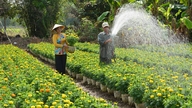

Farmers in the U Minh Thuong buffer zone harvest bananas to sell to traders. Photo: THUY TIEN
Previously, Mr. Danh Mưu, residing in Trung Đoàn hamlet, cultivated bananas on the embankment combined with fish farming, yielding a relatively high harvest. However, years of cultivation gradually reduced soil fertility, so he and other local residents began researching and learning from models in neighboring areas and switched to planting bananas and lotus in combination with fish farming. “Initially, I was hesitant, but after visiting and seeing the success of those who had done it before, I decided to renovate nearly 2 hectares of land to grow lotus. To date, the model has developed sustainably, bringing in an income of over 200 million VND/hectare/year,” Mr. Mưu shared.
For example, Mr. Nguyen Van Tien, residing in Minh Kien A hamlet, cultivates 6 hectares of ginger, earning over 400 million VND per year; Mr. Nguyen Hoang Duong, residing in Cong Su hamlet, has 2 hectares for shrimp farming and banana cultivation, earning approximately 300 million VND per year; Mr. Ly Hong Dien, residing in Kinh Nam hamlet, has nearly 2 hectares for banana cultivation, fish farming, and ecotourism , earning nearly 400 million VND per year…
Economic development has led to a flourishing rural landscape. Notably, rural roads in the U Minh Thuong buffer zone have been paved with asphalt and concrete, facilitating trade and travel for residents even during the rainy season. Irrigation has also received significant investment, enabling people to diversify their crops and livestock to better serve market demands… “Now, electricity, roads, schools, and health stations are all in place. Many brick houses with tiled roofs are springing up, significantly improving people's material and spiritual lives,” affirmed Mr. Luu Hoang Tuoi, a resident of Cong Su hamlet.
According to the People's Committee of U Minh Thuong commune, the buffer zone is currently focusing on developing integrated multi-cropping models such as vegetables, fruit trees combined with fish farming, rice-fish farming, shrimp-banana farming, etc., bringing significant income to the people. "Since the 2000s, the lives of people in the U Minh Thuong buffer zone have improved significantly, with many households rising from poverty to prosperity. This further confirms that if farmers persevere in their work and production, they will certainly succeed," said Duong Quoc Khoi, Chairman of the People's Committee of U Minh Thuong commune.



THUY TIEN
Source: https://baoangiang.com.vn/gan-4-thap-ky-kien-tao-dat-u-minh-a491248.html