

The Java stork, scientifically known as Leptoptilos Javanicus, is a rare bird species with a population of no more than 10,000 individuals worldwide. It is most abundant in India, Nepal, Sri Lanka, Bangladesh, Myanmar, and Thailand. In Vietnam, this species is only found in the South Central and Southern regions. Besides the name Java stork, it is also known as the wolf stork or wolf heron.
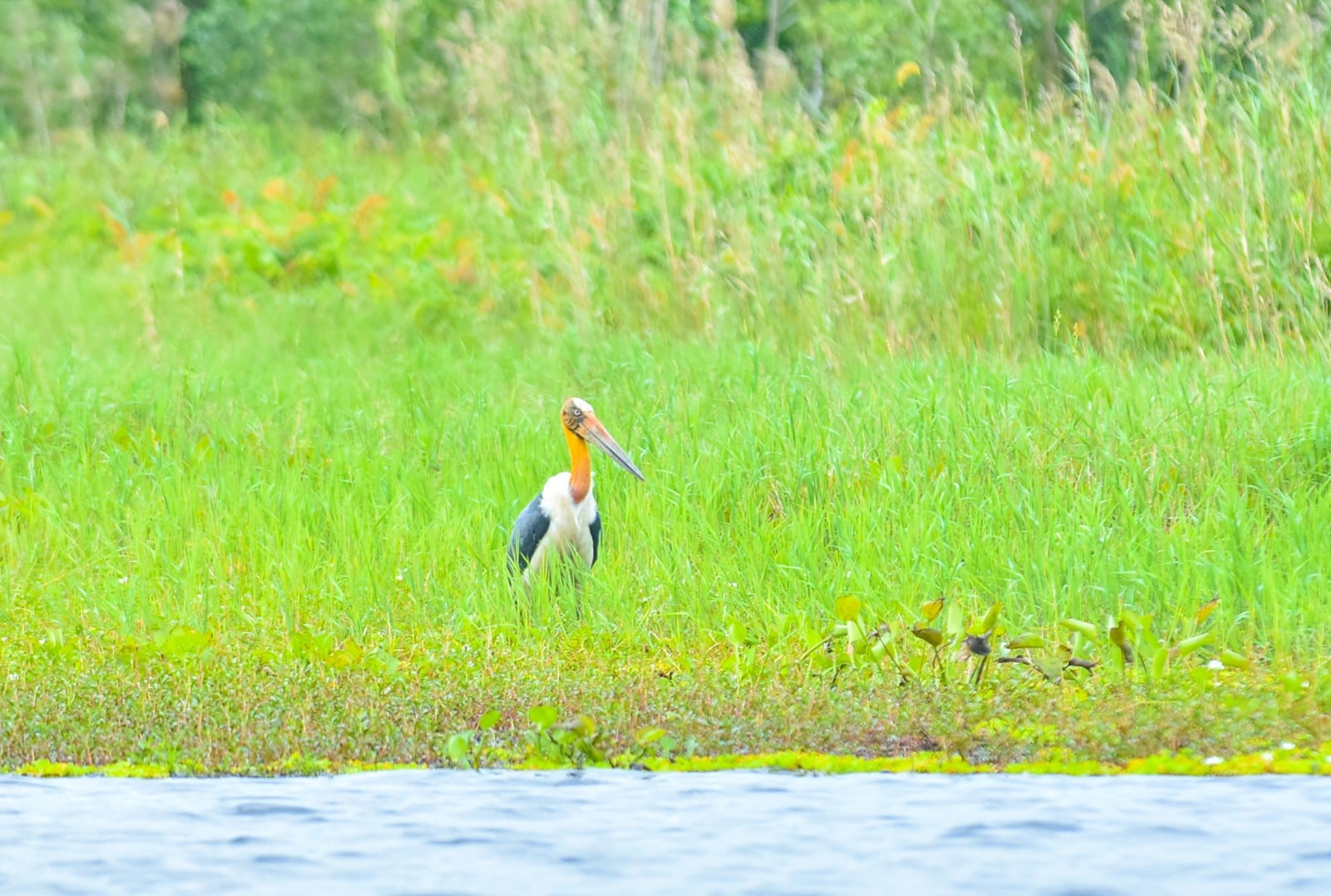 Javanese storks forage in U Minh Thuong National Park. Photo: MINH DIEN
This bird has a peculiar appearance, with a bald head and neck, and little to no brown feathers. Its face, back, wings, and tail are dark green, its belly is white, and its legs are light black. Adult birds reach a height of 1.2 meters and weigh 6-8 kg. Their diet consists mainly of fish, frogs, and small snakes, so their habitat is typically wetlands, swamps, flooded grasslands, forest edges, and coastal areas.
According to Tran Van Thang, Deputy Director of U Minh Thuong National Park, Javanese storks settle and breed here. In 2002, in the melaleuca forest on peatland (an area not affected by fire), the unit discovered 7 nests, of which 4 contained chicks (each nest with 2-4 chicks). Further surveys revealed that 42 Javanese storks were recorded living in U Minh Thuong National Park. By June 2003, the park had recorded 114 individuals, the highest number ever.
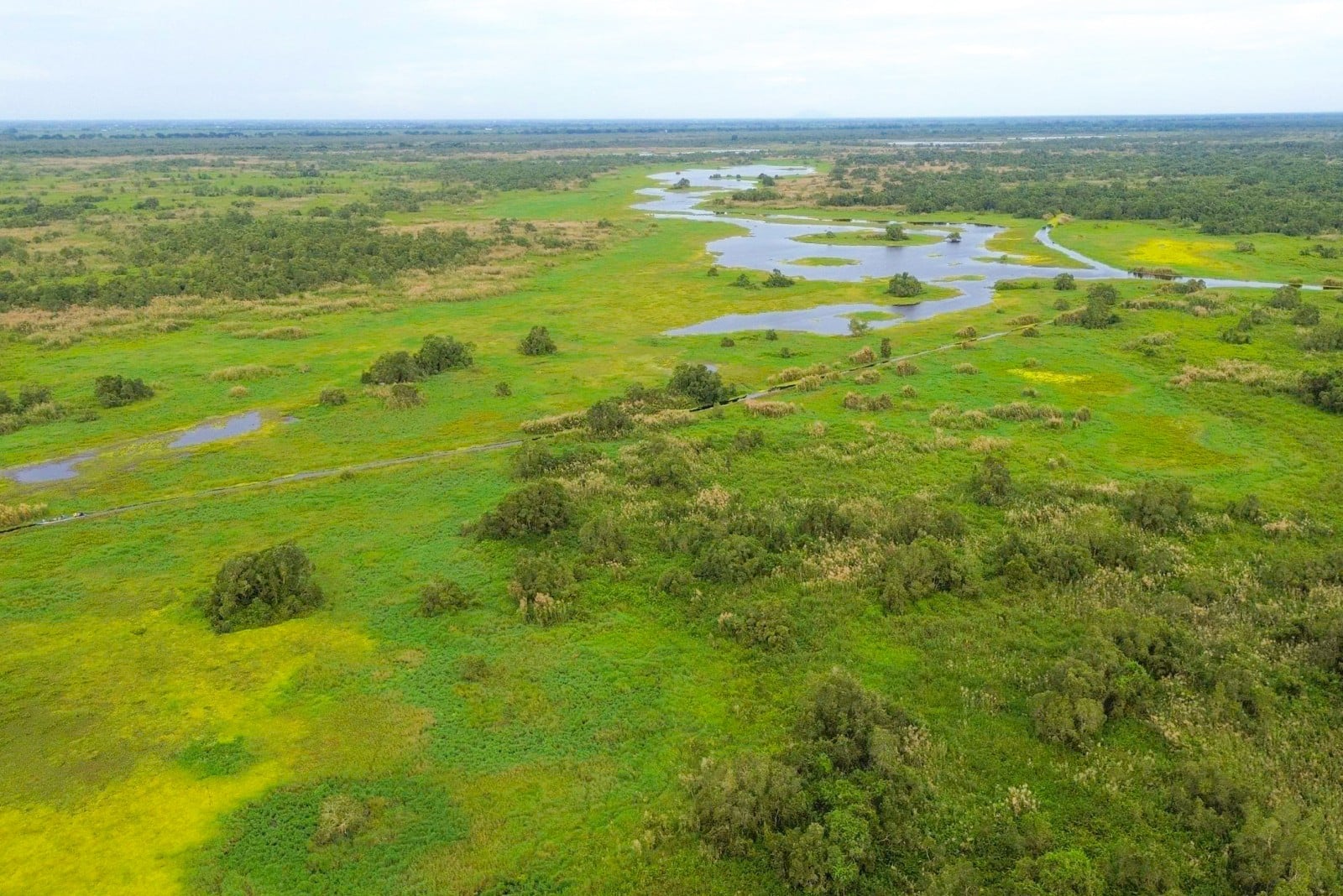
The diverse ecosystem in U Minh Thuong National Park provides an ideal habitat for many animal species. Photo: MINH DIEN
Over time, fewer and fewer Javan storks have been recorded, and the unit has also spotted them less frequently. This is due to shrinking nesting and foraging grounds, or possibly due to forest fires in the Melaleuca forests, which have gradually destroyed the habitat of this bird species. "Recently, U Minh Thuong National Park recorded a Javan stork foraging in a waterlogged area for quite a long time, then flying deep into the vast Melaleuca forest. This is a positive sign, and the unit is striving to continue preserving the diverse ecosystem so that Javan storks, as well as all other species, can live and reproduce more," Mr. Thang said.
Ms. Truong Be Diem, a tour guide at U Minh Thuong National Park, regularly leads tourists on tours of the ecosystem. Previously, she occasionally encountered Javan storks foraging for food. However, in recent years, she hasn't seen them. "This time, it's rare for Javan storks to appear outside searching for food. Perhaps the dense undergrowth deep within the forest makes food difficult to find, so they migrate to open areas. To avoid disturbing the Javan storks, we only observe them from a distance and provide explanations to help tourists learn more about this rare bird," Ms. Diem said.
Mr. Tran Cong Minh said that he and his friends from Ca Mau were fishing in U Minh Thuong National Park when they spotted a Javanese stork at a relatively close distance. At first, he didn't pay attention, thinking it was just a type of heron, but it was quite tame. "Now I know this is a rare and endangered bird listed in the Red Book. Meeting it was lucky, so today I caught more snakehead fish, including a huge spotted snakehead weighing over 5kg," Mr. Minh said with a smile.
| U Minh Thuong National Park has four main ecosystems: Melaleuca forests on peat soil, mixed forests on peat soil, Melaleuca forests on clay soil, and grassland ecosystems. The park is home to approximately 334 plant species, 32 mammal species, 190 bird species, 53 reptile and amphibian species, 33 fish species, and many aquatic animal species. Currently, 57 endangered and rare animal and plant species live there. Regarding birds, the park is home to 6 species listed in the Vietnamese Red Book: Javanese stork, grey-footed pelican, white-necked crane, black-headed white-crowned heron, egret, and lotus heron. |
MINH DIEN
Source: https://baoangiang.com.vn/gia-day-java-xuat-appear-tro-lai-a470383.html
![[Photo] National Assembly Chairman Tran Thanh Man attends the policy seminar to promote Vietnam-Türkiye cooperation.](https://vphoto.vietnam.vn/thumb/1200x675/vietnam/resource/IMAGE/2026/04/16/1776351415367_vna-potal-chu-tich-quoc-hoi-tran-thanh-man-du-toa-dam-chinh-sach-thuc-day-hop-tac-viet-nam-tho-nhi-ky-8705791-jpg.webp)




































































Comment (0)