

Each horn product tells a story of creativity and the spread of the value of the Do Hai horn handicraft craft (Binh Son commune, Ninh Binh province) by young people passionate about national culture.
To date, the Do Hai horn handicraft village has a tradition spanning over a century. Buffalo horns have long been a material closely associated with the daily lives of Vietnamese people. From this, the villagers of Do Hai patiently polish and breathe life into this rough material to create products such as horse whips, ladles, spoons, tea boxes, hat straps, hair combs, hairpins, etc., primarily serving people in Northern Vietnam.
Over the years, the craft of horn carving in Do Hai has not only been a livelihood for the local people but has also become a part of the village's cultural memory.
 |
The public views Do Hai's horn handicraft products at the historical site 22 Hang Buom ( Hanoi ). |
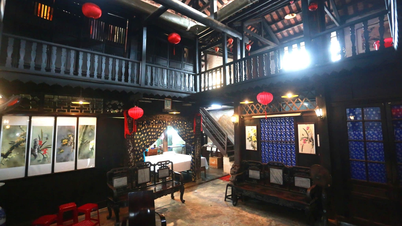
Driven by a love for heritage, a group of young people in Hanoi established the Tam Mot brand (42 Hang Bac Street, Hoan Kiem Ward), partnering with the Do Hai horn handicraft village, focusing on crafting and designing products from buffalo horns. They have continued the story of this traditional craft village. Within the historical space of 22 Hang Buom Street, the Tam Mot booth transports visitors back to the old Do Hai countryside with its red tiled roofs, bitter gourd vines in front of the porch, bamboo pillars, and familiar bamboo blinds.
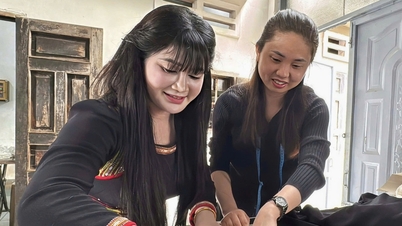
Nguyen Ha Thuong, 24 years old, a member of the Tam Mot brand, shared at the booth: “The most famous of Do Hai's horn handicraft products is the horn comb. To make a complete horn comb, it requires dozens of steps from cutting the horn, heating, flattening, creating the blank... to grinding, polishing, and carving. Each step is important, requiring the craftsman to be skillful, observant, and always innovative to produce diverse products with rich designs.”
The horn handicrafts at the booth stand out not only for their high quality but also for the beauty of their patterns and motifs, such as mother-of-pearl and shell inlay, each possessing a unique charm. Besides horn combs, the public is also introduced to other products such as hairpins, bracelets, picture frames, art prints, and decorative mascots. A special feature of these products is the natural, rustic yet unique and distinctive horn grain, making them highly valuable and practical.
Many visitors, especially young people, expressed surprise at the handcrafted items made from horn, and were interested in learning about the story of the Do Hai craft village and how the artisans transform rough buffalo horns into exquisite products. Nguyen Tra My (19 years old, from Thanh Oai commune, Hanoi) shared: “I am impressed with the hairpins and paintings of women from the feudal era here. The horn hairpins beautifully adorned the hairstyles of women in the past, and through them, I understand more about the history and traditional culture of the Northern Vietnamese countryside. The hairpin today carries an old story but with a more modern design, which perfectly matches the ao dai I am wearing.”
Leaving the Tet atmosphere at the historical site of 22 Hang Buom Street, everyone's hearts felt warmer with joy and hope for the continuation of the lifeblood of Vietnamese traditional crafts. Young people with passion, belief, and creative ways of spreading this heritage will help traditional values affirm their position in today's life.
Source: https://www.qdnd.vn/van-hoa/doi-song/gia-tri-sung-my-nghe-do-hai-1025695

![[Photo] National Assembly Chairman Tran Thanh Man attends the policy seminar to promote Vietnam-Türkiye cooperation.](https://vphoto.vietnam.vn/thumb/1200x675/vietnam/resource/IMAGE/2026/04/16/1776351415367_vna-potal-chu-tich-quoc-hoi-tran-thanh-man-du-toa-dam-chinh-sach-thuc-day-hop-tac-viet-nam-tho-nhi-ky-8705791-jpg.webp)




























































































Comment (0)