

Jean-Baptist Taberd (Vietnamese name: Từ) was born in Saint-Etienne, Loire district (France) on June 18, 1794. Taberd joined the Foreign Missions Society, headquartered in Paris (MEP), and was ordained a priest on July 27, 1817. On November 7, 1820, he left France for Dang Trong (Southern Vietnam) to preach the Gospel. Taberd diligently learned to speak Vietnamese and write in Chinese characters, Nom script, and Latinized Quốc ngữ, with his best learning resource probably being the Annam-Latin Dictionary by Bishop Pigneau de Behaine. Taberd's main focus was on training native missionaries.
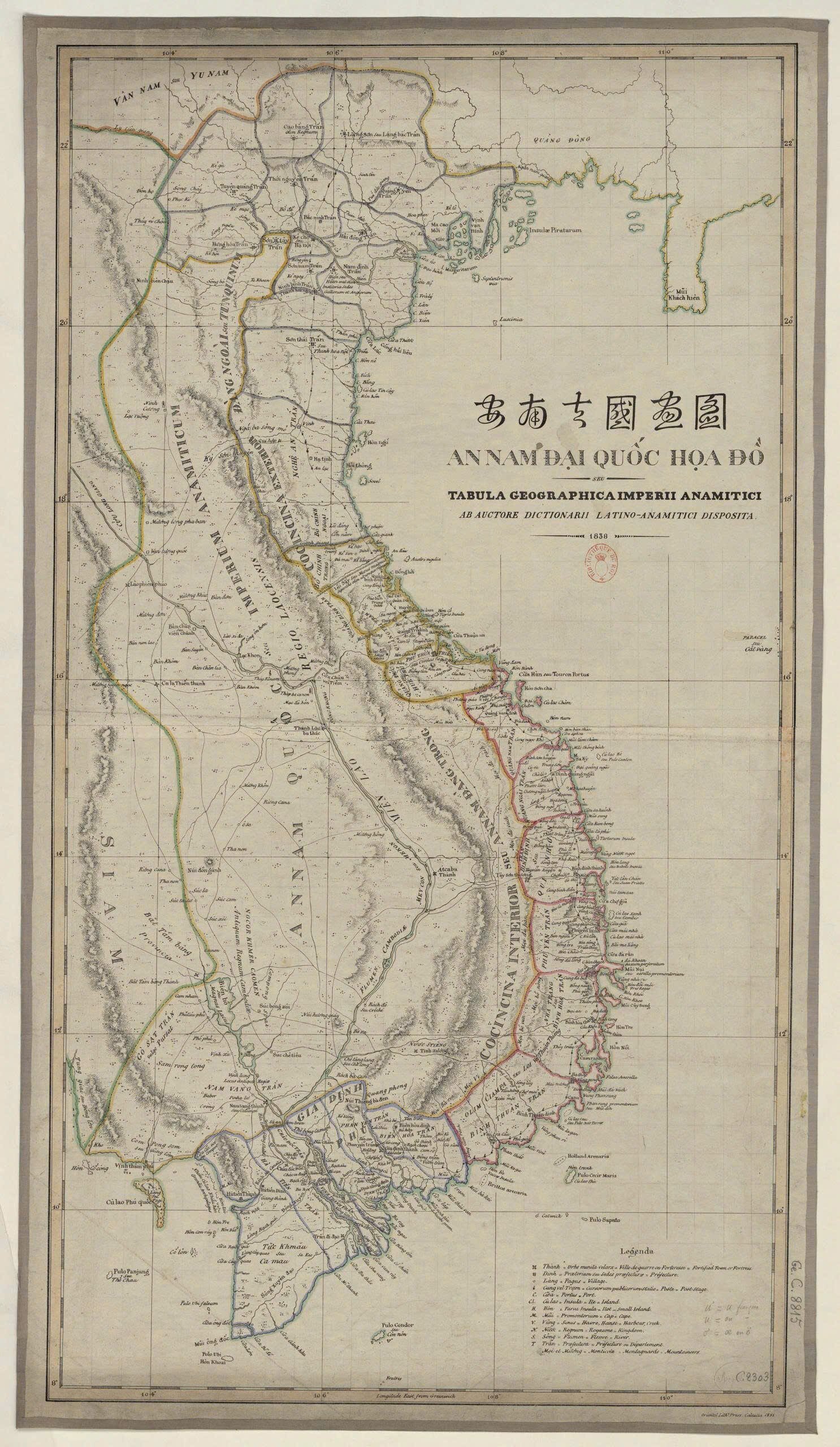
The 1788 map bears the inscription “R. de Saigon” [Saigon River].
Photo: National Library of France
At the end of 1827, Governor-General Le Van Duyet of Gia Dinh returned to the capital to pay homage to Emperor Minh Mang. Taberd met him twice. In March of the following year (1828), when Le Van Duyet returned to his post, on June 1st, the three missionaries Taberd, Gagelin, and Odoric were allowed to leave Hue and go to Gia Dinh.
A map fully documenting the place names of contemporary Vietnam.
The An Nam Dai Quoc Hoa Do ( An Nam Great Map) – a remarkable work by Taberd. Up until its publication in 1838, our country had never had a map as large, comprehensive, and detailed in its geographical descriptions as this one. Analyze and compare it with the Dai Nam Nhat Thong Toan Do (Dan Nam Unified Map) (1840), an official map of the Minh Mang dynasty.
Place names on the Taberd 1838 map are all written in Chinese characters, while the ANĐQHĐ map uses Latinized Vietnamese, including both administrative and colloquial names, plus place names given by foreign countries. For example: Thạch Bi Mountain (in Chinese) has the colloquial name Mũi Nại (in Vietnamese) and is called Cap Varella in Western languages.

Bishop Pigneau de Behaine – author of the Annam-Latin Dictionary, a document that greatly assisted Taberd in his self-study in Vietnam.
Notably, the 1838 Taberd map lists approximately 505 place names in Latin or Vietnamese. In the center of the map, Taberd wrote in large letters: An Nam quốc seu (or) Imperium Anamiticum. At that time, Vietnam was divided into: Gia Định phủ (later Cochinchina), Cocincina interior seu (or) An Nam Đàng Trong, and Cocincina exterior seu (or) Đàng Ngoài or Tunquinum.
Taberd explains that a citadel is a military defensive stronghold and disregards the possibility that it also refers to an administrative unit comprising several provinces, such as Gia Dinh citadel or Bac citadel. The map shows: Binh Dinh citadel, Binh Hoa citadel (near Nha Trang), Gia Dinh citadel (Saigon). Taberd explains that a "dinh" is the administrative center of a province. In reality, in Dang Trong (Southern Vietnam), a "dinh" was an administrative unit later called a province and then a district. Therefore, in the map, Taberd only records the name of the province for the provinces of Dang Ngoai (Northern Vietnam) from Bo Chinh northward. For the provinces of Dang Trong, both the name of the province and the location of the "dinh" are recorded. The number of provinces in Taberd's map is roughly equivalent to the number of provinces in the Dai Nam Thuong Do (Northern Vietnam), except for Bo Chinh Ngoai (now part of Ha Tinh province), Bo Chinh Trong (inner Vietnam) which was transferred to Quang Binh province, and Quang Duc province which was changed to Thua Thien prefecture. Vinh Thanh province was also changed into the two provinces of Vinh Long and An Giang.
Regarding the supply and postal routes along the national and dependent territories, Taberd was the first to meticulously map them. These included the main route from the Nam Quan Pass – Lang Son, through Hanoi, Hue, and to Gia Dinh (Saigon). There were also secondary routes: the route to Hanoi via Hai Dong (Hai Duong), Quang Yen, then looping up to Lang Son and Cao Bang; and the route from Hanoi through Thai Nguyen to Cao Bang, with a branch going from Thai Nguyen to Lang Son…
In Central Vietnam, starting from the main highway in Vinh, there is a road crossing the Truong Son mountain range, reaching Quy Hop where it splits into two branches: one branch goes through Ky Son, while the second branch passes through Co Thai Pass, Ban Don, Lao Xi Da, crosses to the right bank of the Mekong River to Lac Khon…
In Southern Vietnam, there is a main road from Gia Dinh citadel through Lai Thieu to Ba Den mountain, which splits into two branches: one heading west to Phnom Penh, and the other north to Che Tang Lang. There is also a road from Ha Tien citadel to Phnom Penh. From Phnom Penh, there are many more roads to Com Pong Som, Bat Tam Bang, and other destinations.
The continental shelf and the South China Sea contain the most place names: names of estuaries, capes, bays, islets, and islands, all very rich and accurate. Taberd recorded the historical geography of Dang Trong (Southern Vietnam) in more detail than Dang Ngoai (Northern Vietnam) (the number of place names is also greater). Gia Dinh Prefecture encompassed the entire southern region, which was transformed into Gia Dinh town in 1802, but Taberd still recorded the old administrative form.
In terms of cartographic style, Taberd drew maps based on Western maps, ensuring accurate meridians and parallels. However, when recording place names, Taberd used official Vietnamese documents. He mostly transcribed from Sino-Vietnamese into Latin-language maps provided by the contemporary National Historical Institute. He also added place names given by foreigners before they knew the actual place names in Vietnam.
Regarding the archipelago in the South China Sea, whose administrative name is Hoang Sa (in Chinese characters), Taberd recorded its common name as Cat Vang (in Vietnamese), which Westerners call Paracel. The place name Cat Vang is a Vietnamese word found only in ancient Dai Viet and present-day Vietnam; it could not be found anywhere else.
Although there were a few minor errors in the place names, such as Long Xuyen Dao becoming Song Xuyen Dao, or Xuong Tinh (Stieng Country) becoming Tinh Xuong, Bishop Taberd's map is truly a historical treasure unmatched by any contemporary map. ( to be continued ).
(Excerpt from *Notes on Vietnamese History and Geography* by the late scholar Nguyen Dinh Dau, published by Tre Publishing House)
Source: https://thanhnien.vn/gia-tri-vo-gia-cua-ban-do-taberd-1838-185241008215439532.htm























































































Comment (0)