

- Monday, April 8, 2024 09:05 (GMT+7)
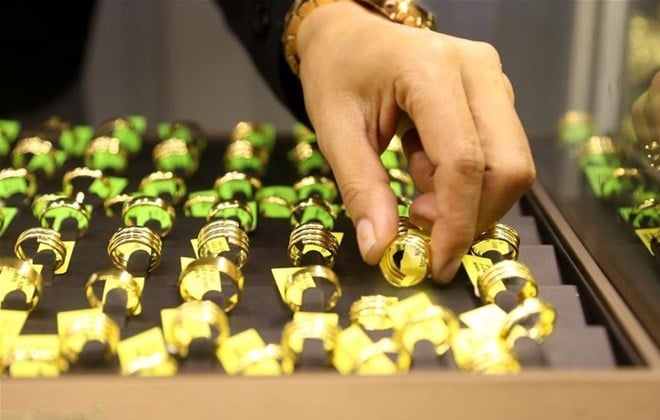
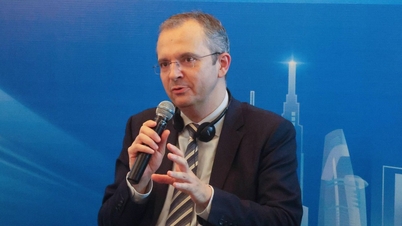
That's the assessment of economist David Rosenberg, president of Rosenberg Research. According to the expert, the latest surge in gold prices is "particularly impressive."
"Gold prices rise when the dollar strengthens and inflation expectations fall. During that time, the Fed is expected to continue keeping interest rates high. All these developments would normally harm gold prices, but things are going against that pattern," he noted.
According to research by a team of experts from Rosenberg Research , the reason for the high price of gold is not on the supply side, as it has been stable in recent years. The reason lies on the demand side, as central banks around the world view gold as a reserve asset.
Currently, the Chinese yuan has lost its status as the world's second-largest reserve currency. Countries like Japan, Russia, Türkiye, and Poland are concerned about over-reliance on the US dollar. As a result, gold is being sought after as a hedge against economic risk.
Rosenberg said: “After a period of divesting from gold due to the belief that physical reserves were outdated, central banks are once again increasing their gold holdings on a large scale.”
Demand for gold is surging in emerging markets like India and China, while Western investors are lagging behind as high interest rates and booming stock prices diminish the precious metal's appeal.
In addition, the boom in the circuit board manufacturing industry to serve the artificial intelligence craze is believed to be another factor driving up gold prices.
Rosenberg assessed that the recent recovery in gold prices stems from global geopolitical risks and an unpredictable macroeconomic outlook.
In monetary terms, he analyzed: with the US debt-to-GDP ratio reaching 120% and service costs escalating, investors are increasing their holdings of gold amid the risk of a financial crisis.
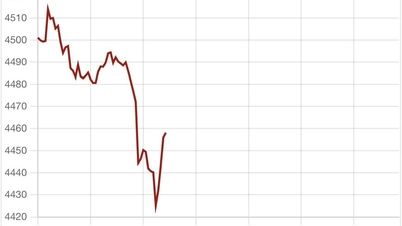
With gold prices gaining steady upward momentum, Rosenberg predicts they could continue to rise by another 15%—or even 30%—to $3,000 per ounce as central banks begin cutting interest rates.
Economists have presented two scenarios: the first is a "soft landing" (avoiding a recession), and the second is a typical bear market. Both scenarios support the price of gold.
In a "soft landing" scenario, assuming global real interest rates return to their pre-2000 average levels, the USD would fall by approximately 12%, pushing the price of gold up by about 10%.
But if a recession were to hit the global economy (with global real interest rates returning to the 2014-2024 average), coupled with a stable stock market and a dollar depreciation of around 8%, the price of gold could rise by 15% to the $2,500/ounce range.
He said: "Combining assessment methods has helped us identify the downside risk to gold as low. Gold still has plenty of room to rise. It is more likely to reach $3,000 per ounce than to fall back to $1,500 per ounce due to escalating geopolitical tensions."
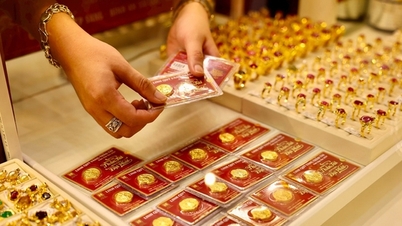
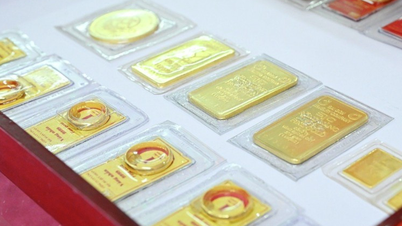
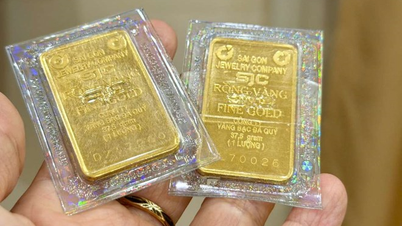
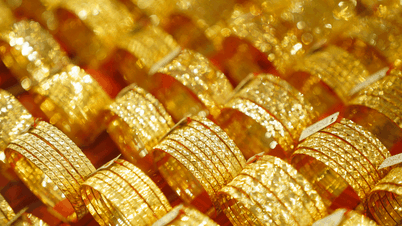
At the close of trading last week, the domestic SJC gold price, as listed by DOJI Group, was 79 million VND/ounce for buying and 82 million VND/ounce for selling. The difference between the buying and selling price of SJC gold at DOJI was adjusted upwards to 3 million VND/ounce.
Saigon Jewelry Company (SJC) listed the buying price of SJC gold at 79.5 million VND/ounce; the selling price is 81.9 million VND/ounce. The difference between the buying and selling price of SJC gold is 2.4 million VND/ounce.
Meanwhile, the world gold price listed on Kitco is at $2,329.2 per ounce.
Source
![[Photo] The courage of new recruits of Brigade 144 on the training ground.](https://vphoto.vietnam.vn/thumb/1200x675/vietnam/resource/IMAGE/2026/05/27/1779881651341_anh-man-hinh-2026-05-27-luc-18-32-52.png)


![[Photo] The heat at the fireworks display site on the opening night of the Da Nang International Fireworks Festival 2026](https://vphoto.vietnam.vn/thumb/1200x675/vietnam/resource/IMAGE/2026/05/27/1779889741485_ndo_br_z7872039145157-fecaba5112f39e8352544099d7ef4738-5140-jpg.webp)















































![[Photo] The courage of new recruits of Brigade 144 on the training ground.](https://vphoto.vietnam.vn/thumb/402x226/vietnam/resource/IMAGE/2026/05/27/1779881651341_anh-man-hinh-2026-05-27-luc-18-32-52.png)


























Comment (0)