

Lan Anh's journey is a story of inheritance and breakthrough, as a young person learns to step out of her father's shadow to find her own voice, while still keeping her love for the culture of Northwest Vietnam intact.
Inheritance from my father
In Sa Pa, many people know Lan Anh's father, "Sa Pa Khi." His wood carvings have long become a visual memory of this land, where images of mothers carrying goods on their backs, children playing by the stream, or the early morning market are recreated with simple yet profound carvings.
.jpg)
Lan Anh's childhood was filled with the scent of wood and the rhythmic sound of chiseling. As a young girl, she only dared to watch her father work. When she began to pick up a knife and practice carving, Lan Anh couldn't avoid the comparative glances. Each time she finished a piece, the familiar question would ring out: "Is that the daughter of Mr. Sa Pa Khi?" Her father's name came first, a source of pride, but also an invisible pressure.
Lan Anh once admitted that there were times she feared she was just "a shadow" of her father. Everything she did was met with an excessively high standard. But in that house, her father never placed heavy expectations on her. He didn't praise loudly, nor did he scold her when she messed up a stroke. He simply sat quietly beside her, adjusting her knife grip, showing her how to listen to the wood, which pieces were brittle, and where to stop before cracking.
Mr. Khi's dedication to his craft wasn't through lengthy lectures, but through his attitude towards life. For him, sculpting wasn't just a means of livelihood, but a way to preserve the soul of the land. He didn't choose to sculpt vibrant festivals, but sought out the most ordinary moments of life. The culture of Northwest Vietnam in his paintings is the gentle smile of a H'Mong woman, the deep wrinkles on a mother's face, the flickering fire in a wooden kitchen. Perhaps this perspective unconsciously permeated Lan Anh: Art isn't about showcasing technique, but about telling stories through genuine emotion.
What impressed her most was her father's relentless pursuit of knowledge. When his health no longer allowed him to do heavy work, he learned to sew. As technology advanced, he explored social media, learned video production, and music editing, not to follow trends, but to better understand his daughter's world . Anything he couldn't express in words, he searched online and sent to her.
That very image made Lan Anh wonder: Why is it that someone who has lived more than half their life is still endlessly curious, while she, then so young, hesitated before trying something new? From her father, she learned that motivation is not something given to you, but something that is kindled when you witness the perseverance of others. More than technical skills and a love for the profession, what Mr. Khi passed on to his daughter was his attitude towards life: quiet perseverance and appreciation for the simplest things in his homeland.
.jpg)
Not only is he a child of "Sa Pa Khi"
Once she had mastered the art of carving, Lan Anh began to ask herself: How will I tell the story of Northwest Vietnam? Unable to simply repeat her father's path, she sought to expand her materials and visual language.
The old roofing planks became a deliberate choice. For Lan Anh, the cracks and grain weren't flaws, but marks of time. The old wood retained the memories of the house, of the rain and sun, of the hands that had touched it. By cleaning each grain, she believed she was "awakening" those memories, and then breathing new life into them.
Lan Anh's distinctive feature lies in her combination of sculpture and brocade. If wood represents memory, then brocade is the soul. She goes to the market early in the morning, chats with locals, learns the meaning of each pattern, and selects handcrafted fabrics that take months, even years, to complete. When she incorporates the brocade onto the wooden board, each artwork gains a vibrant layer of culture, not just for viewing, but for feeling.
The process of completing a single artwork can take up to 50 hours: cleaning the wood, rough carving, meticulously detailing the eyes and folds of the clothing, then carefully attaching fabric, adding light and mist. Some paintings, like "Spring, Summer, Autumn, Winter, and Spring Again," evoke the cyclical nature of time; others depict Red Dao people harvesting tea from ancient trees, or three generations of a highland family gathered together. Each theme is a slice of life, both familiar and evocative.
If Lan Anh previously struggled with the question of how to live up to her father's legacy, she now gradually understands that she doesn't need to escape his shadow by denying it, but by extending it in a new direction. Inheritance is not about repetition, but about continuing through personal creativity.
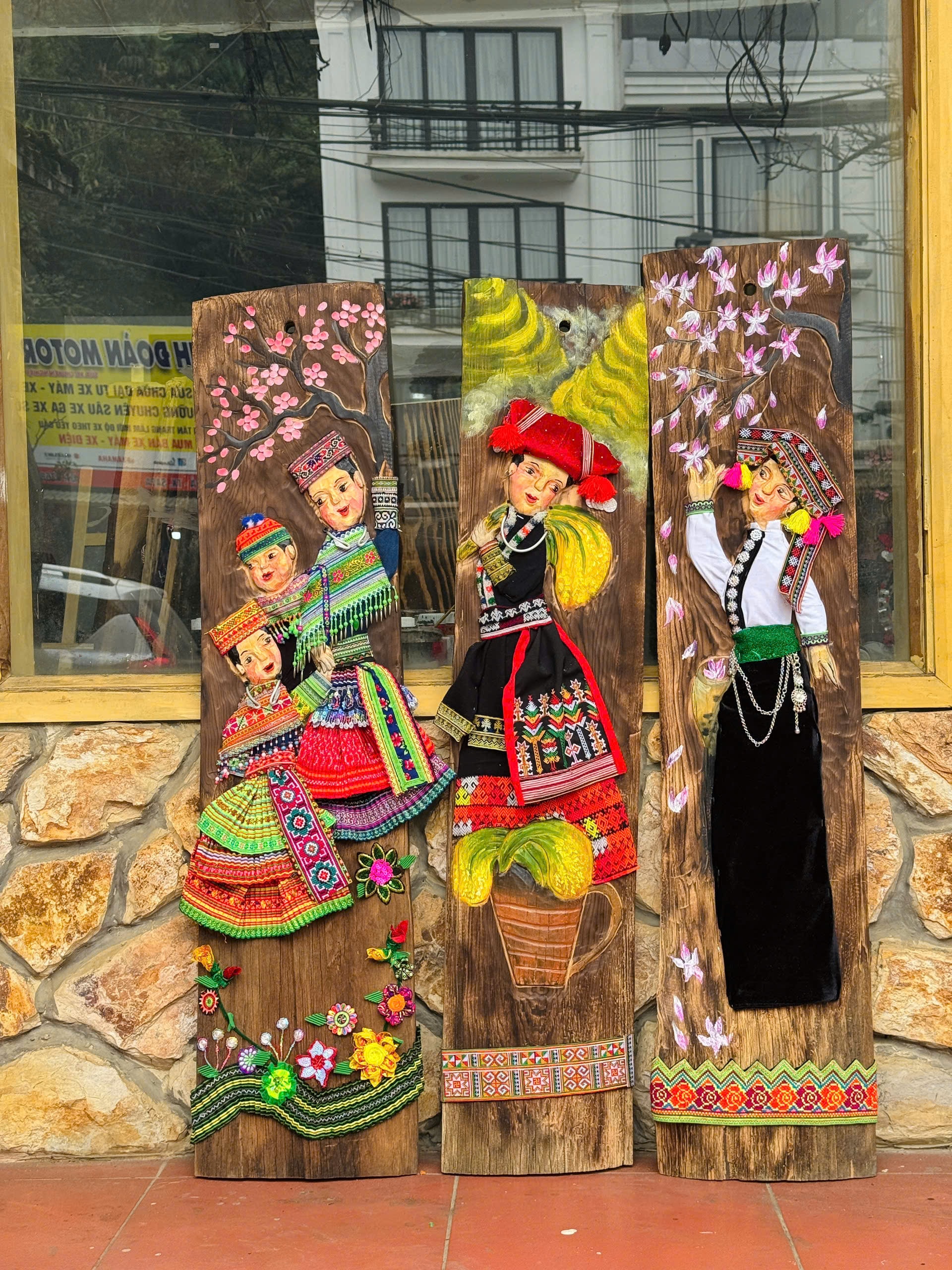
She doesn't carve paintings to cling to the past. Lan Anh understands that Northwest Vietnam is changing every day. Wooden roofs are gradually giving way to concrete, and looms are becoming less common. But she believes that amidst this transformation, there is still a need for someone to preserve the most pristine colors so that when someone goes far away, they still have something to remember.
Lan Anh's aspirations go beyond simply selling souvenirs. She wants each piece to become a bridge connecting her homeland's culture beyond borders. When tourists hold a wooden painting combined with brocade in their hands, it's not just a handcrafted product, but a story about the people, their love for the land, and the enduring spirit of the highland culture.
From the sound of her father's chisel years ago, Lan Anh has found her own unique sound. She remains the daughter of "Sa Pa Khi," but is also a young artist with her own distinctive style, one who dares to experiment, dares to combine, and dares to dream big. Amidst the fragrant wood and vibrant fabrics, Lan Anh's journey of growth is not just the story of an individual continuing the family legacy. It is also the journey of a young generation in Northwest Vietnam: cherishing their roots, but unafraid to venture out into the wider world; preserving culture, but not confining it to the past.
Currently, Lan Anh's works are mainly chosen by hotel and homestay owners to decorate their spaces in a local style. But for this young woman, that's just the beginning. In the early days of spring, when the mountains of Sa Pa are still shrouded in morning mist, Lan Anh began to think further ahead. She cherishes the idea of creating smaller, more delicate products that tourists can easily carry on their journeys. More than just a souvenir, it will be a piece of memory, where wood, brocade, and the stories of Northwest Vietnam accompany travelers on their long journeys.
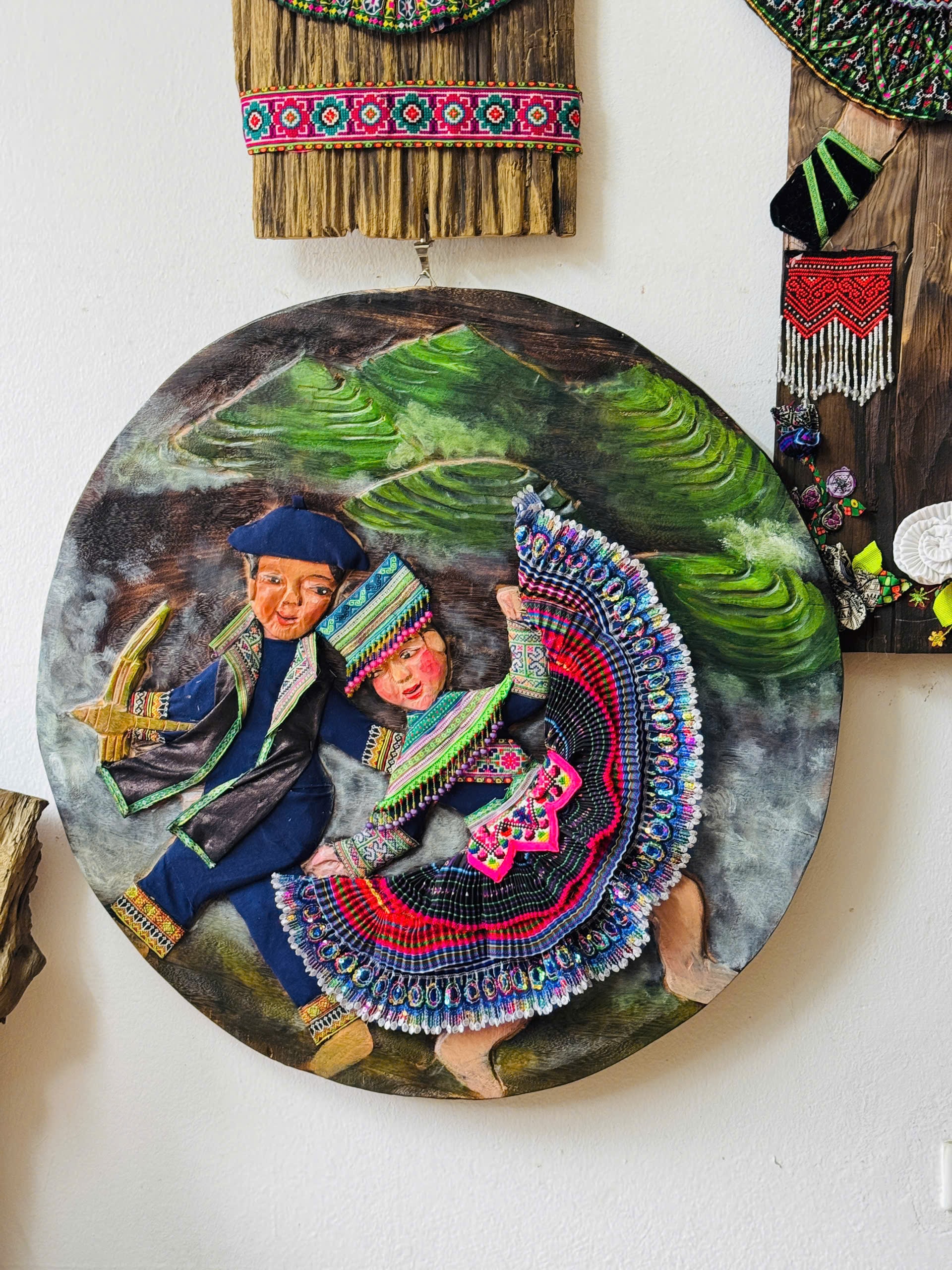
Furthermore, Lan Anh hopes to transform her work into a creative experience. She plans to prepare pre-processed wood blanks and carefully selected pieces of brocade fabric so that each visitor can complete their own artwork. In that moment, they will not only be observing the culture from the outside, but also touching it, listening to the gentle sound of the knife striking the wood, and feeling the rough texture of the fabric under their fingertips.
She believes that as long as there are young people willing to start, and patient hands preserving and renewing traditions, Northwest Vietnam will not only remain in memory, but will continue to live vividly through stories told with all their hearts.
And who knows, perhaps from an old piece of wood amidst the spring in the mountains, a new dream might quietly grow.
Source: https://hanoimoi.vn/giac-mo-tu-tieng-duc-cua-cha-734383.html
![[Image] Expediting land clearance at Alley 310 Nghi Tam to facilitate the construction of Tu Lien Bridge](https://vphoto.vietnam.vn/thumb/1200x675/vietnam/resource/IMAGE/2026/04/14/1776160406551_ndo_br_z7724148990408-9e5d4777e3c4504998b4286178b2e66e-jpg.webp)


![[Photo] General Secretary and President To Lam visits and delivers a policy speech at Tsinghua University.](https://vphoto.vietnam.vn/thumb/1200x675/vietnam/resource/IMAGE/2026/04/14/1776164592318_vna-potal-tong-bi-thu-chu-tich-nuoc-tham-va-phat-bieu-chinh-sach-tai-dai-hoc-thanh-hoa-trung-quoc-8700658-5437-jpg.webp)















![[Infographic Series] Red Addresses of Dong Nai: Song Pho Square, Bien Hoa Police Station, the End Point of the Ho Chi Minh Trail - 1973, the Victory Site of Tau O Checkpoint](https://vphoto.vietnam.vn/thumb/402x226/vietnam/resource/IMAGE/2025/9/26/1331532306fb4ad18e4a849e5c64202a)

































































Comment (0)