

Average income is nearly 11 million VND/month.
Recently, the Ho Chi Minh City Department of Education and Training released a report on the current state of preschool education in urban and industrial areas of Ho Chi Minh City. The report provides noteworthy information regarding the implementation of regulations, policies, and income for preschool teachers, especially in urban and industrial areas of the city.
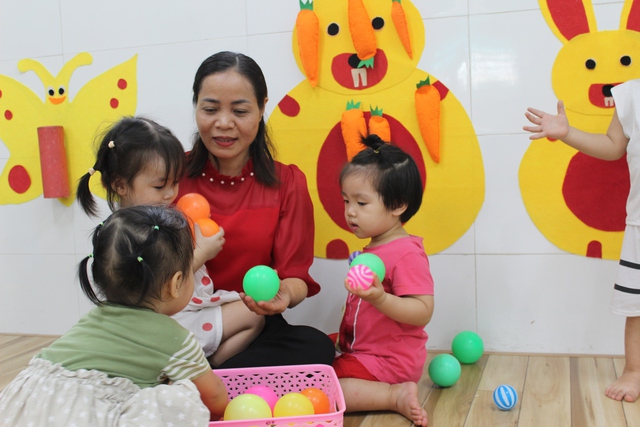
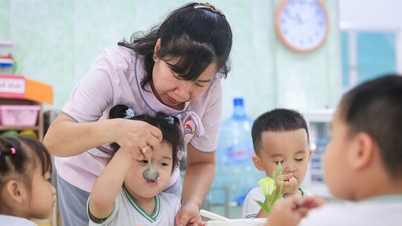
Public kindergarten teachers in District 7, Ho Chi Minh City
According to the leaders of the Ho Chi Minh City Department of Education and Training, based on the relevant legal documents, preschool teachers are entitled to full salaries, preferential allowances, and seniority allowances as stipulated by the Government and the Ministry of Education and Training.
In addition, public preschool teachers in Ho Chi Minh City receive support according to resolutions of the City People's Council such as:
Resolution No. 01/2014/NQ-HĐND dated June 14, 2014, of the Ho Chi Minh City People's Council on supporting preschool education; Resolution No. 01/2021/NQ-HĐND on amending and supplementing point c, clause 4.2, Article 2, with a total amount exceeding 247 billion VND.
Resolution No. 04/2017/NQ-HĐND dated July 6, 2017, of the Ho Chi Minh City People's Council on policies to attract preschool teachers; Resolution No. 04/2021/NQ-HĐND on amending and supplementing Clauses 1 and 2 of Article 1, with a total amount exceeding 200 billion VND.
Resolution No. 03/2018/NQ-HĐND dated March 16, 2018, of the Ho Chi Minh City People's Council on promulgating regulations on additional income payment for officials, civil servants, and public employees in the state management sector, political and social organizations, and public service units managed by the city, now Resolution No. 08/2023/NQ-HĐND dated September 19, 2023, of the Ho Chi Minh City People's Council on promulgating regulations on additional income payment in accordance with Resolution No. 98/2023/QH15 dated June 24, 2023, of the National Assembly on piloting some specific mechanisms and policies for the development of Ho Chi Minh City.
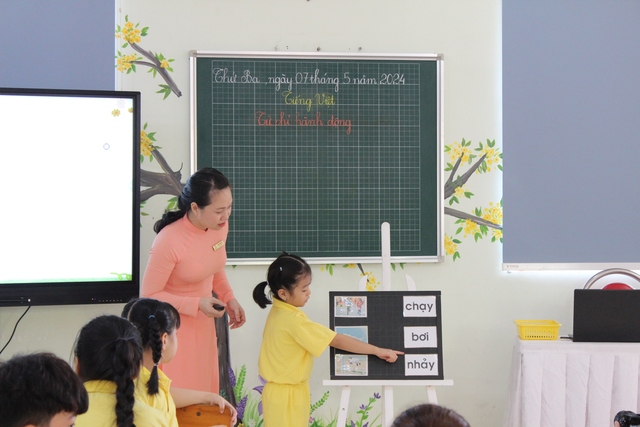
A preschool teacher at a public school in Ho Chi Minh City during a lesson introducing children to writing.
For preschool teachers in industrial zones: In accordance with Resolution No. 27/2021/NQ-HĐND dated December 9, 2021, of the People's Council on policies for developing preschool education in industrial zones in Ho Chi Minh City, 187 teachers received subsidies totaling VND 1,258,400,000.
According to the Ho Chi Minh City Department of Education and Training, the highest total income for public kindergarten administrators in the city is 17,059,000 VND/month, the lowest is 10,682,000 VND/month, and the average income is 13,870,500 VND/month.
Public kindergarten teachers in Ho Chi Minh City earn the highest income at 16,869,000 VND/month, while the lowest earns 5,103,000 VND/month. The average income for public kindergarten teachers in Ho Chi Minh City is 10,986,000 VND/month.
Ho Chi Minh City is currently short of 529 public preschool teachers.
According to the Department of Education and Training, Ho Chi Minh City currently has 2,611 management staff, 27,359 teachers, and 11,458 support staff at the preschool level. As of January 2024, the city is short 278 public preschool management staff and 1,200 preschool teachers (including 529 public preschool teachers and 671 private preschool teachers). However, public preschools still maintain a ratio of 2 teachers per group/class.
The Department of Education and Training acknowledges that while Ho Chi Minh City has policies to attract preschool teachers, these policies still do not fully meet the living needs of those from the provinces who have to rent housing and cover their living expenses. Therefore, upon graduation, many choose to work independently or apply for positions in private organizations or units to earn a higher income. Consequently, the Department of Education and Training proposes both short-term and long-term solutions, such as organizing flexible recruitment of civil servants through various methods: competitive examinations, selection processes, or onboarding, and conducting multiple recruitment drives throughout the year.
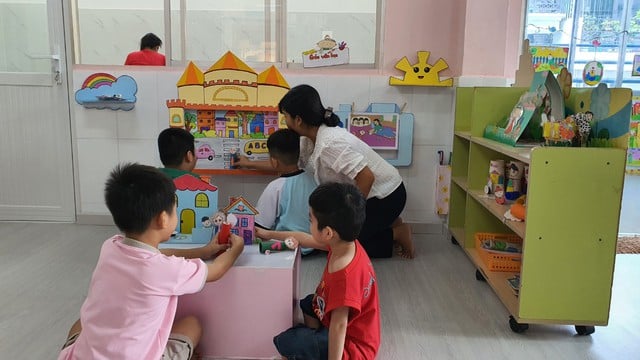
Ho Chi Minh City is currently short of 529 public preschool teachers.
Continue to promote the decentralization of recruitment organization for public non-profit units, enhance the responsibility of unit heads, and proactively attract resources. At the same time, sign contracts with teachers while personnel have not yet been recruited to ensure the unit's operation.
The Department of Education and Training also stated that it will coordinate with the Department of Home Affairs to submit to the Ho Chi Minh City People's Committee for consideration and guidance on the unified timeframe for transferring civil servants and the timeframe for organizing the first recruitment of civil servants citywide; and to receive preschool teachers transferring to Ho Chi Minh City according to the needs of the units.
Continue to propose and develop policies to attract preschool teachers, overcome financial difficulties, and ensure their long-term involvement in the education sector; strengthen coordination with training institutions to create incentives for students to study early childhood education.
Regarding Government Decree 105/2020/ND-CP on policies for the development of preschool education, the Ho Chi Minh City Department of Education and Training proposes adjusting the percentage of children of workers and laborers working in industrial zones who are eligible for support policies at preschools and support for preschool teachers in private and non-governmental preschools (from 30% down to 20%).
As of the end of the 2023-2024 school year, Ho Chi Minh City had 3,469 preschool education facilities with 340,746 children. This included 1,248 schools; 1,955 independent preschool groups, kindergartens, and preschool classes; and 266 smaller groups (with a maximum of 7 children).
Over the years, the results of universal preschool education for 5-year-old children in Ho Chi Minh City have been maintained and developed steadily. The percentage of 5-year-old children completing the preschool education program has reached 99.9%.
Furthermore, the percentage of 5-year-old children attending two sessions per day has reached 100%. Throughout Ho Chi Minh City, all 312 wards, communes, and towns have met the standards for universal preschool education for 5-year-old children.
Source: https://thanhnien.vn/tphcm-giao-vien-mam-non-cong-lap-thu-nhap-cao-nhat-gan-17-trieu-dong-thang-18524091808015027.htm


![[Photo] Prime Minister Pham Minh Chinh presides over the conference announcing the establishment of the International Finance Centre in Vietnam.](/_next/image?url=https%3A%2F%2Fvphoto.vietnam.vn%2Fthumb%2F1200x675%2Fvietnam%2Fresource%2FIMAGE%2F2025%2F12%2F21%2F1766309817714_ndo_br_dsc-3400-jpg.webp&w=3840&q=75)

![[Photo] Prime Minister Pham Minh Chinh presides over a meeting on private sector economic development.](/_next/image?url=https%3A%2F%2Fvphoto.vietnam.vn%2Fthumb%2F1200x675%2Fvietnam%2Fresource%2FIMAGE%2F2025%2F12%2F20%2F1766237501876_thiet-ke-chua-co-ten-40-png.webp&w=3840&q=75)




































































Comment (0)