

Seeing their students not dressed warmly enough to come to class, the loving feelings of Ms. Hoang Thi Chien and Ms. Hoang Thi Hue - teachers at Bac Xa Primary School - resurfaced, giving them motivation and strength to dedicate themselves tirelessly to teaching in the border region of Lang Son.
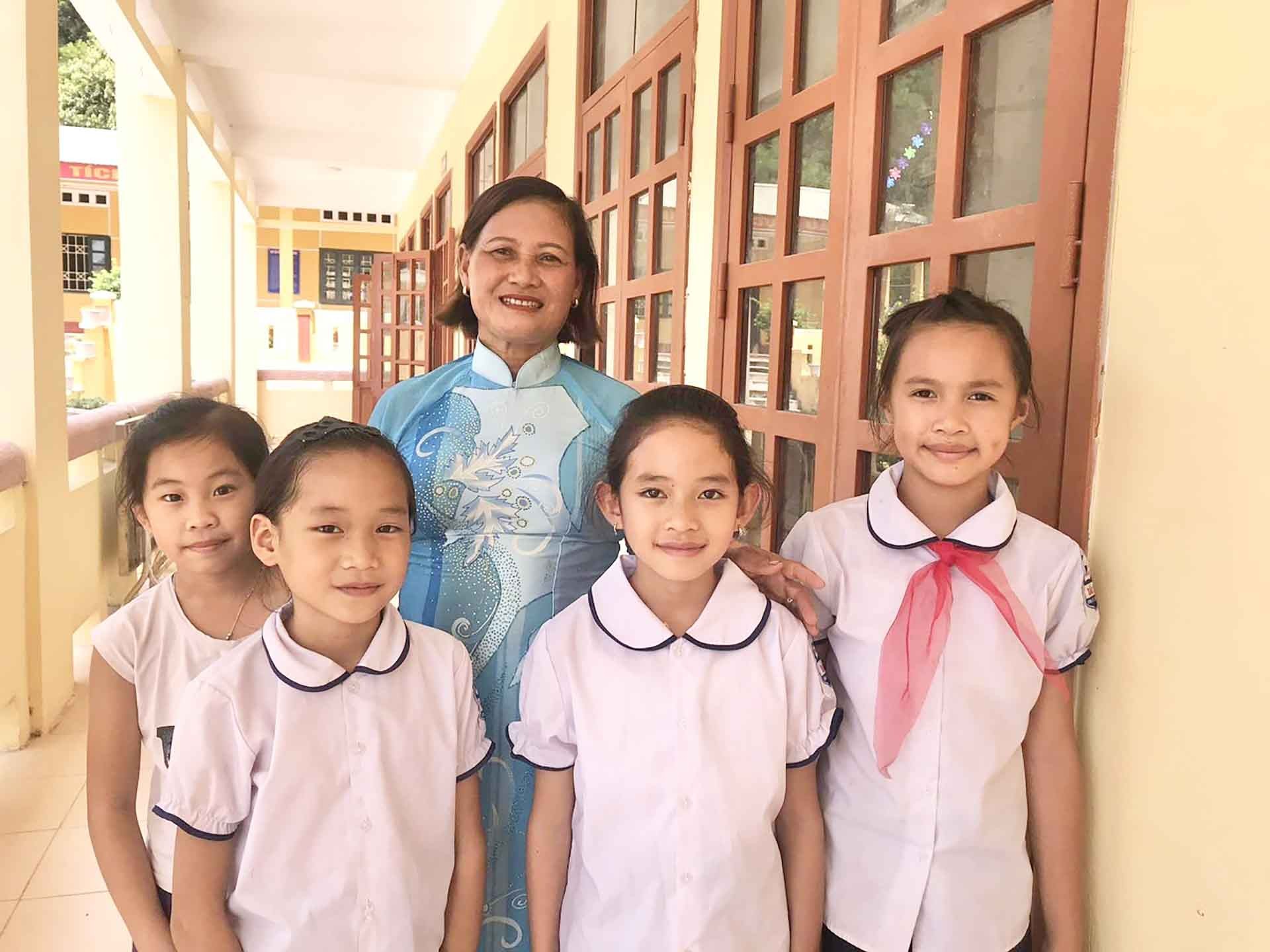 |
| Ms. Hoang Thi Chien with her students. (Photo: Provided by the interviewee) |
Bac Xa is a border commune located in the northeastern part of Dinh Lap district, with a border stretching over 33km with China. Scattered throughout this rugged border region are villages and hamlets inhabited by ethnic minorities such as the Tay, Nung, Dao, and San Chi, who have lived there for generations.
Memories of over 30 years
Born in Ban Hang, Kien Moc commune, Dinh Lap district, Ms. Hoang Thi Chien studied at a 12+2 Teacher Training College in Lang Son city, then continued her studies at university. After graduation, she started working at Kien Moc Primary School in 1988, and later transferred to several other schools, all belonging to Bac Xa Primary School.
The time right after graduation is also the most memorable memory for teacher Chien. She recounted: “At that time, I went to teach at Ban Muc school, Kien Moc commune, Dinh Lap district. Every day, I had to walk 8 km from my house along a forest trail. Every week, after teaching on Friday afternoon, I would pack my bags and go home early Saturday morning to rest for the weekend, then return to school on Monday morning as planned.”
One day, it rained heavily, and the stream's water level rose, but I still risked wading through it even when the water reached my waist. Partly because I'm a pretty good swimmer, so I wasn't afraid of the water. At school, I was the only teacher in charge of about 30 students, aged 6 to 14, but they were all in first grade.”
Back then, people's lives were difficult, so they didn't prioritize sending their children to school. Teachers who wanted children to attend school had to go to each house to persuade families.
By the second year, the students had become familiar with the teacher, many had learned to read and write, and the parents were happier, trusted the teacher more, and were more willing to bring their children to school.
There was no proper road to get to school, only a narrow path used by the villagers, so Ms. Chien slipped and fell many times, getting her clothes dirty. At times, she could only laugh to herself and encourage herself to keep going towards the school.
In 2009, Ms. Chien learned to ride a motorbike, and then she was assigned to move to Ban Chao school to continue her career of "stationing herself in the village." Every time she went to teach, Ms. Chien had to leave her motorbike on the riverbank and then wade across a branch of the Ky Cung River.
Ms. Chien said: "When it rains and the floodwaters rise, I have to stop teaching. Looking at the raging floodwaters that make crossing the river impossible, I feel even more sorry for the students who have to wait for the flood season to pass before we can meet again and continue our work of teaching."
In 2010, she moved the school to Ban Tang, Kien Moc commune, once again. The path was still a steep, winding trail, about 7 km long, requiring climbing to the mountaintop and descending into a ravine to reach the school. In 2019, due to having young children, Ms. Chien transferred to Bac Xa Primary School, teaching at the main school and no longer having to work in the remote village.
A journey of "settling in a remote village" filled with love.
After graduating from Hanoi Pedagogical University, Ms. Hoang Thi Hue spent over 25 years "stationed" in many of the most challenging schools in the villages of Bac Xa.
Recalling her heartwarming memories of teaching in remote villages, she said: "What I remember most is when I was teaching at the school in Khuoi Ta village, and then a few years later I moved to the school in Hang village..."
"These were all extremely difficult places to travel to, with only footpaths and no roads for motorbikes or cars. I remember back then, the Bac Xa border guard post had to use horses to carry food from outside to the post. As for me, every time I went to class, it was a journey that involved crossing countless mountain passes and streams..."
At that time, Ms. Hue didn't know how to ride a motorbike; her family only had an old bicycle that her parents bought for her to go to work. Every Friday afternoon, she would go home to her parents to rest for the weekend, then prepare more food and clothes so that on Sunday afternoon she could cycle nearly a hundred kilometers to the school, in time for the first day of teaching.
Ms. Hue recalled: “I just trudged through the forest alone, stopping to rest when I was tired. On days when I had to carry warm clothes, food, and books for the students, and couldn't transport them by bicycle, I had to carry them on my shoulder. Sometimes it rained, the road was slippery, and I kept falling, then getting up again with my clothes covered in mud and soaking wet. By the time I reached the school, it was very late at night...”
Now, many generations of Ms. Hue's students have graduated and achieved success. Right here at Bac Xa Primary School, there are two students from the first generation Ms. Hue taught who have returned to the school to stand on the podium alongside her, continuing to guide future generations of students. Many of them have graduated from Hanoi Medical University and Hanoi University of Medicine and Pharmacy, and are now doctors working locally and in Hanoi.
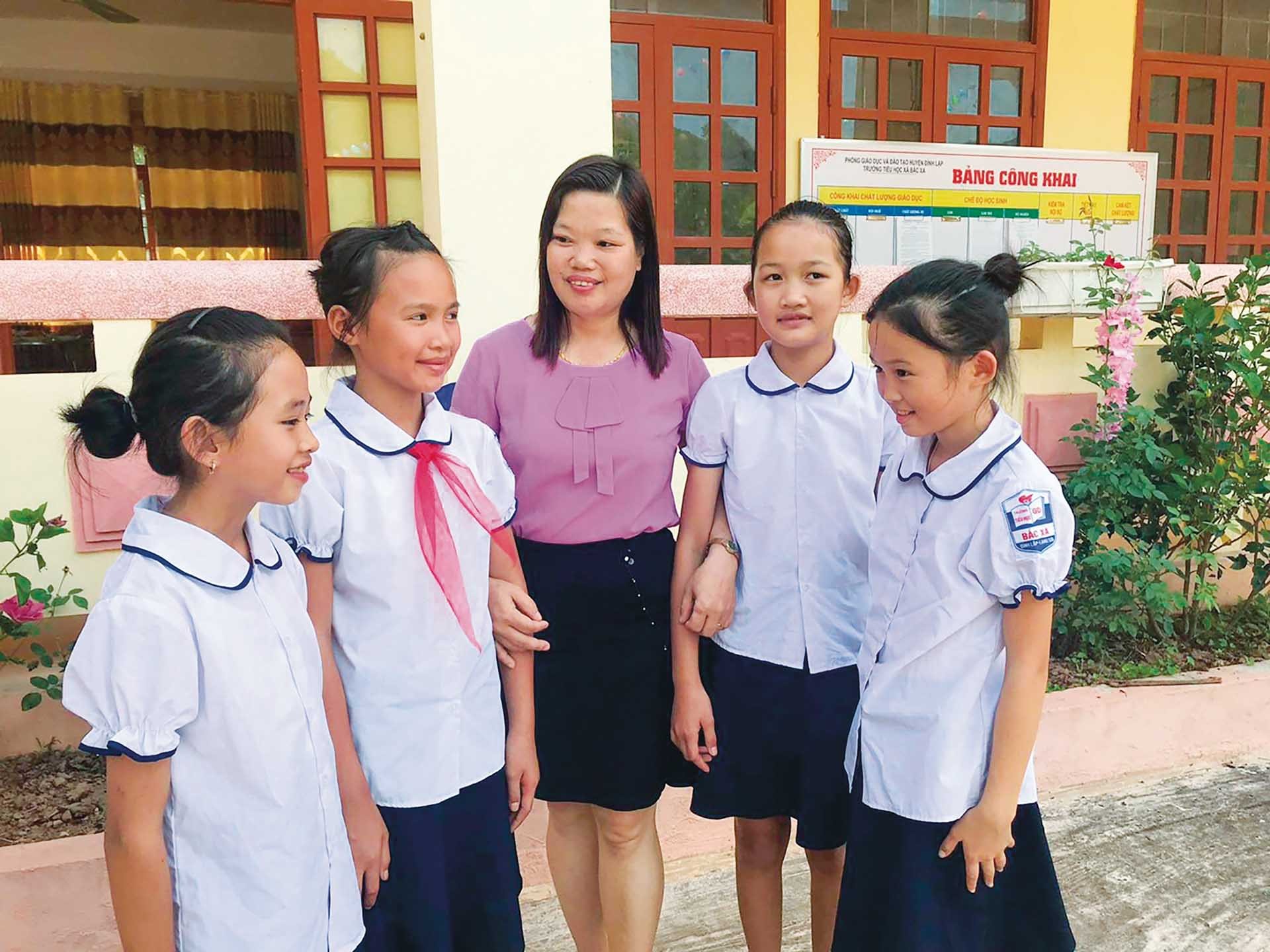 |
| Ms. Hoang Thi Hue is always proud to be a teacher in the border region. (Photo: Provided by the interviewee) |
No matter how difficult it is, I still come to class.
Ms. Chien's family was large and poor. Her grandfather, who was also a teacher, always encouraged her to get a good education so she could pursue a career as a teacher.
He once told her, "Teachers bring faith and impart knowledge to generations of students, helping them learn to be good people who will be useful to society later. The happiness of the profession will stay with a teacher throughout their life. You must persevere in this profession and not give up in the face of difficulties."
Remembering her grandfather's words, no matter how remote or difficult the school locations were, she still went to school every day to be with her students. She persevered through the challenging roads, through rain and cold, to impart knowledge to generations of students.
Ms. Chien believes that teaching experience is accumulated daily through the teacher's own research, learning, and self-improvement. She shared: "Every profession requires passion. I love teaching, so no matter what subject or class I'm assigned to teach, I always strive to update my knowledge and make each lesson engaging for students of all ages. For elementary school students, the lessons must be even simpler, easier to understand, and easier to remember. I even have to repeat things many times so they understand and remember the lesson."
Teacher Chien's happiness in her profession grows stronger every day as she continues her journey of spreading knowledge in the border region of Lang Son. Looking back at the many generations of students who have grown up from her schools and classrooms, she is very proud to continue teaching the children of her former students. She smiles and says, "Many times, the families of these students meet me with close and affectionate feelings, as both parents and children are my former students, respectfully greeting me, 'Our teacher, our children's teacher.'"
For Ms. Hoang Thi Hue, pride in her teaching profession in the border region is always filled with endless memories and emotional stories.
In the atmosphere of the whole country looking forward to Vietnam Teachers' Day on November 20th, she emotionally shared: "These days, we have never received flowers from our students, but the greatest reward is the greetings and thanks from the bottom of the hearts of parents and students of many generations."
The happiness of teachers and students in the highlands is that simple, yet it holds immense meaning; it quietly ignites our dreams each day, guiding us forward together.”
Source



















































































Comment (0)