

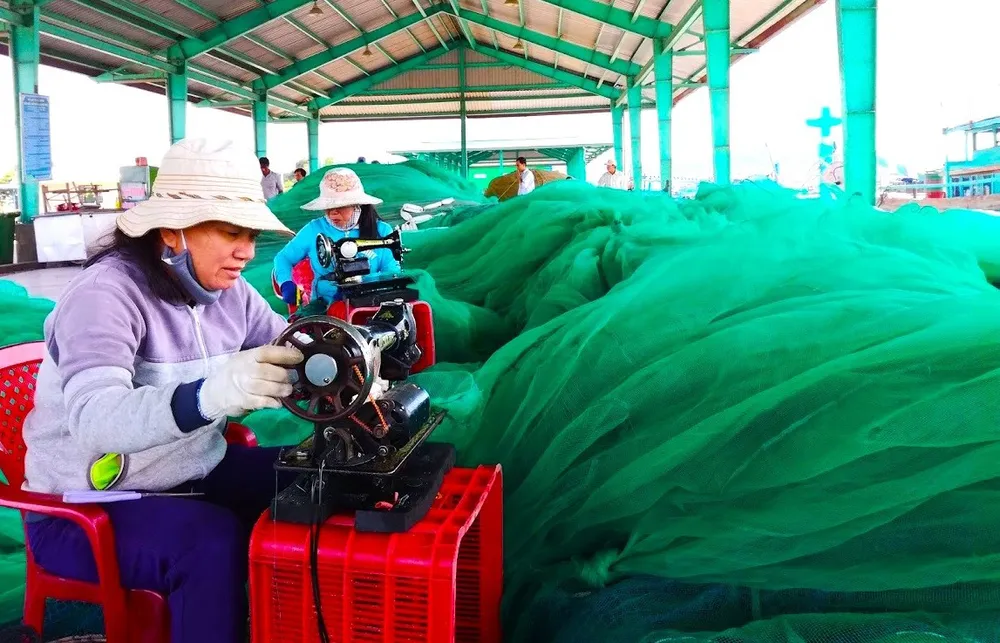
In the golden afternoons falling on the sand dunes, along the fishing villages and ports of Lam Dong province, one of the country's three key fishing grounds, we easily encounter images of women sitting around large fishing nets, sewing machines, their hands nimbly mending torn mesh, tying knots as if embroidering into them the emotions and memories of the sea. The job of mending and repairing fishing nets for hire may seem like a quiet occupation, but it hides within it the patience, perseverance, and deep love of the sea of these women living by the waves. "For us who mend nets for hire, it's a profession deeply ingrained in our consciousness. Besides serving the fishing boats that venture out to sea, this work also contributes to creating jobs for many laborers, especially women," shared Mrs. Nguyen Thi Luu, a woman over 50 years old residing in Mui Ne ward (Lam Dong province), while diligently mending nets.
The work of mending and repairing fishing nets is usually quiet. A woman only needs a small yard, a few wooden needles, a spool of nylon thread, and patience. More modernly, some women use sewing machines to reinforce the net edges. Their hands move swiftly, their eyes following each mesh, mending frayed areas and repairing tears. Sometimes, an entire morning passes before they've repaired or mended just a few meters of net. This work demands meticulousness, perseverance, and considerable sacrifice, because if the net isn't strong, fish can easily escape, making the crew's journey difficult. Therefore, this profession requires patience, sitting for hours, backaches, and blurred vision, but it's rare to hear them complain.
The craft of mending and repairing fishing nets not only provides supplementary income but also becomes a cultural memory. In many coastal villages like Mui Ne, La Gi, and Phan Thiet, women often gather together, mending nets while chatting and exchanging experiences. These patched nets not only protect fish and shrimp but also preserve the sense of community and neighborly spirit. Ms. Tran Thi Thu, a long-time net-mending worker in Phan Thiet ward, confided: “My mother taught me how to mend nets when I was only 12 years old. Now it’s my turn to pass it on to my daughter. It’s not just a way to earn a living, but also to help my children understand that behind every successful fishing trip lies the diligent work of women.”
Indeed, in the modern pace of life, while many traditional crafts are gradually fading away, the craft of weaving and mending fishing nets quietly persists as a "living memory." The people of the coastal villages see it as a connecting thread between the past and the present, between the generations of their ancestors and their descendants.
As evening falls, the fishing nets are stretched out and neatly stacked, waiting to be loaded onto the boats tomorrow. The figures of the fishing village women still linger on the docks, their small stature befitting the livelihoods of countless families and the peacefulness of the sea voyages.
Source: https://www.sggp.org.vn/giu-hon-lang-bien-post812518.html























































![[Workers' Month 2026] Spreading love on the Vinh - Dong Hoi frontline: Nearly 1 billion VND spent on caring for the lives of workers.](https://vphoto.vietnam.vn/thumb/402x226/vietnam/resource/IMAGE/2026/05/20/1779237885217_img_8650.jpeg)
















































Comment (0)