

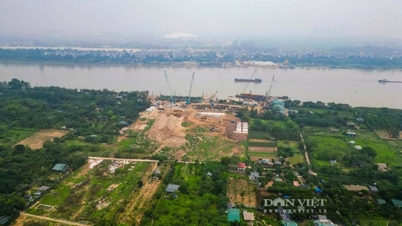
According to the Ministry of Agriculture and Environment – the agency in charge of drafting the resolution – the 2024 Land Law (Article 79) specifically stipulates 31 cases in which the State can reclaim land for socio-economic development in the national and public interest. However, in reality, many key projects that play a driving role in promoting socio-economic development in localities, contributing significant revenue to the state budget from land use fees, land lease fees, value-added taxes, creating many jobs for local workers, and promoting the development of supporting business services, lack regulations on land reclamation. This creates difficulties in accessing land and implementing projects.
Land acquisition is a very sensitive issue, as it directly affects the rights of those whose land is being acquired. Numerous conflicts and unnecessary "hot spots" have arisen during land acquisition. In reality, there have been projects implemented under the mechanism of negotiated land use rights transfer, but a small portion of the land could not be agreed upon between the investor and the land users, leading to a "stalled project." This results in wasted land resources, delays in investment progress, and difficulties for investors. Furthermore, the 2024 Land Law stipulates that land can only be acquired after a decision approving the compensation, support, and resettlement plan has been made. The Ministry of Agriculture and Environment argues that this regulation is not in line with the urgent requirements for completing key national projects and emergency public investment projects, and does not ensure flexibility for projects where the majority of landowners agree to land acquisition before the compensation, support, and resettlement plan is approved.
To resolve this issue, the draft Resolution has added three cases in which the State can reclaim land for socio -economic development in the national and public interest. Specifically, it adds cases of land reclamation for urgent public investment projects; projects within free trade zones and international financial centers. Furthermore, it adds cases of land reclamation for projects implemented through land use right agreements that have expired or whose extended deadlines have not yet been reached. Currently, the drafting agency is proposing two options. Option 1 : In cases where land is used for a project through an agreement on land use rights that has expired or has exceeded the deadline for completion of the agreement, but more than 75% of the land area and more than 75% of the land users have been agreed upon, the Provincial People's Council shall consider and approve the revocation of the remaining land area to allocate or lease it to the investor. Option 2 : In cases where land is used for a project through an agreement on land use rights that has expired or has exceeded the deadline for completion of the agreement, but more than 85% of the land area and more than 85% of the land users have been agreed upon, the Provincial People's Council shall consider and approve the revocation of the remaining land area to allocate or lease it to the investor. The Ministry of Agriculture and Environment proposed choosing Option 1 , arguing that selecting this option would help accelerate the implementation of investment projects and overcome the situation of many "stalled" projects causing land waste as seen in the past. In addition, the draft resolution also stipulates cases of land reclamation to create a land fund for project payment under Build-Transfer (BT) contracts, and land leasing for continued production and business activities in cases where organizations are using land reclaimed by the State as stipulated in Articles 78 and 79 of the Land Law…
The addition of land reclamation cases as proposed in the draft resolution aims to promptly address obstacles in the implementation of the Land Law. However, the regulation requiring an agreement rate of over 75% or 85% of the land area and over 75% or 85% of the land users to be reached, after which the Provincial People's Council will consider and approve the reclamation of the remaining land area for allocation or lease to the investor, needs careful consideration to ensure a balance between the rights of those whose land is reclaimed and the rights of the investor. Regulations that are both legally sound and acceptable to the public will ensure that the policy, once enacted, is quickly implemented.
Source: https://daibieunhandan.vn/go-diem-nghen-trong-thu-hoi-dat-10389162.html

![[Photo] General Secretary and President To Lam presides over a meeting on preparations for the review of one year of operation of the three-tiered government system.](https://vphoto.vietnam.vn/thumb/1200x675/vietnam/resource/IMAGE/2026/06/02/1780391821195_a1-bnd-4595-9717-jpg.webp)










![[Video] Prime Minister Le Minh Hung: Completing breakthrough mechanisms to develop an international financial center](https://vphoto.vietnam.vn/thumb/402x226/vietnam/resource/IMAGE/2026/06/02/1780416130959_tt-jpg.webp)

![[Video] General Secretary and President To Lam: Shifting from completing the restructuring of the apparatus to ensuring its smooth operation.](https://vphoto.vietnam.vn/thumb/402x226/vietnam/resource/IMAGE/2026/06/02/1780415840629_tbt-jpg.webp)



















































Comment (0)