

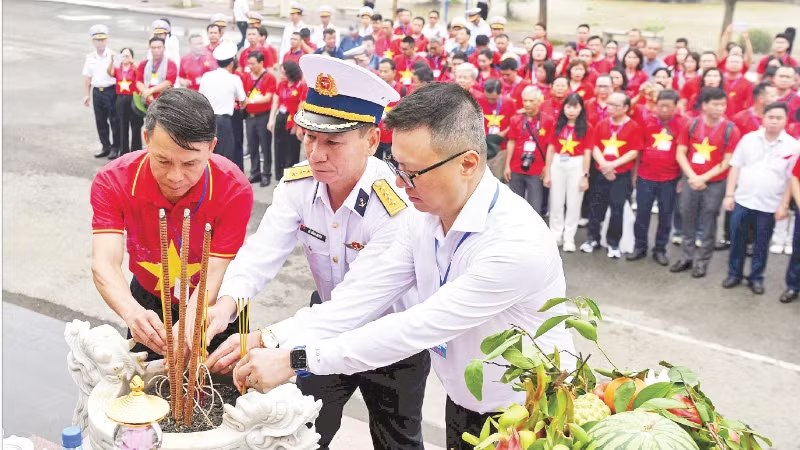
Together with Nhan Dan Newspaper and Communist Magazine, these five key media outlets form a core information axis, playing a leading role in guiding the flow of official information, contributing to strengthening social trust and firmly protecting the Party's ideological foundation. This is a strategically significant step, reflecting the long-term vision of our Party and State to elevate revolutionary journalism in the new development stage.
The policy of streamlining the apparatus and improving the effectiveness and efficiency of the political system has been consistently implemented by the Party and the State for many years, and the field of journalism and media cannot be outside this requirement for reform. Practical experience shows that the dispersion of resources, overlapping functions, and lack of effective coordination mechanisms in some periods have weakened the overall strength of the media system, causing resource waste, directly affecting the ability to guide information, and sometimes resulting in the official voice not being strong or fast enough to dominate the media space. Reorganization towards a more centralized and professional direction is both an internal need and an objective requirement.
However, as is often the case with major policy decisions, this reorganization was immediately exploited by some extremist and ill-intentioned individuals to distort and misrepresent the issue. On the internet, arguments emerged claiming this was a "step backward for press freedom," a manifestation of "tightening control over information," and even interpreted as an "internal purge." These speculative arguments deliberately separate the decision to reorganize media outlets from the overall strategy of reforming the political system, ignoring the fact that the restructuring of the press had been planned for many years, as part of a clear roadmap with cautious and consistent steps.
Today, every individual can become a "source of information" in the digital environment, and media activities are undergoing profound changes in both structure and operation. Without a unified guiding mechanism, journalism can easily become fragmented, even engaging in unethical competition. When resources are divided and the power of direction is diminished, information gaps will appear, creating fertile ground for fake news and harmful information to spread, disrupting social perception and negatively impacting public trust.
Given this situation, transferring key media outlets to the direct control of the Central Party Committee should be seen as a fundamental solution to overcome existing limitations and create conditions for maximizing their combined strength. Unified coordination enhances communication effectiveness, ensures consistency in information direction, and minimizes news delays that allow misinformation to infiltrate and spread. Therefore, this is a step aimed at increasing the leadership capacity of the press, not narrowing its operational space as false and deliberately distorted claims suggest.
From the practical experience of leading and managing the press, it is clear that the core issue is not whether or not there is leadership, but rather how to lead in a way that best enhances the role of the press in social life. Misconceptions often deliberately equate "leadership" with "imposition," and "direction" with "control," aiming to create misunderstandings. However, looking at the world , no press operates entirely outside the framework of the law and political institutions.
In Vietnam, revolutionary journalism was born and matured during the struggle for national liberation, national construction, and defense. From this essence, journalism, in addition to reflecting reality, also fulfills the function of guiding and promoting positive values, fighting against wrongdoing and evil, and contributing to building social consensus.
In Vietnam, revolutionary journalism was born and matured during the struggle for national liberation, national construction, and defense. From this essence, journalism, in addition to reflecting reality, also fulfills the function of guiding and promoting positive values, fighting against wrongdoing and evil, and contributing to building social consensus.
Currently, with hostile forces increasingly using cyberspace to undermine the Party and the State, strengthening the Party's direct leadership role over key media outlets is becoming even more necessary. This will help the press effectively fulfill its functions and duties, avoid being swept along by deviant trends, and possess the courage to perform its role of social criticism in a constructive and responsible manner.
Comrade Nguyen Thanh Lam, Member of the Central Committee of the Party and Director General of Vietnam Television, emphasized that transferring key media agencies to the direct control of the Central Committee of the Party is not only a change in the management model, but also reflects innovation in leadership thinking regarding ideological and communication work in the new situation; at the same time, it requires upholding fundamental principles and promoting the role of connecting the Party with the people.
Comrade Vu Viet Trang, Secretary of the Party Committee and Director General of the Vietnam News Agency, affirmed that this is a strategic transformation in the position, role, and function of key press agencies to enhance the effectiveness and efficiency of information and propaganda work, meeting the requirements of the new period. The unity in understanding among the leaders of press agencies reflects a high level of political determination in building a strong, capable, and competent system of key press agencies to fulfill its mission in the new context.
However, organizational restructuring is only a necessary condition; the sufficient condition lies in the ability to transform the organizational model into practical capabilities. Specifically, key media outlets must truly become strategic content production centers, hubs of intellect, technology, and political acumen. This requires a comprehensive transformation from journalistic thinking to operational models, from production processes to content distribution methods.
In the fierce competition of modern media, there is a growing risk of chasing speed, views, likes, and sensational, easily digestible content. Without upholding ethical standards, journalism can easily lose its identity and credibility, eroding public trust. Therefore, media outlets, especially leading ones, must provide information more quickly and attractively, while also ensuring accuracy, depth, and a high level of accountability from journalists. Consequently, building a team of journalists with strong political convictions, impeccable professional ethics, modern thinking, and multi-faceted operational capabilities should be recognized as a key factor in ensuring the sustainable development of the leading media system.
Furthermore, the relationship between the press and the public needs to be strengthened on a foundation of trust. The press cannot stand outside of life, nor can it be detached from the issues that concern the people. Every journalistic work must truly be the embodiment of social responsibility, of listening and understanding. When the press truthfully reflects the pulse of life, accompanying the legitimate concerns and expectations of the people, it will create persuasive power and build solid trust in society. Placed within the overall strategy of reforming the political system, building a streamlined, focused, and modern system of key press agencies aims to create a solid "ideological infrastructure" in the digital age, contributing to the sustainable development of the country.
Source: https://nhandan.vn/gop-phan-kien-tao-niem-tin-thuc-day-su-phat-trien-post960795.html
![[Image] Hanoi's urban life under the challenge of a "scorching hot" environment](https://vphoto.vietnam.vn/thumb/1200x675/vietnam/resource/IMAGE/2026/05/25/1779706979265_nang-nong-t5-2026-minh-duy-7-4636-jpg.webp)
![[Image] Close-up view of the interchange connecting the two expressways and Long Thanh Airport.](https://vphoto.vietnam.vn/thumb/1200x675/vietnam/resource/IMAGE/2026/05/25/1779703378210_ndo_br_z7863716673926-224453a31600126cce10622af6290afd-4549-jpg.webp)




































































Comment (0)