


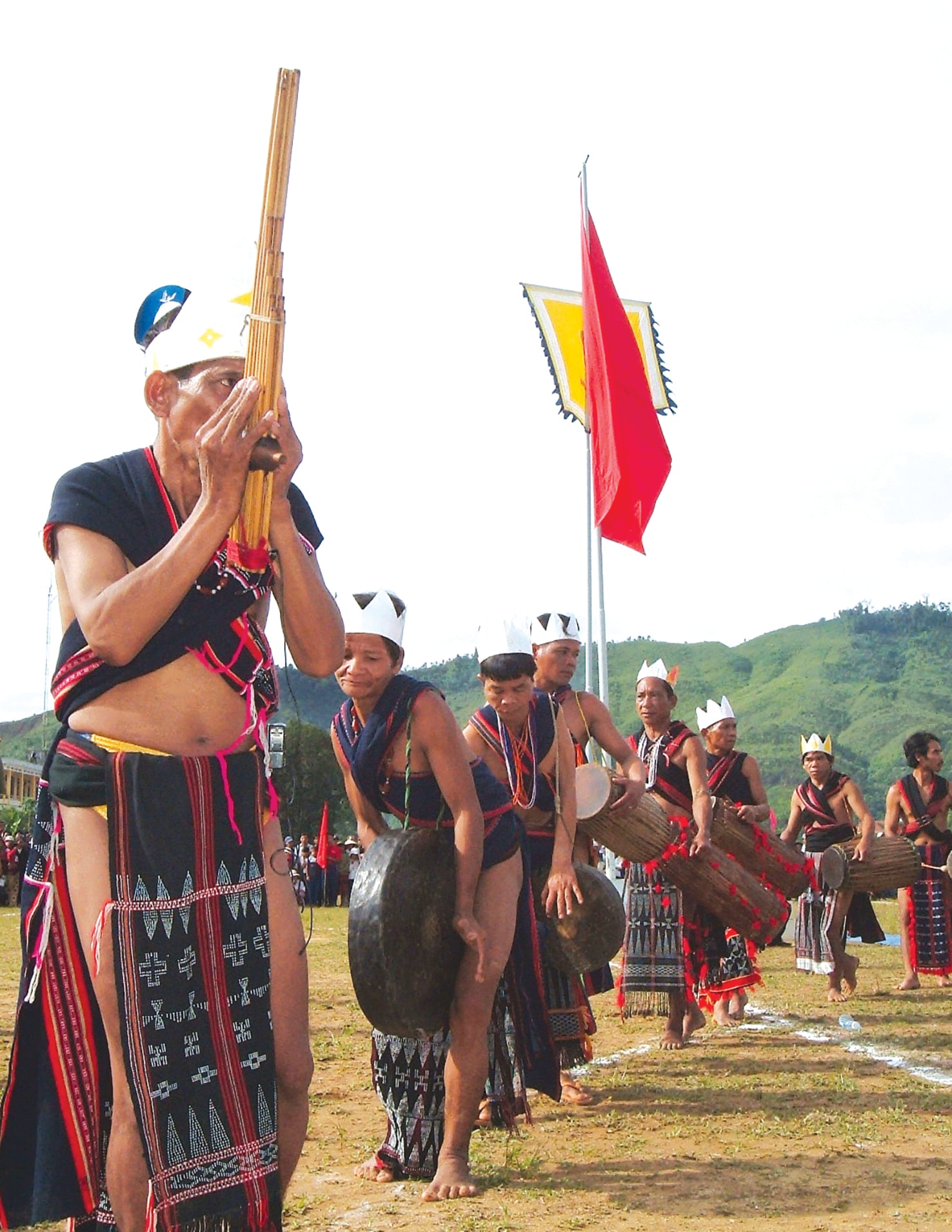
When gongs and drums learn to call each other
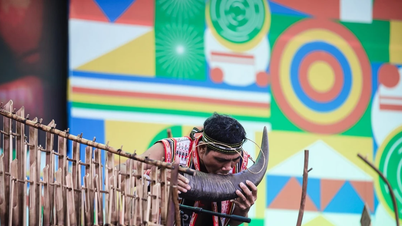
“The gongs and drums call out to each other and respond to each other in alternating single and double beats, then the entire gong ensemble rises up in harmony. In this harmony, we can clearly hear the Chơ-Gơr drums sometimes beating in unison.” A long-serving official in the former Hiên district once explained the “abundant sounds” of the Cơ Tu people’s gong ensemble, and this was recounted by musician Thái Nghĩa in his research on Cơ Tu gong art published in 2001. “That is the gong signaling that the village is entering a big and joyful festival,” the official from the former Hiên district added.
"A grand and joyful festival" - that's the festival featuring buffalo sacrifice. But if the orchestra lacks the deep, resonant sound of the gongs, then it's a smaller-scale festival, with only pork but no buffalo sacrifice… "Each type of gong has its own unique voice, and gong performances clearly demonstrate organization and express communal symbolism," musician Thai Nghia concludes.
To fully understand the sound of the gongs, musician Thai Nghia began collecting gong music and folk songs in western Quang Nam province in 1979. Through contact with artisans, careful notation, and verification, musician Thai Nghia recognized the characteristics, features, and connection of gongs to the lives of the Co Tu people.
“Every year, the Co Tu people organize many festivals. And if each festival corresponds to a cycle of agricultural production in the fields, then each ritual of the festival must also have rules for gong and drum ensembles that are appropriate to those rituals,” musician Thai Nghia observed. For example, in the buffalo feast festival, the artisans must adhere to five rituals when playing the gongs and drums…
Don't think the sound of gongs and drums is soulless in the vast forest. The villagers' feelings are all poured into them; even those far away can feel it, like the harmonious gong and drum performance of a "great and joyful festival." The Tâng tung da dá, the dance of offering to the heavens, is similar. Researcher Hoàng Hương Việt once observed that, amidst the rhythmic gong and drum music before the village communal house, the Cơ Tu girls spread their bare arms, expressing their support on all sides, while their feet firmly planted on the ground. Unwavering, like the word "pếc" (myself, my own) in the Cơ Tu language. This mountain, this land, is mine…
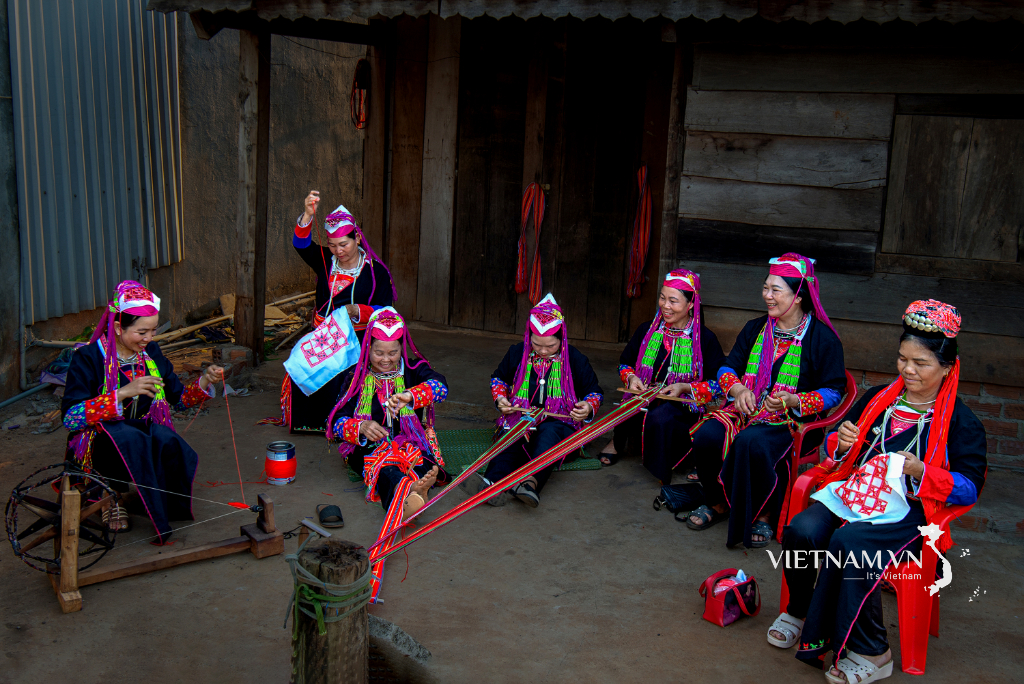
.jpg)
The rhythm of life "urges" the rhythm of music.
On the coastal side, the connections between folk music and traditional festivals of Quang Nam province become even more apparent.
Dr. Nguyen Van Manh ( Hue University of Education) once concluded that the traditional festivals of the Vietnamese people in Quang Nam maintain unique forms of folk literature, performing arts, and visual arts. They are even more unique when recognizing that this is a cultural region where various environmental landscape elements (forests, mountains, plains, rivers, and seas) intersect and integrate (Vietnamese, Chinese, Cham, and Western influences).
He listed that in the traditional festivals of the Vietnamese people in Quang Nam, besides religious rituals, there are at least 7 clusters of folk games and festivities. Among them are familiar forms of folk music such as Ba Trao singing (fishing festival, whale worship ceremony), Sac Bua singing (Tet festival), Bai Choi (popular in Tet festivals and mountain opening ceremonies), Tuong (Ba Thu Bon festival, mountain opening ceremony)...
More than 10 years ago, I had the opportunity to hear musician Xa Van Hung share the story of his years-long pursuit of transcribing the musical score of "Kéo neo nhịp lơi" and translating the 62-page original Han-Nom script of the traditional Vietnamese opera "Long thần bả trạo ca". When recounting his journey of collecting and translating the "Long thần bả trạo ca" script, the conductor and musician of three traditional Vietnamese opera troupes in Thang Binh and Hoi An concluded: Traditional Vietnamese opera is not merely a form of folk entertainment, but a spiritual and religious activity of fishermen…
According to musician Xa Van Hung's analysis, the traditional "ba trao" folk songs currently circulating in Quang Nam usually have three basic parts: setting sail and casting nets; the boat encountering trouble at sea and seeking help from the deity; and praising the benevolent deity who always protects and blesses the people. Reading them again, we realize that the stories of life on the water seem to have been perfectly "copied" into the songs and dances, thus creating the plays and stories for the fishing festivals and ceremonies honoring the deity.
From a musical perspective, the Bả Trạo dance combines the chanting style of Buddhist monks, the storytelling style of traditional opera, and elements of Quảng-style folk songs, Bài Chòi chants, funeral chants, and boat racing chants, as well as Huế-style poetry recitations. Professor Trần Quốc Vượng once offered a different, very interesting perspective: the Bả Trạo dance has the characteristics of a Mandala ritual in Buddhist ceremonies, as its prayers contain a lofty and profound humanitarian spirit encompassing all ten categories of beings. Not only Bả Trạo, but also extending to Sắc Bùa singing, Bài Chòi, and traditional opera, the rhythms of life outside the home blend and "urge" the rhythms in the music, culminating in a festival.
In the mountains, if the gongs and drums of the Chơ-Gơr festival call out to each other, letting visitors from afar know that a major festival (buffalo sacrifice) is taking place, then in the coastal region, familiar melodies also intertwine to form a festival. As in the lyrics of Thuận Yến's song "Aspiration," a musician from Quảng province, "Sending love to the land / yields branches full of fruit…", once folk music is incorporated into a festival, the community gains the sounds and nuances of local culture from daily life.
Source: https://baoquangnam.vn/gui-am-nhac-dan-gian-vao-le-hoi-3153958.html
![[Photo] General Secretary To Lam working with the Central Inspection Committee](https://vphoto.vietnam.vn/thumb/1200x675/vietnam/resource/IMAGE/2026/03/05/1772718314670_a1-bnd-8682-5192-jpg.webp)
![[Photo] Prime Minister Pham Minh Chinh receives the Minister of Emergency Situations of the Russian Federation.](https://vphoto.vietnam.vn/thumb/1200x675/vietnam/resource/IMAGE/2026/03/05/1772712011395_ndo_br_thiet-ke-chua-co-ten-76-png.webp)









































Comment (0)