

However, providing clean water to the remaining 20 communes, mainly in downstream areas, remains a "bottleneck" that needs to be addressed in order to achieve the goal of 100% of rural households having access to centralized clean water by the end of 2025.
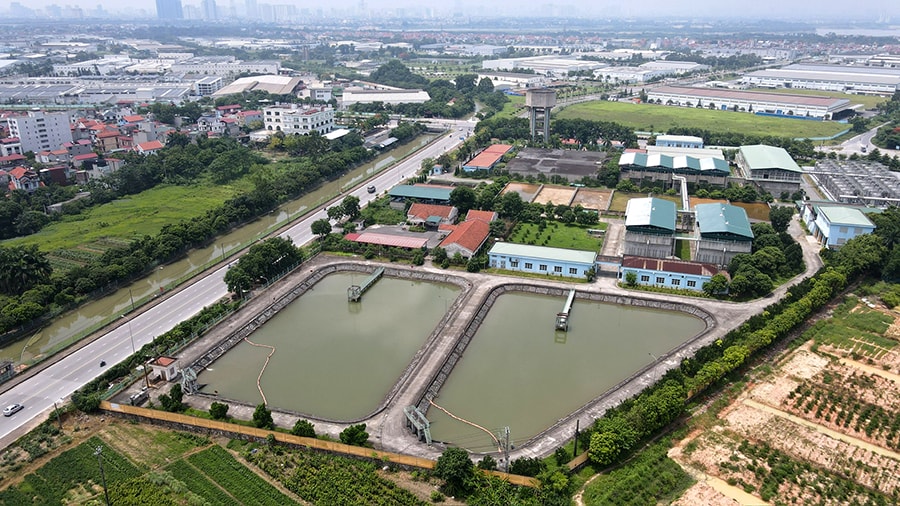
There are still "bottlenecks".
During the period 2021-2025, Hanoi implemented a comprehensive set of solutions to enhance the capacity for producing and distributing clean water. The designed capacity of the entire system increased from 1.52 million m³/day in 2021 to approximately 1.9 million m³/day in 2025.
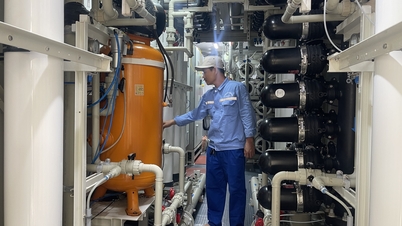
This increase in capacity stems from major projects, such as: the Da River Surface Water Treatment Plant completing phase 2, increasing its capacity to 600,000 m³/day; and the Red River Surface Water Treatment Plant currently in the preparation phase for commercial water supply. The increased source capacity helps the water supply system operate more stably. Actual water supply capacity is maintained at 1.3-1.5 million m³/day, sufficient to meet the needs of domestic use, production, security, and fire prevention and control. Many water treatment plants and stations have upgraded their equipment, ensuring water quality meets the standards of the Ministry of Health .
Simultaneously, the rural water supply network has been significantly expanded. In 2021, 247 out of 413 communes in Hanoi had centralized water supply systems. By the end of 2025, this number is expected to increase to 359 out of 413 communes (106 out of 126 communes after administrative reorganization from July 1, 2025), equivalent to 98% of rural households having access to clean water. This result reflects the tremendous efforts of the government system and the business community.
However, according to the Hanoi Department of Construction, 20 communes, following the administrative reorganization, have yet to complete their clean water connections. Most of these communes are located at the end of the water supply line, so their operation heavily depends on the progress of the source and transmission pipeline projects. Of these, 15 communes have achieved a connection rate of 90-95%, but are still incomplete due to unstable water pressure. Four other communes have only reached 70-85%, as the main pipeline is not yet completed. Ba Vi commune, in particular, still relies on gravity-fed water and requires a separate project from the state budget to ensure a long-term clean water supply.
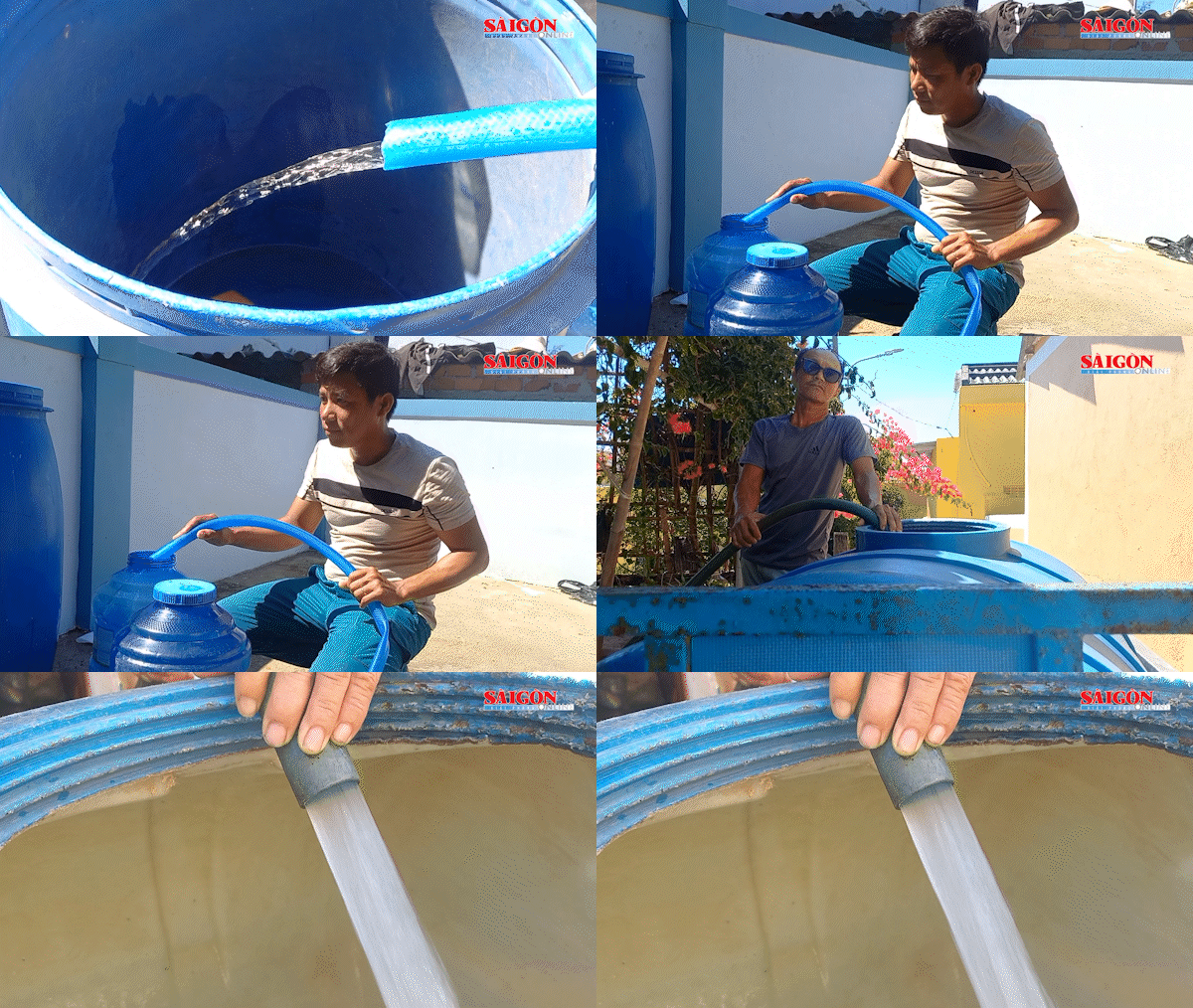
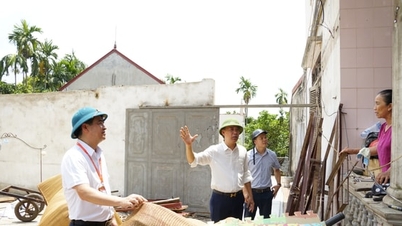
Mr. Duong Kim Lien (Yen Son village, Ba Vi commune) said that his family is currently using stream water piped down from the mountain. During the dry season, the stream sometimes dries up, affecting the family's daily life. Therefore, the family hopes to have access to clean water soon to ensure hygiene and greater stability.
These shortcomings stem from several causes. Some water source and transmission line projects are behind schedule due to land acquisition issues or route adjustments. Furthermore, since the projects are implemented through a public-private partnership model, their progress heavily depends on the investor's implementation capabilities. In many communes, the habit of using self-sourced water such as drilled wells and rainwater remains prevalent, leading to a low connection rate despite investment in the network. Another difficulty is that some transmission pipelines have been completed but not yet put into operation because the water source projects are not yet finished, causing disruptions in water regulation between regions.
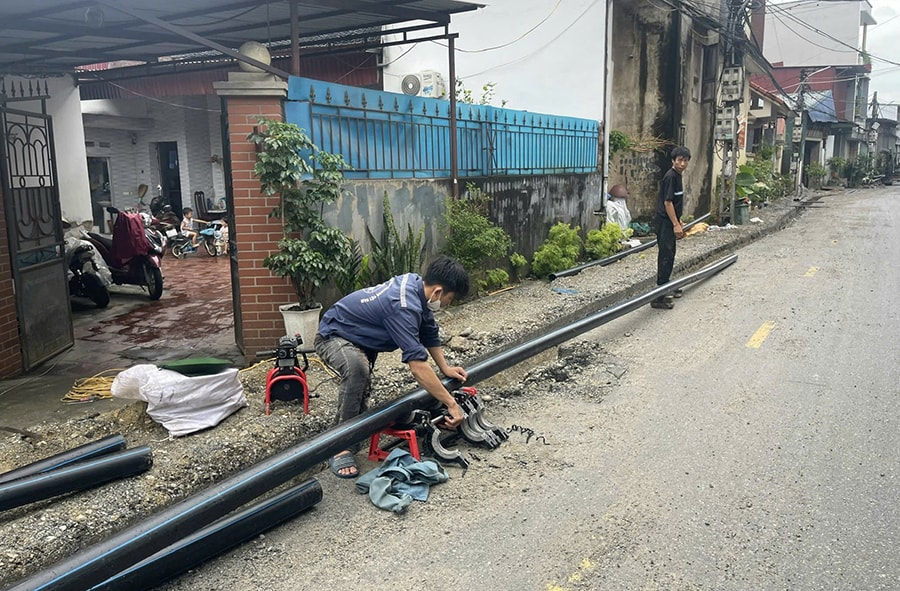
Focus on resolving difficulties for the last 20 communes.
To achieve the goal of 100% of rural households having access to clean water by 2025, Hanoi is implementing various solutions. According to Nguyen The Cong, Deputy Director of the Hanoi Department of Construction, the city is requiring water supply companies to urgently complete assigned source projects, especially the Red River Surface Water Treatment Plant and the transmission pipeline system. Completing the main pipelines will help stabilize water pressure in downstream communes and support the simultaneous completion of local water supply network projects.
For the water supply network in the remaining communes, the People's Committees of the communes are tasked with reviewing and resolving land-related issues and supporting the construction unit. In addition, monitoring progress, facilitating the transportation of materials, and supporting the construction of difficult sections will help shorten the completion time. For Ba Vi commune, the city requires the locality to urgently complete the necessary documents for investing in a clean water system using budget funds, suitable to the specific topographical conditions.
Regarding policy, the Department of Finance will coordinate with other sectors to develop support and incentive mechanisms for businesses investing in remote and disadvantaged areas – where costs are high but the potential for return on investment is low. At the same time, the Department will appraise and propose adjustments to policies for projects that are behind schedule, creating conditions for investors to accelerate implementation. The Department of Agriculture and Environment will coordinate with localities to support the handling of land issues, grant permits for pipeline construction through dikes, and guide people to temporarily use existing water sources according to standards.
In the long term, the Department of Construction is developing a Water Supply Development Plan for the period 2026-2030, aiming to expand and improve the capital's water supply system according to the plan until 2045, with a vision to 2065. This is an important foundation for ensuring water security, improving the ability to regulate water flow between regions, and meeting the rapid urbanization rate of Hanoi.
As an area that has already received investment in a clean water system, Nguyen Doan Hoan, Secretary of the Party Committee of Phuc Tho commune, said that the locality, in coordination with the water supply unit, has encouraged people to change their habit of using self-extracted water and encouraged them to connect to the centralized system to ensure health and water safety.
With the strong involvement of the city, the decisive actions of departments and agencies, and the efforts of water supply companies, Hanoi is nearing the goal of "covering" rural water supply networks. This is not only an infrastructure target but also a crucial contribution to building advanced new rural areas, ensuring social welfare and improving the quality of life for millions of people in the capital city.
Source: https://hanoimoi.vn/ha-noi-tang-toc-hoan-thanh-muc-tieu-nuoc-sach-nong-thon-727395.html




![[Photo] First session of the 14th Congress of the Vietnam Trade Union](https://vphoto.vietnam.vn/thumb/1200x675/vietnam/resource/IMAGE/2026/06/03/1780465947883_ndo_br_img-3852-jpg.webp)








































![[Video] Sunset at Lap An Lagoon – Where the sun sets over the fishing nets](https://vphoto.vietnam.vn/thumb/1200x675/vietnam/resource/IMAGE/2026/05/31/1780192137701_beach-landscape-sea-water-nature-grass-745871-pxhere-com.jpeg)





































Comment (0)