

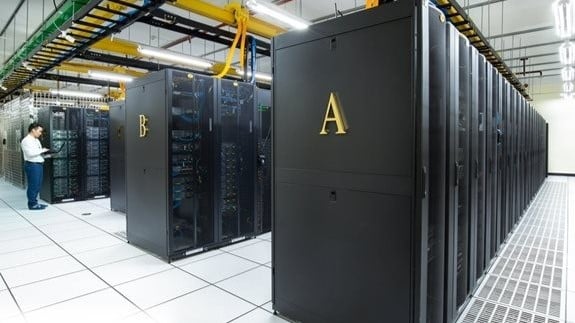
The Digital Infrastructure Development Strategy to 2025, with a vision to 2030, approved by the Prime Minister under Decision No. 1132/QD-TTg, aims to build a modern, secure, and sustainable digital infrastructure ecosystem. Initial results, from online public services to telecommunications networks, data centers, and digital platforms, demonstrate that Vietnam's digital infrastructure is undergoing a strong transformation, becoming a crucial foundation for enhancing national competitiveness in the data economy era.
Digital infrastructure is making breakthroughs.
With just a computer connected to the internet, in about 10 minutes, Mr. Nguyen Van Tuan in Hanoi completed the online passport application process for his son. No waiting, no queuing, and no need to go to the office in person. After about a week, the passport will be delivered to his home. “I find it very convenient and fast. For a cost of nearly 200,000 VND, I only need to take a photo of my son and fill in all the information to complete the passport application,” Mr. Tuan shared.
That convenience stems from a smoothly operating digital infrastructure, which shapes how the entire system functions.
In the digital age, digital infrastructure is not just a technical tool but also a strategic factor determining national competitiveness. Digital infrastructure is composed of technical infrastructure, data infrastructure, and application infrastructure. According to experts, technical infrastructure must cover all layers from end users to servers and data storage, while ensuring universal and high-speed network connectivity. Data infrastructure needs to be managed according to the principles of "accuracy, completeness, cleanliness, viability, uniformity, and shared use." Application infrastructure includes platforms and services deployed in socio-economic life, from online public services to AI, IoT products, and digital economy applications.
The core elements of a strong digital infrastructure include technology, security, institutions, and people. Data institutions must be clear, avoiding overlaps and obstacles; technology requires mastery to avoid dependence on foreign countries; security and safety are essential to protect data from attacks; and people need a team of core technology experts and a wide user base to effectively utilize the infrastructure.
Vietnam's telecommunications and internet infrastructure has developed strongly in recent years with numerous undersea and international fiber optic cables; widespread 4G and 5G networks, with plans for 6G deployment; along with name networks, domain name servers, and IPv6. Vietnam is currently among the top 7 in the world and ASEAN in IPv6 adoption rate, with 65% of users having switched.
“Vietnam’s technical infrastructure is developing at a breakneck pace,” said Mr. Nguyen Truong Thanh, Technical Director of the Vietnam Internet Center. Vietnam’s telecommunications and internet infrastructure has developed strongly in recent years with numerous undersea and international fiber optic cables; widespread 4G and 5G networks, progressing towards 6G deployment; along with name networks, domain name servers, and IPv6. Vietnam is currently among the top 7 in the world and ASEAN in IPv6 adoption rate, with 65% of users having switched. This is an important stepping stone to ensuring the safe and sustainable development of digital infrastructure.
According to the 2024 report by the Vietnam Cloud Computing and Data Center Club (VNCDC), data center capacity is experiencing strong growth, projected to increase from 45 MW in 2024 to 525 MW in 2025 and nearly 1,000 MW in 2030. Revenue from leasing space, power, IP, and bandwidth at data centers for hosting servers and network equipment is expected to reach US$1.4 billion by 2030.
Telecommunications companies like VNPT and Viettel have also made significant contributions to this process. VNPT is deploying internet, mobile network, and satellite connectivity projects to ensure comprehensive connectivity across land and sea, aiming to transform Vietnam into a regional connectivity hub. Viettel also reported strong development in information and communication technology infrastructure, with applications in agriculture, forestry, the economy, and national security and defense. Data center capacity is projected to reach 524.7 MW by 2025, and Viettel is also a leader in the application of green data centers.
Removing bottlenecks to ensure safe and sustainable system development.
However, the "heart" of the digital-data infrastructure still faces bottlenecks regarding standardization, interoperability, green energy, and mastery of core technologies. Addressing these challenges is essential for Vietnam to achieve its national digital transformation goals, create momentum for building a safe and sustainable digital infrastructure, and contribute to leading the way in the global data economy era.
Professor Ho Tu Bao, from the Institute for Advanced Studies in Mathematics and a member of the National Advisory Council on Science, Technology, Innovation, and Digital Transformation, pointed out the shortcomings: Despite having many data centers and policies to build national data infrastructure, data has not followed a unified architecture, limiting connectivity and sharing, and lacking high-performance computing infrastructure, hindering the exploitation of big data and the development of core technologies.
Mr. Nguyen Xuan Hoa, Global Market Director of ABB Technology Group, believes that foreign investors are hesitant to invest in data centers, mainly due to inadequate power infrastructure and the lack of "green" energy sources. Limitations in international connectivity and operational capacity are barriers for Vietnam in attracting global technology corporations and achieving Net Zero targets. To overcome these challenges, Vietnam needs to control cloud infrastructure and foundational technologies, while investing in multi-route international connections with 2-3 times the redundancy to enhance connectivity, protect data, and improve sovereignty. Clean energy is also a prerequisite for building large-capacity data centers.
Mr. Nguyen Xuan Hoa noted that delays would mean investment opportunities would go to other countries. Mechanisms and policies also need to be improved, including data laws, data sharing regulations, investment incentives for data centers, and encouragement of green energy. For example, Malaysia, where investors receive tax refunds on imported equipment, attracts global data centers; Vietnam could adopt a similar mechanism to promote the development of digital infrastructure.
Public-private partnerships are a strategic solution to connect stakeholders, share risks, and effectively utilize resources. Pioneering digital technology companies will operate and deploy applications, while the government ensures the legal framework, cybersecurity, and data sovereignty.
According to Ms. Nguyen Thi Ngoc Dung, Chief of the Office of the National Data Association, data human resources are crucial, with data experts and engineers forming the core force operating digital infrastructure and mastering core technologies. The Association has implemented intensive training programs and international cooperation to build a team of data operators and develop core technologies. Data human resources are considered a strategic factor, similar to the role of physical infrastructure engineers in the development of traditional infrastructure.
Public-private partnerships are a strategic solution to connect stakeholders, share risks, and effectively utilize resources. Pioneering digital technology businesses will operate and deploy applications, while the State ensures the legal framework, cybersecurity, and data sovereignty. Digital application infrastructure also needs to maximize the use of big data, from public service platforms and digital identity cards to AI in healthcare, education, finance, tourism, and smart cities. With effective data connectivity, Vietnam will develop a high-value-added digital economy and expand into international markets.
Source: https://nhandan.vn/ha-tang-so-quoc-gia-but-pha-manh-me-post926689.html


































































































Comment (0)