

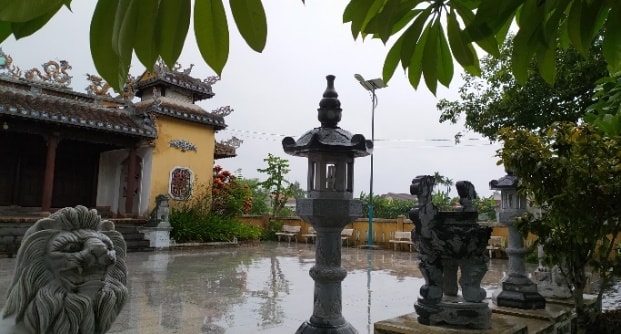
This book introduces the family tree.
In 1959, the book "A Document on the Southern Migration of Our Ancestors" was published in Saigon. The author was Lam Hoai Nam, the pen name of Nguyen Le Tho, who was then the District Chief of Que Son District.
The book primarily introduces the two genealogies of the Pham and Nguyen clans, two prominent clans of Quang Nam at that time. These two genealogies occupy nearly 70 pages out of the book's 109 pages.
The author specifically explains the reasons and purpose behind the book's creation in the preface: "On the occasion of a plea regarding private land ownership between the Pham and Nguyen clans (the Pham clan had 500 voters, the Nguyen clan had 350 voters) in Phu Huong commune, Que Son district, because the commune council reduced the amount of private land, citing the reason that public land in the commune was very little and had not been allocated in the past, how could that be?"
To fully understand the issue, after contacting representatives of the two clans, we asked them to look up the ancestral records and genealogies of the two clans that are still preserved (records from the time of the Pham clan's ancestor Pham Ngu Lao) (...).
We are also honored to have the good fortune to bring to light the glorious achievements of the pioneering warriors and founding fathers who, during a period of turmoil, were largely unknown to the people and therefore could not be honored."
Thanks to this book, two rare genealogical records have been widely introduced and have attracted the attention of researchers. These are two of the oldest and earliest published genealogical records in the southern Quang Nam region.
Lineage of meritorious officials
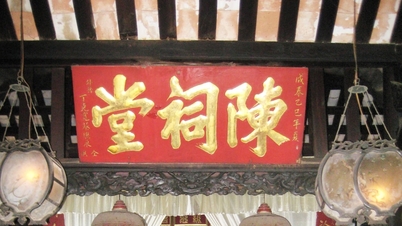
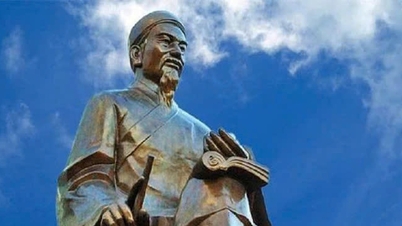
It is unclear who compiled the Phạm clan's genealogy; all that is known is that a person in the 14th generation "took over" the work because the old genealogy was "torn up." According to the genealogy, the founding ancestor of the Phạm clan (in Hương Quế and Đồng Tràm villages) was Phạm Nhữ Dực, a descendant of Phạm Ngũ Lão.
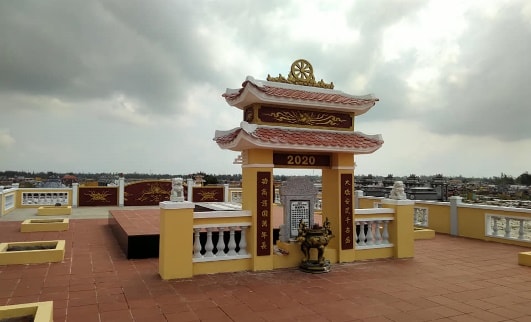
He was appointed by Ho Quy Ly to the South in 1402 as Chief Military Commissioner of Thang Hoa Prefecture, responsible for pacifying the Cham people and relocating Vietnamese people to settle in the new land.
He died in 1409 and was buried in Dong Tram village (Huong An commune).
According to the family genealogy, Phạm Nhữ Dực's eldest son was Phạm Đức Đề, who led troops against the Champa after the 1407 incident.
Pham Duc De's eldest son, Pham Nhu Du, had previously assisted Le Loi and was appointed as the governor of Thang Hoa prefecture.
Pham Nhu Du's son, Pham Nhu Tang (4th generation), followed Le Thanh Tong in the campaign against Champa in 1471, and later took charge of the Quang Nam province.
Pham Nhu Tang's son, Pham Nhu Trieu, served as Chief Commander of the Six Central Military Commissions under Emperor Le Thanh Tong.
According to the family tree, the Pham clan has two branches. The first branch is in Dong Tram village, with Pham Duc Doi as its founding ancestor. The second branch is in Huong Que village, with Pham Nhu Tang as its founding ancestor.
The genealogy of the Nguyen clan in Huong Que village states that the clan's founder was Commander Nguyen Van Lang (1496 - 1573), also known as Nguyen Van Giau, originally from Tien Bao commune, Nghi Xuan district, Duc Quang prefecture, Nghe An province. He migrated south and settled in Huong Que village. The genealogy records his death on the 17th day of the 12th lunar month of the Quy Dau year, at the age of 78 (page 70). Thus, he was born in 1496 and died in 1573.
This family tree was written by Nguyen Van Dinh, a descendant of the eighth generation of the family, between 1774 and 1777 (during the reign of Lord Nguyen Phuc Thuan). In reality, it is more of a "briefly compiled history of the Nguyen family" than a true family tree.
The document states: "Our ancestors were people who rendered great services and were honored by the imperial court. If we do not leave behind any records, it would be like being in a house at night without a torch, so we must compile this historical record so that future generations will not be misled."
Nguyen Van Lang had four sons, the second of whom, Nguyen Ngoc Thanh, was revered by the villagers of Huong Que as one of the three founding fathers of the village. All four served as officials under the Nguyen lords.
In addition, subsequent generations such as Nguyen Ngoc Diem (3rd generation), Nguyen Ngoc Chanh (4th generation), Nguyen Van Vinh (7th generation), Nguyen Van Thuan, Nguyen Van Hy (8th generation)... were all meritorious individuals under the Nguyen lords and the Nguyen dynasty.
The two genealogies of the Nguyen and Pham clans are considered to be the earliest and most complete, carefully preserved by their descendants.
Although many issues still need further investigation and clarification, this is a valuable historical document, providing some information about the arduous period of our ancestors' conquest of Champa and expansion of the territory, and about the early period of establishing villages and communities in the Quang Nam region.
This also serves as the basis for providing documentation for the recognition and preservation of historical and cultural relics in the area.
Source: https://baoquangnam.vn/hai-bo-gia-pha-quy-3147243.html


![[Photo] General Secretary and President To Lam presides over a working session with the Central Policy and Strategy Committee on the development of the materials industry.](https://vphoto.vietnam.vn/thumb/1200x675/vietnam/resource/IMAGE/2026/05/21/1779359935432_a3-bnd-3129-1412-jpg.webp)
![[Photo] National Assembly Chairman Tran Thanh Man working with the Standing Committee of the Law and Justice Committee](https://vphoto.vietnam.vn/thumb/1200x675/vietnam/resource/IMAGE/2026/05/21/1779378929214_ndo_br_1-4610-jpg.webp)






































































Comment (0)