

Genealogical record written on cloth
The Dinh clan church in Hoa Ha village, Tam Thanh commune, Tam Ky city, still preserves a genealogical record written on a piece of white, hand-woven cloth, which the clan calls "eight-fabric".
This large piece of cloth, approximately 1.2 meters wide and 3.6 meters long, details of the lineage are recorded. Alongside it, the names of the Dinh clan members, their spouses, their descendants, the places of residence for each generation, their burial sites, and even their death anniversaries are clearly documented.
All the details mentioned above are arranged in a vertical layout – exactly like the writing style on long scrolls from the ancient Confucian era. The person who compiled the family tree followed the rule of "living in red ink, deceased in black ink" (living people recorded in red ink, deceased people recorded in black ink) when writing the final section about relatives who lived during their time.
The beautiful calligraphy on the aforementioned cloth-bound family tree belongs to Mr. Dinh Van Thong, the 13th generation of the Dinh clan in Hoa Thanh village, Phu Quy commune, Ha Dong district, Tam Ky prefecture.
Mr. Thong was born in 1871, passed the Confucian scholarly examination around the beginning of the 20th century, and was a renowned teacher in the southern coastal area of Tam Ky. When the Confucian examination system was abolished, the contemporary government invited him to teach Confucianism at the French-Vietnamese primary school in Tam Ky district. From then on, he was affectionately called "Teacher Tu Dinh" by many parents.
Through this special family tree written on cloth, we learn that the founding ancestor of the Dinh clan in Hoa Thanh village, now Tam Thanh commune, originated from Ninh Binh province and settled in the coastal area of Dien Ban district. Later, his descendants moved to the coastal area of Thang Binh before the 12th generation settled in Hoa Thanh commune, on the coast of Ha Dong - Tam Ky district.
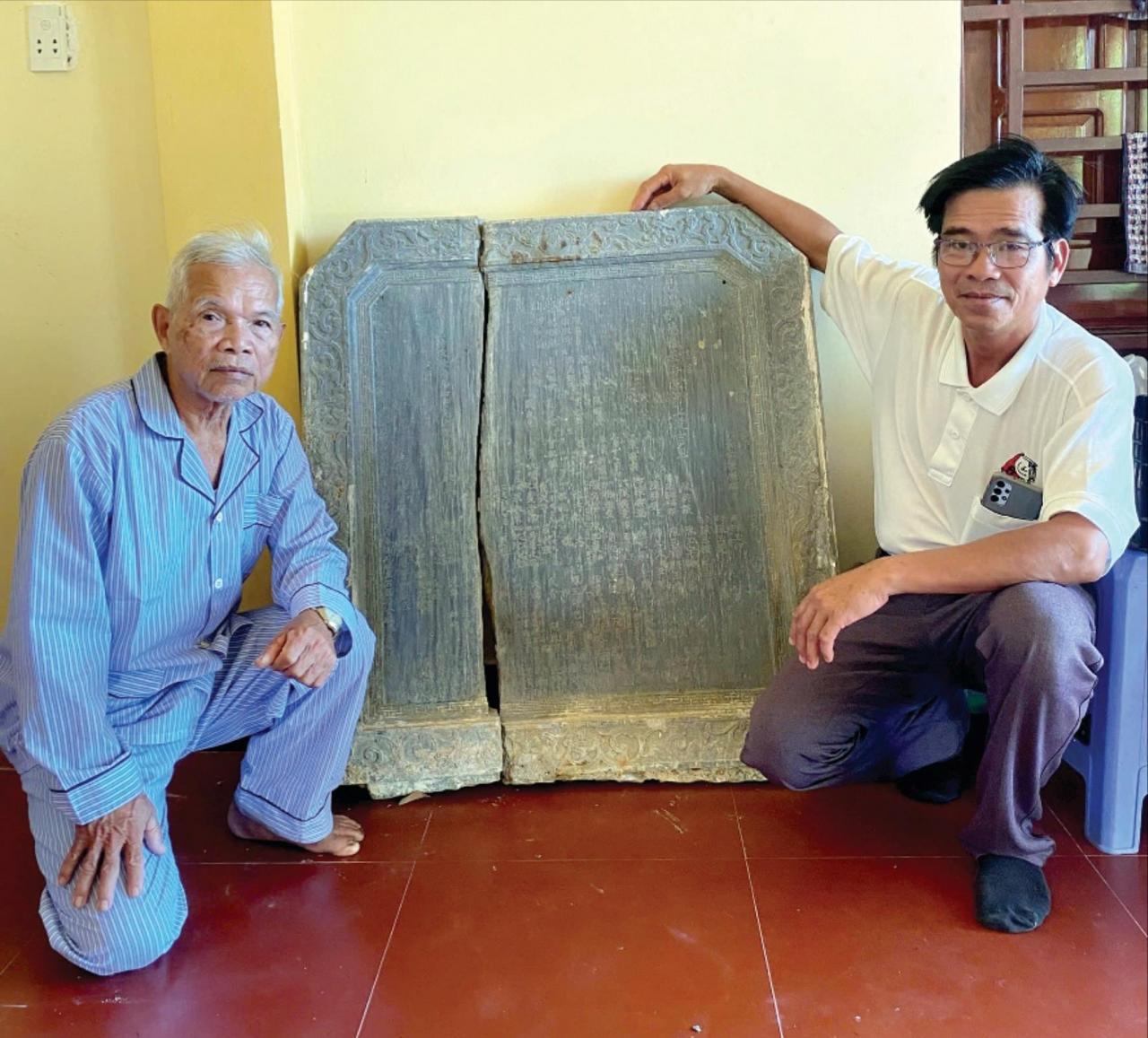
Genealogy inscribed on stone
The Tran clan church in Bich An village, Tam Xuan 1 commune, Nui Thanh district, currently preserves a stone stele measuring 1.2 meters high and 1 meter wide.
The front of this stele is inscribed with 24 vertical lines containing approximately 600 Chinese characters of various sizes. At the top of the stele is a large horizontal line inscribed with the words "Trần Đại lang tự sở xuất" (roughly translated: from the Trần family's descendants downwards).
The largest font size is shown on the line describing the date of erection of the stele: "Hoang Trieu Tu Duc thap nhat nien, That nguyet, thuong hoan, cat nhat" (This stele was erected on an auspicious day, between the first and tenth days of the lunar calendar, July 1858, the 11th year of the Tu Duc reign).
The inscription in medium font records eight generations of descendants, from Mr. Tran Dai Lang to Mr. Tran Ngoc Suy (the person whose name is on the stele).
Along with the main details about names and lineage, there are smaller footnotes about burial places, death anniversaries, and other details about important members of the family. Among these is Mr. Tran Hung Nhuong (sixth generation), who was once the tutor of Prince Hong Nham (later Emperor Tu Duc).
In particular, besides the lines describing the family lineage, there is a line near the end that reads, "The content of this stele was drafted and reviewed by Nguyen Duc, Deputy Scholar of Ha Dong District, who held the position of Prefect in Hai Duong Province and was appointed as a Composer in the Imperial Cabinet" (translation: The content of this stele was drafted and reviewed by Deputy Scholar Nguyen Duc - who was serving as Prefect in Hai Duong Province and held the rank of Composer in the Imperial Cabinet).
It is known that, according to ancient custom, important folk texts - especially inscriptions - were considered an honor for the family if they were reviewed by a scholar of the time.
Two genealogical records written in various scripts.
The tomb of the ancestor Le Tay Tru of the Le clan - the founding ancestor of Phu Hung village, Phu Quy commune, Ha Dong district (now in Phu Binh village, Tam Xuan 1 commune, Nui Thanh district) - has an inscription recounting how the founding ancestors of the Le clan migrated from the north to the land south of the Tam Ky river confluence to establish their settlement.
What's special is that this inscription is written in three languages—Chinese, French, and Latin-based Vietnamese—on the vertical surfaces within a carved image of a three-tiered tower: Chinese characters at the top, French below, and Vietnamese at the bottom.
From the inscription, we learn that the founding ancestors of the Le clan in Phu Hung village originated from the coastal area of Than Phu, Nghe An . The Chinese text records this migration as follows: "During the Hong Duc era, following the decree of the Champa colonizers, the Ancestor and the First Ancestor joined the campaign and resided there, joining forces with the Nguyen, Tran, and Do clans to reclaim public and private land, thus establishing the territory and founding the village of Tan Khuong. During the Chanh Hoa era, it was changed to Phu Khuong, later to Phu Hung."
The genealogical record, translated into Vietnamese, reads: "During the Hong Duc era, following the court's order to take over the Champa territory, our ancestor and the first-generation patriarch of our clan joined the battle and remained, along with the Nguyen, Tran, and Do clans, to cultivate public and private land. After defining the village boundaries, they requested the establishment of a commune name."
On the tombstone of the ancestor of the Nguyen clan in Bich Ngo village, Duc Hoa commune, Tam Ky district (now at Go Trau cemetery, Tam Xuan 1 commune, Nui Thanh district), there is also a genealogical record inscribed in three scripts: Chinese characters, Nom script, and Latin-based Vietnamese.
The genealogical record recounts how the clan's ancestors moved south of the Tam Ky River and established two villages, Cay Vong and Cay Bong. Later, Cay Vong changed its name to Bich Ngo, and Cay Bong village separated to become a distinct place called Bong Mieu.
At the end of this three-character genealogical record, there is an eight-line, seven-character poem with the first four lines as follows: “Since arriving in Quang Nam province/ Born and raised here today/ Planning for the sake of descendants, we have cultivated the land/ Respecting the gods and saints, we have built a temple…”.
Source: https://baoquangnam.vn/nhung-ban-pha-ky-dac-biet-o-tam-ky-xua-3146921.html





















![[Photo] Prime Minister Pham Minh Chinh holds a phone call with the CEO of Russia's Rosatom Corporation.](/_next/image?url=https%3A%2F%2Fvphoto.vietnam.vn%2Fthumb%2F1200x675%2Fvietnam%2Fresource%2FIMAGE%2F2025%2F12%2F11%2F1765464552365_dsc-5295-jpg.webp&w=3840&q=75)














































Comment (0)