

In Tien Giang , harvesters climb trees, tapping the peel with the handle of a knife and observing the color, thorns, and stem of the fruit to select high-quality durians, earning millions of dong each day.
Early in the morning at the end of November, the 4,000 square meter durian orchard in Phu Quy commune, Cai Lay town, echoed with the clattering sounds and laughter of the harvesting workers. High up in the trees, 28-year-old Dang Quoc Tan used the handle of a knife to tap around the durian fruit, then used the knife to cut at the stem. Ripe fruits fell from one person to another, who caught them in a plastic basket at the base of the tree.
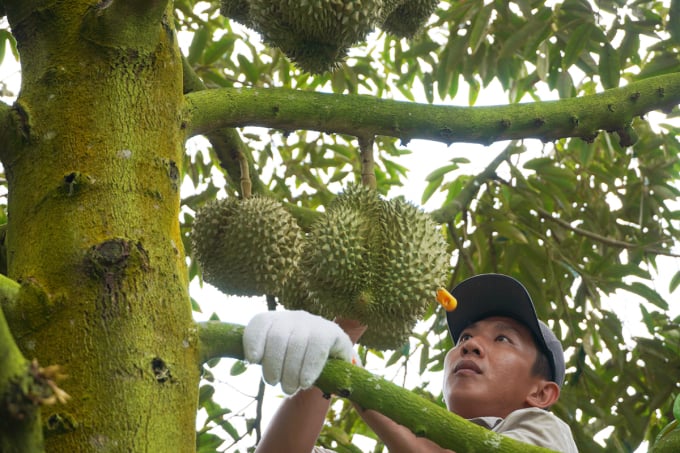
Dang Quoc Tan uses the handle of a knife to tap around the durian shell to check its quality before cutting it. Photo: Hoang Nam
Tien Giang is the "durian capital" of the Mekong Delta, with an area of 18,000 hectares in the districts of Cai Be, Cai Lay, Chau Thanh, and Cai Lay town. Currently, 10,000 hectares are bearing fruit with an average yield of 26.4 tons per hectare. Farmers here are in the off-season durian harvest, which lasts until January next year, with an estimated production of 200,000 tons. Monthong durians are purchased directly from the orchards by traders at prices ranging from 130,000 to 145,000 VND per kilogram.
After about four hours, Tan and a group of 5-6 people finished harvesting nearly 4 tons of ripe durian. Despite wearing protective gloves, the young man's hands were still covered in scars from thorns after many years. His unprotected arms and legs had many scratches and tears from the thorns.
Four years ago, Tan was a truck driver transporting durian for traders. After repeatedly encountering groups of high-earning durian pickers, he asked to join them to learn. Initially, apprentices like Tan were assigned the task of standing under the trees and using baskets to catch the fruit. The pickers would then gradually instruct them on how to distinguish ripe, mature, and unripe durians based on the sound they made when tapping the shell.
"Ripe durians have shriveled, dry skin, and hollow spaces inside, so when tapped, they make a rattling sound that resonates far. Conversely, unripe durians have dense flesh, resulting in a dull, hollow sound," Tan said, adding that harvesters can also distinguish ripe durians by whether the skin is yellow or green, the base and tips of the thorns are dry and dark, the stem is open, and other specific characteristics of each type of durian.
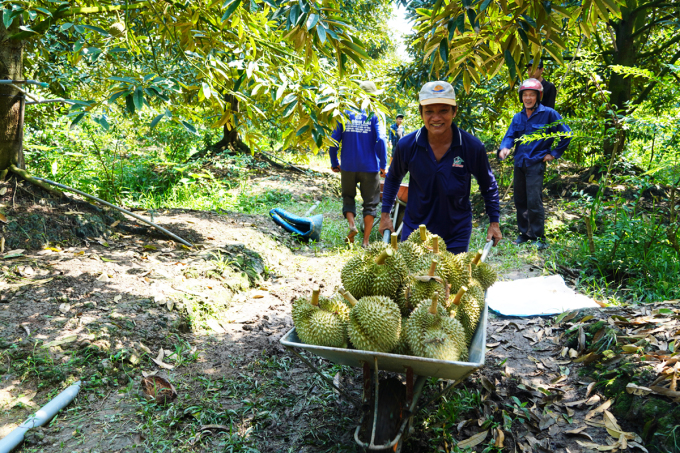
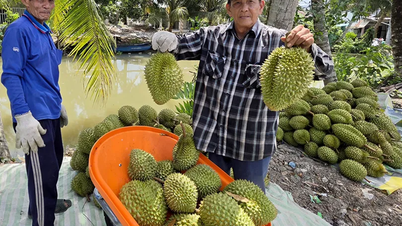
Farmers in Phu Quy commune use wheelbarrows to push durians from the orchards to collection points where traders wait to weigh them. Photo: Hoang Nam
Typically, the purchasing unit sets a limit of 30-50 kg of low-quality durian per ton, not accepting unripe fruit. However, many inexperienced workers often mistakenly cut unripe durians and have to compensate for the damage. "It takes about two years to become a professional durian cutter," Tan said, adding that besides being a cutter, he also buys durian in small quantities from orchards, about 4-7 tons per day, to resell to warehouses.
According to Mr. Tan, each durian orchard is divided into two harvesting periods, each about a week apart. Besides the main season, the area of off-season durian cultivation is also increasing rapidly, so harvesters have work almost year-round. After the durian season ends in Tien Giang, following the Lunar New Year, they will continue working in Can Tho and Soc Trang, and at the end of the season, they will move to Dak Lak and Lam Dong.
Although there are harvesters in other regions, during the peak durian season when prices are high, traders often bring along local harvesters – usually brothers who have worked together for many years. "With a price of 130,000 VND per kilogram, a 5-6 kg durian would be worth 600,000-800,000 VND, so traders still use familiar harvesters because they trust them," Mr. Tan said.
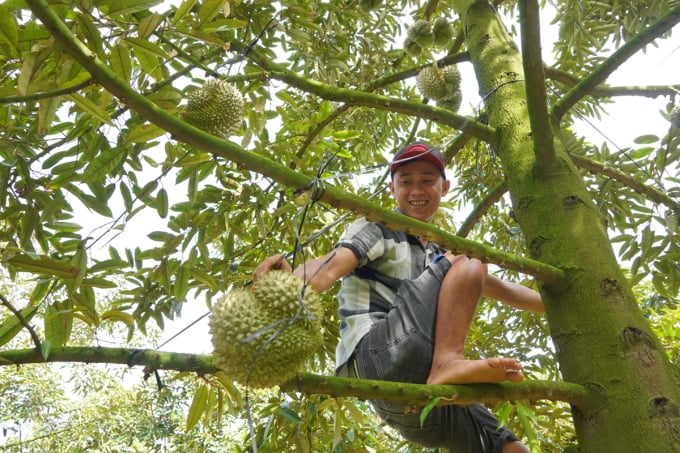
Mr. Nguyen Tan My has over 9 years of experience cutting durians with his bare hands. Photo: Hoang Nam
With over 9 years of experience, 26-year-old durian harvester Nguyen Tan My from Hoi Xuan commune said that durian cultivation in the Eastern region is extensive, yielding hundreds of tons per day, so harvesters are paid by the kilogram. Depending on whether the durian is harvested on-site or transported to the warehouse, the price per kilogram ranges from 1,500 to 3,000 VND, and harvesters must compensate for any durians that are harvested prematurely.
If the trees aren't too tall, a seasoned worker like Mr. My can harvest up to 10 tons of durian per day. Conversely, in the Mekong Delta, durian production is lower, and workers are usually paid by the day, at a rate of 1-1.5 million VND.
Due to the attractive pay, many young people in the area who used to be landscape trimmers have started learning the trade of pruning durian trees. But even for skilled pruners like Mr. My, this job also carries many risks. A week ago, while climbing a tree about 3 meters high, he lost his footing but luckily landed on a branch, suffering only minor scratches.
"Last year, a member of the team was hidden in the foliage, and the harvester above didn't see him, so he threw a durian that hit him in the face, requiring nearly 10 stitches," My recounted.
Hoang Nam
Source link


![[Image] Shipbuilders exposed to steel and record-breaking heat.](https://vphoto.vietnam.vn/thumb/1200x675/vietnam/resource/IMAGE/2026/06/04/1780545781745_ndo_br_img-5402-4683-jpg.webp)






















































![[Video] Sunset at Lap An Lagoon – Where the sun sets over the fishing nets](https://vphoto.vietnam.vn/thumb/1200x675/vietnam/resource/IMAGE/2026/05/31/1780192137701_beach-landscape-sea-water-nature-grass-745871-pxhere-com.jpeg)




































Comment (0)