

Stir - wake up - reach out
The turbulent events stemming from the "underground contracting" and "contracting system 10" implemented by Party Secretary Kim Ngoc (Vinh Phu province) were summarized, forming the foundation for the Politburo 's later issuance of Resolution 10-NQ/TW on April 5, 1988, on the Reform of Agricultural Economic Management. Resolution 10 has gone down in the history of the revolution during the reform period, creating a positive direction in exploring new management methods in agriculture, linking the interests of farmers with the results of their labor, changing the structure of agricultural production; enhancing labor motivation and increasing output, achieving food self-sufficiency, leading to an abundant rice supply, laying the foundation for market-oriented agriculture, shifting from self-sufficiency to production linked to consumption and orienting the "rice economy" towards export. Recognizing the contributions of then-Provincial Party Secretary Kim Ngoc, General Vo Nguyen Giap wrote: "The country owes a debt of gratitude to Kim Ngoc. A dedicated man who dared to introduce new ideas, the country's development today is thanks to rice, which Ngoc pioneered."
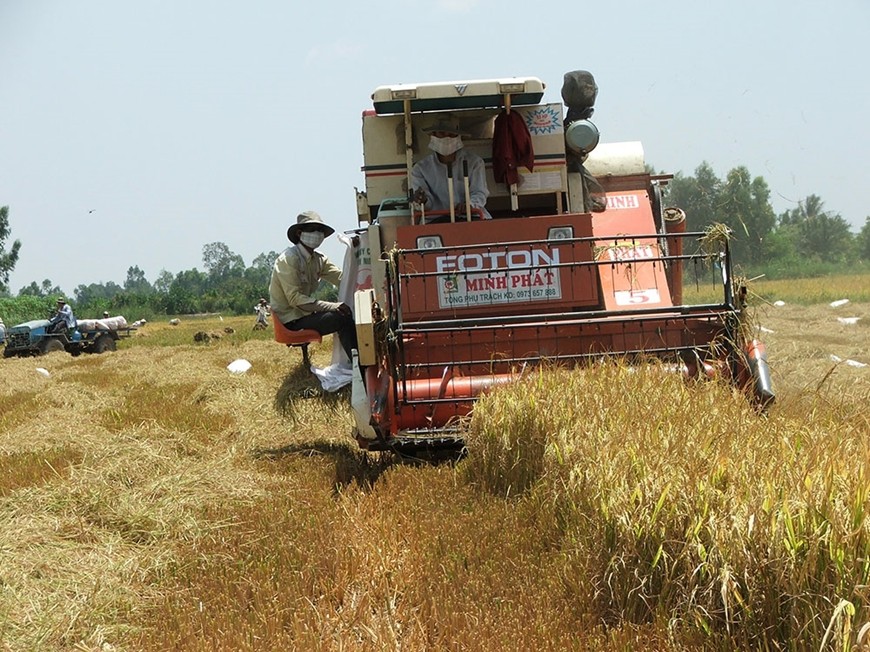
Farmers in Tam Binh district, Vinh Long province, are harvesting rice.
A turning point in Vietnamese rice trade and a significant milestone in its journey to the global market was the historic event of August 23, 1989, when the first shipment of 10,000 tons of 35% broken rice, priced at US$235 per ton, was exported to India. In just over four months at the end of 1989, Vietnam exported 1.4 million tons of rice, achieving a turnover of US$322 million, with an average export price of US$226 per ton. This event marked the beginning of Vietnamese rice's continuous development over several decades and had a considerable impact on the global rice market.
Ten years later (in 1999), Vietnamese rice marked a new historical milestone with export revenue exceeding US$1 billion for the first time, with a production volume of 4.6 million tons and an average export price of US$227/ton. Vietnam officially became one of the world's leading rice exporting countries. Ten years after that (in 2009), Vietnam's rice export volume exceeded 6 million tons for the first time, with a value of nearly US$2.5 billion.
In 2011, Vietnamese rice production reached a record high of 7.1 million tons, generating $3.65 billion in revenue, with an average export price of $495 per ton. This period also marked the beginning of efforts to improve rice quality and build a Vietnamese rice brand in the international market. On June 30, 2022, after passing an extremely rigorous testing process with over 600 criteria, Vietnamese rice was exported under its own brand. From then on, the reputation of Vietnamese rice spread rapidly throughout the world.
Reaching out to the world, we cannot forget November 12, 2019, when ST25 rice, bred by engineer Ho Quang Cua (Soc Trang), was honored for the first time at the "World's Best Rice" award in Manila (Philippines). And for the second time, ST25 rice reached the pinnacle of glory, winning first prize in 2023! This marks a new beginning for Vietnamese rice on its journey to establish a global reputation. Upon receiving this award, Labor Hero Ho Quang Cua shared: “Driven by national pride and a deep love for rice, I thought, if Thailand can do it, why can't we? Therefore, I made a firm decision and strived to successfully breed a fragrant Vietnamese rice variety. I believe ST25 will open a new chapter in the development of the Vietnamese rice market.”
The story of Vietnamese rice is not just about the rice fields; it's also about the market, prices, competition, timing, and adapting to changing circumstances, sometimes even driven by a sense of duty and sentiment! For example, in July 2023, India banned the export of Non-Basmati white rice. This decision created significant export opportunities. Seizing this opportunity, Vietnam accelerated its exports, exporting an additional 1.2 million tons of rice, earning approximately $780 million, bringing the total annual export to 8.3 million tons, worth $4.78 billion, a 38.4% increase compared to 2022.
Thanks to its established reputation, the rice grains of the Mekong Delta are increasingly thriving. Vietnamese businesses such as Loc Troi Group, Trung An High-Tech Agriculture Joint Stock Company, Vietnam Seed Corporation - Vinaseed, Tan Long Group, etc., are more confident in investing and collaborating with farmers and cooperatives to build specialized rice-growing areas, export-oriented rice raw material zones, and rice brands. This aims to leverage the advantages of free trade agreements (FTAs) to penetrate large markets such as Japan, the European Union (EU), and the United States, opening doors for Vietnamese rice to enter markets in Africa and the Middle East. This will create momentum for exporting approximately 9 million tons of rice in 2024, worth about 5.7 billion USD. The average export price of rice reached its highest level at 627.9 USD/ton, an increase of 10.6% compared to 2023, and it is consistently present in over 150 national and regional markets worldwide. Whenever the world talks about rice, they think of Vietnam!
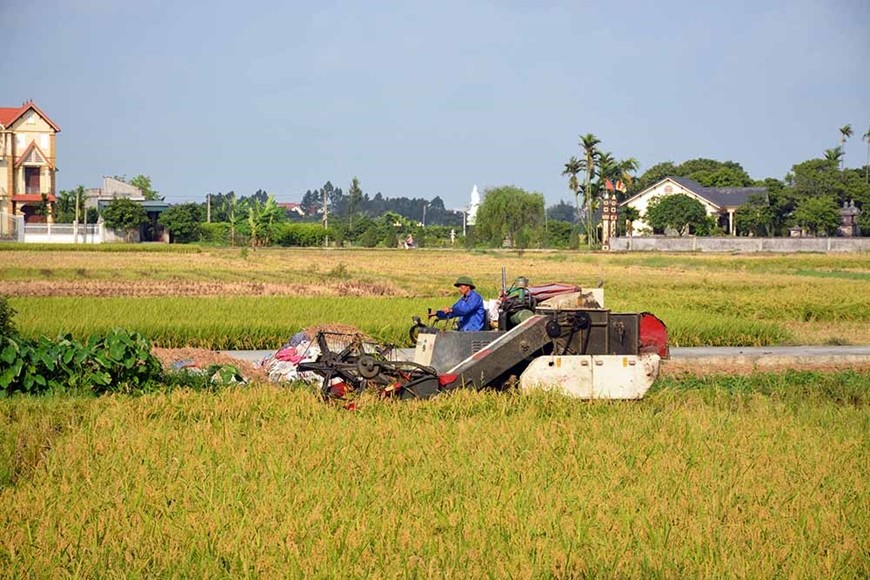
Farmers in Thanh Ha district, Hai Duong province, are harvesting rice.
The call to adulthood...
Looking back over the past 50 years, it seems that every 10 years, Vietnamese rice has elevated itself to a new level. Vietnam has become a major rice producer and trader, the most important link in the global food supply chain and security. The journey of Vietnamese rice is also the relentless journey of the Government, the Ministry of Industry and Trade, and the Ministry of Agriculture and Environment in negotiating, opening up, and developing markets; the flexible and decisive "entry into battle" of rice production, processing, and logistics businesses serving the development of the rice industry; and the Vietnam Food Association. Above all is the diligence, patience, and resilience of the farmers, and of generations of soldiers who fought and sacrificed for independence and freedom, so that today, the green fields have become a song.
However, in the value chain, rice farmers only receive 20-27% of the value, businesses receive 13-27%, and the highest profit margin of 20-32% still belongs to international distributors. Vietnamese rice has only helped rice farmers escape hunger and reduce poverty; the path to wealth from rice is still fraught with difficulties. Farmers still face unstable and precarious harvests, and agriculture remains on the verge of takeoff as farmers still lack control over the market for their products.
Entering a new era for the nation, rice farming no longer relies solely on diligent hands but must also depend on science and technology, scientists, and rice farmers. More immediately, it requires building an ecosystem that effectively utilizes the advantages of new-generation FTAs, helping rice exports continue to expand and write a new chapter in the history of Vietnamese rice.
Source: https://baolaocai.vn/hanh-trinh-hat-gao-lang-ta-vuon-ra-the-gioi-post401183.html










![[Photo] Prime Minister Pham Minh Chinh attends the Conference on the Implementation of Tasks for 2026 of the Industry and Trade Sector](/_next/image?url=https%3A%2F%2Fvphoto.vietnam.vn%2Fthumb%2F1200x675%2Fvietnam%2Fresource%2FIMAGE%2F2025%2F12%2F19%2F1766159500458_ndo_br_shared31-jpg.webp&w=3840&q=75)








































Comment (0)