

No one knows exactly when Buu Son Pagoda was built, but it is known that the pagoda was constructed around the late 18th or early 19th century. This pagoda was once bestowed with five golden characters by King Gia Long: "Ngự Tứ Bửu Sơn Tự" (Imperial Gifted Buu Son Pagoda).
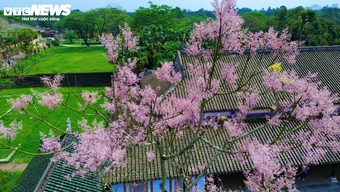
Buu Son Pagoda, also known as "Tower Pagoda," is located on the slopes of Ba Nai hill, facing the Phu Hai estuary, enjoying a cool climate year-round. From the pagoda's courtyard, visitors can admire the panoramic view of Phan Thiet city. Next to the ancient Buu Son Pagoda stands a majestic five-story pagoda, over 10 meters high, in a lotus-pink color. Having endured countless years of rain, sun, sea winds, and fierce wars, the pagoda suffered damage and temporary repairs. In 1961, Buu Son Pagoda was rebuilt on its original foundation. From 2001 to 2015, the pagoda underwent expansion and construction of many new structures, including: concrete roads; the five-story pagoda; the monks' quarters, the main hall, and two bell towers; the statue of Quan The Am (Guan Yin); and the construction of the triple-arched gate, the Loc Uyen garden, and a surrounding wall. Due to its location on the slopes of Ba Nai hill, rebuilding the pagoda required considerable effort and expense from the monks and Buddhist followers. The most striking impression upon visiting Buu Son Pagoda is the majestic, towering stupa against the clear blue sky; the 50-ton monolithic stone statue of Avalokiteśvara Bodhisattva, a marvel of craftsmanship, could only be successfully erected with sincerity, meticulousness, and skill. The main hall of the pagoda, covering nearly 400 square meters , features a two-tiered roof with gracefully curved corners. While not massive, standing here and looking in all directions, one can feel a sense of solemnity and peace. The main hall houses the statue of Shakyamuni Buddha and the Arhats; the upper floor houses the statues of the Dharma Protectors and the Great Bodhisattva. The left hall houses the statue of Avalokiteśvara Bodhisattva; behind the main hall is the area for worshipping ancestors and spirits. The statue of Quan Thế Âm (Guan Yin) faces the sea at Phú Hài, as if to protect and bless the gentle, honest people of this coastal town, ensuring their prosperity. The temple's structures are built on a hillside spanning over 6,000 square meters, following the natural slope of the hill, with the main hall rising more than 27 meters above Nguyễn Thông street. Yet, the surrounding landscape retains its pristine and ancient charm.
After being rebuilt in a magnificent style, Buu Son Pagoda has attracted many visitors from all over to offer incense, worship Buddha, and admire the unique architectural structures. In recent years, the pagoda has been considered an attractive destination for spiritual and cultural tourism . Ms. Nguyen Thi Lan, a visitor from Lam Dong province, shared: “The natural scenery here is spacious, beautiful, and charming. Coming to Buu Son Pagoda, visitors feel the tranquility and peace, forgetting all the worries of daily life. Besides its ancient architectural style, the pagoda also preserves many precious artifacts and is an ancient temple whose name is recorded in the precious books of our ancestors…” Especially, if visitors come to visit, admire the scenery, learn about the history, culture, and architecture of the pagoda, and miss a meal, they can have a simple vegetarian meal with the Zen master and listen to Buddhist teachings.
The ancient architecture of Buu Son Pagoda, along with the landscape of the Po Sah Inu Cham tower and the ruins of the Ong Hoang palace, all combine to create a beautiful and harmonious architectural complex, situated along the wide Nguyen Thong road that winds through Ba Nai hill.
Source
![[Photo] Prime Minister Pham Minh Chinh receives the Chinese Ambassador to Vietnam](https://vphoto.vietnam.vn/thumb/1200x675/vietnam/resource/IMAGE/2026/04/05/1775397481797_ndo_br_dsc-5512-jpg.webp)



















































Comment (0)