

Cao Bang is home to eight ethnic groups: Tay, Nung, Mong, Dao, Kinh, Lo Lo, San Chi, and Hoa... Each ethnic group possesses its own unique culture, creating a vibrant tapestry of diverse cultures. Nature has bestowed upon Cao Bang a landscape that is both majestic and poetic, captivating the hearts of people. This charming land has been the source of many enchanting folk songs, full of genuine emotion and deep affection.
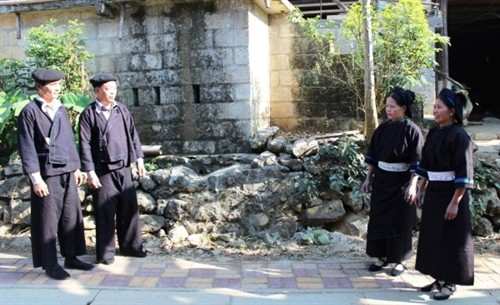
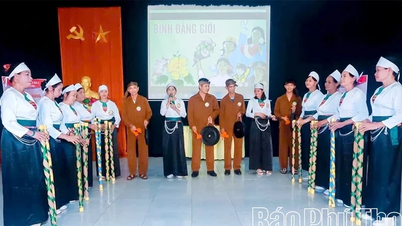
The courtship songs of the Nung An ethnic group. Photo: Archival material.
The Tay and Nung ethnic groups are fundamentally similar in their languages, songs, and folk melodies such as sli, luon, nang oi, phong slu... They also share some common proverbs and folk sayings. And because of this, when I was a child, I witnessed young men and women from both ethnic groups interacting, getting to know each other, and singing love songs together. These love songs weren't just sung during leisure time; they were also performed during festivals, holidays, while working in the fields, going to the market, and at weddings to congratulate the family on welcoming a new bride and to wish the young couple a lifetime of happiness.
At the same time, in order to preserve and promote cultural values, departments, agencies, and localities often organize folk song and courtship singing competitions, thereby contributing to promoting the cultural and artistic movement, patriotic emulation at all levels and sectors, and fostering the strength of the great unity of ethnic groups in the area. As I sit writing this article, I can still hear the faint melody of a former student's song, set to music from a poem by teacher Hoang Thi Khuyen:
"I invite you to come to Cao Bang,"
To admire the flowers together on the mountaintop.
Immerse yourself in the enchanting melodies of folk songs.
"My dear, I'm anxiously waiting for you to come home."
Perhaps I will never forget those quiet nights, or market days, or working in the fields... when I would hear the sounds of the folk songs and the sli singing of the young men and women. Each time, my mother would murmur, "Another young man from another village has come to court a girl from our village," then she would listen to each line of the song and comment, "This young man speaks well, skillfully and profoundly." My mother was famous for her excellent folk singing when she was young, and many people admired her, so many women often came to ask her for advice. At that time, I was about 10 years old and didn't understand the meaning of the songs, but I was curious and found it interesting, so I would often run to where the singing was coming from to see which young men and women were courting each other. Under the dim moonlight, some women sat on the floor singing down, while some men sat on the road singing up, their voices sweet, passionate, and conveying the longing and love of the young men and women.
Once, on my way back from the Nặm Nhũng market, passing through Kéo Yên, I was captivated by the singing of the men and women returning from the market. Their voices echoed through the mountains and forests, lingering in my mind as they parted ways to return to their villages. I once wondered about a man's song: "Those fields are so green and lush, has anyone harvested them yet?" Later, as I grew older, I understood it as a way of subtly getting to know each other through song.
The beauty of the courtship songs of the Tay and Nung people of Cao Bang lies in the fact that they are sung on any occasion. They can be performed at night when young men go into the village to find girls to get to know, at weddings, festivals, market days, or housewarming parties... Whenever there is an occasion where young men and women are present, the songs will be sung. The performance spaces are also very diverse, not fixed to any one place. They can be sung while working in the fields; on the hills; when saying goodbye; by the fireplace; on the porch, or on the floor...
Love songs are not pre-written or prepared songs, but rather lyrics that are adapted to the context, the other person's words, and their emotions. Because the exchange is immediate, it requires both men and women to respond flexibly and skillfully, guiding the conversation and creating a harmonious connection. Through the songs and their responses, they understand each other and learn about the other person's character.
The courtship songs of the Tay and Nung ethnic groups, like the Quan Ho folk songs of the lowlands, also utilize many metaphors, similes, and analogies. They often compare things to objects, landscapes, animals, and even the beliefs of the mountain people. The lyrics express a deep level of emotion, and the skillful choice of words makes the listener's heart captivated and unwilling to leave. Therefore, the later the night, the more poignant the singing becomes, and the more the feelings are absorbed by the sweet voice. Many couples have found love and married through these courtship songs.
"The body is tightly bound to the salty bjooc and the dreamy bjooc."
The leaves are scattered, the leaves are urgently plucked.
Diep can gan pat nam tem phieng
"Điếp căn gặn pia liềng vằng lậc"
Pandemic:
You are like plum blossoms, apricot blossoms.
Loving each other isn't about frivolous flirtations.
Love each other like a bowl of water being pushed away.
They love each other like fish racing across a long river.
The Nung people usually sing love songs in the luon and sli styles more often, while the Tay people sing both luon and nang oi, rarely sli. Although the melodies of sli, luon, and nang oi differ, each style having its own unique way of singing, they all share a common characteristic: gentle, heartfelt, and deeply moving, easily touching the listener's heart.
The Tay and Nung people in the eastern region have a slightly different way of singing courtship songs compared to other regions. Although the melodies of sli and luon are almost the same, the way the song begins between the man and woman always starts with the line: "My dear, there's a golden cloud in the sky..." or "My love, there's a pink cloud in the sky," and then the following lines begin to express their feelings. In the courtship songs of the Tay and Nung people, the man always speaks first, taking the initiative to start the conversation and prompting the woman to respond.
The song begins with a young man's tentative inquiry in a setting from the village to the market, bathed in bright sunlight that seems to share his joy at seeing a beautiful, well-dressed girl coming to the market. In the old days, young men and women went to the market not just to buy and sell, but as an opportunity to meet, to play flutes, sing folk songs, and get to know each other. The young man in this song offers the girl sincere praise, showing his respect and admiration for her, thus winning her heart from the very beginning, because for a girl, being praised for her beauty and diligence is the greatest happiness.
The girl, already showing some interest in the boy, subtly hinted at her unmarried status, playfully suggesting she was opening the door for him to approach her. The boy was equally skillful, simultaneously revealing his unmarried status while recounting his circumstances to evoke sympathy. The love song reminds us of the folk verse, "My wife is still unmarried, my old mother is still unmarried." The boy in that folk verse is similar to the one in this love song, but his situation is even more pitiable as he is an orphan living alone. The endearing aspect is that he doesn't directly declare his love for the girl, but instead asks her to act as a matchmaker. This approach is both charming and clever, subtly probing her feelings while also minimizing hurt if she doesn't reciprocate.
Through these courtship songs, we can see the rich souls and profound emotions of the Tay and Nung ethnic groups of Cao Bang in particular, and the Vietnamese people in general. The lyrics are subtle, subtly testing the other person's feelings, a very familiar way of expressing affection in ancient Vietnam. Alongside this, we also see the boldness, the courage to express feelings, and the skillful way the girl guides the boy to overcome his shyness and embarrassment and express his feelings to her.
The final verses are both an expression of love, a sacred vow, and the yearning for happiness shared by countless couples. The call-and-response singing creates a harmonious connection, as if both are leading each other in the same direction, one opening the way for the other to express their feelings, leading to a fulfilling ending. Love songs always contain the most beautiful and meaningful lyrics; however, not all love stories have a happy ending. There are many reasons why young men and women cannot be together, their paths diverging, leaving them with lingering pain and incomplete regrets.
No matter how many years pass, no matter how society has changed with the younger generation's needs for enjoying music and expressing emotions, and how they have truly integrated into the world, somewhere in parties or on stage, the sounds of sli and luong singing still rise, still sweet and poignant.
Writing this, I am reminded of Professor Pham Long, a lecturer in the Literature Department of Thai Nguyen University of Education, who, upon arriving in Cao Bang, wrote: "The melodious sound of someone's voice lingers in the valley / As if unintentionally bidding farewell."
The melodies of the river seem to hold back the footsteps of tourists arriving in Cao Bang, immersing them in the love songs of a Tay or Nung ethnic girl, forgetting whether they are coming or going: "Suddenly forgetting whether they are coming or going / Because Cao Bang will always remain in their hearts."
I believe the teacher's feelings speak for many who come to Cao Bang, a place with enchanting love songs that captivate the heart. And I also believe that the teacher was mesmerized by the soaring voice of a Cao Bang girl from the valley, a voice that stirred the emotions of the old teacher, bringing him back to his twenties. The singing, the lyrics, are the soul of a person, a simple yet deeply meaningful quality; very tender and subtle, yet not without boldness.
Hoang Hien/Cao Bang Newspaper
Source: https://baophutho.vn/hat-giao-duyen-net-dep-cua-dan-toc-tay-nung-221264.htm

![[Photo] Prime Minister Pham Minh Chinh presides over the conference announcing the establishment of the International Finance Centre in Vietnam.](/_next/image?url=https%3A%2F%2Fvphoto.vietnam.vn%2Fthumb%2F1200x675%2Fvietnam%2Fresource%2FIMAGE%2F2025%2F12%2F21%2F1766309817714_ndo_br_dsc-3400-jpg.webp&w=3840&q=75)


![[Photo] Prime Minister Pham Minh Chinh presides over a meeting on private sector economic development.](/_next/image?url=https%3A%2F%2Fvphoto.vietnam.vn%2Fthumb%2F1200x675%2Fvietnam%2Fresource%2FIMAGE%2F2025%2F12%2F20%2F1766237501876_thiet-ke-chua-co-ten-40-png.webp&w=3840&q=75)




























































Comment (0)