

2025: The Year of Innovation
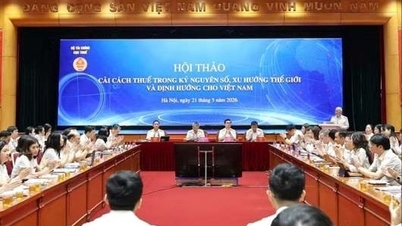
Looking back at history, the tax sector has probably never experienced as much upheaval and profound change as the past year. From March 1, 2025, the nationwide state management model at the General Department level will be replaced by the Department level. Then, from July 1, 2025, when the two-tiered local government system comes into operation, the tax sector will undergo another restructuring process.
Such a thorough reorganization and restructuring has had a profound impact on the tax sector and its personnel in many aspects. This has been mentioned numerous times, in many places, and emphasized by the leaders of the Tax Department at various forums. These issues concern personnel arrangements, efficiency and effectiveness, as well as the (heavy) emotions of many people in the tax sector before and after the implementation of Resolution 18-NQ/TW.
 |
| Director of the Tax Department Mai Xuan Thanh affirmed that in 2026, all officials and employees in the tax sector will enhance their sense of responsibility in performing their duties. |
Of course, the new model operates in a new context, so the pressure is significantly different from before. These are tangible reasons, and their impact can be assessed, not just qualitatively. So what is this new context? It's the institutionalization of new perspectives on the tax system. For the business community, 2025 is the year when many new tax policies will be implemented, including Corporate Income Tax, Value Added Tax, and the Global Minimum Tax…
The implementation of these policies, coupled with the development of new content and the determination of the implementation roadmap—for example, the transition from lump-sum tax to declaration-based tax (effective from January 1, 2026)—has not only subjected the tax sector to workload pressure but has also become the focus of public opinion, and I emphasize that this public opinion is divided on both sides.
Pressure and expectations
Naturally, any change will have reactions, whether fierce or mild. But in the face of these reactions, the tax sector has its own unspoken difficulties! For the general public, the tax sector is very difficult to sympathize with because there seems to be a preconceived notion that it only collects taxes, raises tax rates, and then…collects them again, and, seemingly pays little or no attention to the realities of life.
Ingrained prejudices are inherently difficult to change, but the tax sector is in a position where even if they wanted to share and explain, it would be very difficult to do so. For example, proposing taxable income levels for business households, or managing taxes in a way that both nurtures revenue sources and minimizes tax evasion as much as possible!
Changes in tax policy, at the societal level, will have beneficial effects (in the simplest sense, whether tax payments will increase or decrease) or negative impacts on certain groups affected. However, those working in the tax sector face a double impact: in addition to the tax itself, they also have to deal with the opinions and perceptions of their loved ones. In reality, these are difficult feelings to express or to find empathy for. Even though the tax sector has made significant efforts for taxpayers in recent times, for example, allowing taxpayers to simply declare and upload information to the system, with tax officials handling the rest, this is a perspective that needs to be recognized at a different level than typical administrative reforms. The nature of this pivotal change is that the tax sector is truly shifting from a management mindset to a service-oriented one.
It's also worth mentioning the unique aspect of the tax sector. Simply put, it's a sector where people spend money but rarely feel they're receiving immediate benefits. This is in contrast to other sectors, such as electricity, where customers might pay a higher price but immediately benefit from the coolness of air conditioning or the warmth of heating. Therefore, adjusting a single tax rate, or even implementing a new policy on a larger scale, can be considered extremely difficult for tax officials.
Faced with pressure from all sides—from the goal of increasing revenue, to the need to collect taxes accurately and completely while also creating a long-term source of income—along with the demands of a new spirit, new mechanisms, new laws, and a changing mindset of both collectors and those being collected, coupled with persistent prejudices, what should the tax sector do? Of course, there is much work to be done, and expectations are even higher, but society probably hopes for nothing more than continued dedication to the taxpayer community. Or, as Director Mai Xuan Thanh put it, the tax sector must continue this approach by… “Clarifying the mechanism for measuring taxpayer satisfaction and improving the quality of taxpayer service throughout the sector using a five-step approach: Propaganda-Support-Reminders-Warnings-Inspections.”
If you pay attention, placing the "verification" step at the very end subtly conveys the tax collectors' desire for society to understand their feelings and concerns!
Source: https://thoidai.com.vn/hay-hieu-cho-nganh-thue-219240.html



![[Photo] General Secretary and President To Lam receives Amazon's Senior Vice President David Zapolsky](https://vphoto.vietnam.vn/thumb/1200x675/vietnam/resource/IMAGE/2026/05/22/1779466547770_a1-bnd-3513-6601-jpg.webp)




























![[Video] GNI inaugurates KB library worth over 1.9 billion VND in Tuyen Quang](https://vphoto.vietnam.vn/thumb/402x226/vietnam/resource/IMAGE/2026/05/22/1779438835786_video-gni-khanh-thanh-thu-vien-kb-tri-gia-hon-19-ty-dong-tai-tuyen-quang-20260522152939.jpeg)

































































Comment (0)