

The Agreement within the framework of UNCLOS on the Conservation and Sustainable Use of Marine Biodiversity in the Area Beyond National Jurisdiction (BBNJ) is the third agreement implementing UNCLOS, further strengthening UNCLOS, contributing to the consolidation of multilateralism, and marking a new milestone in the development of international law.
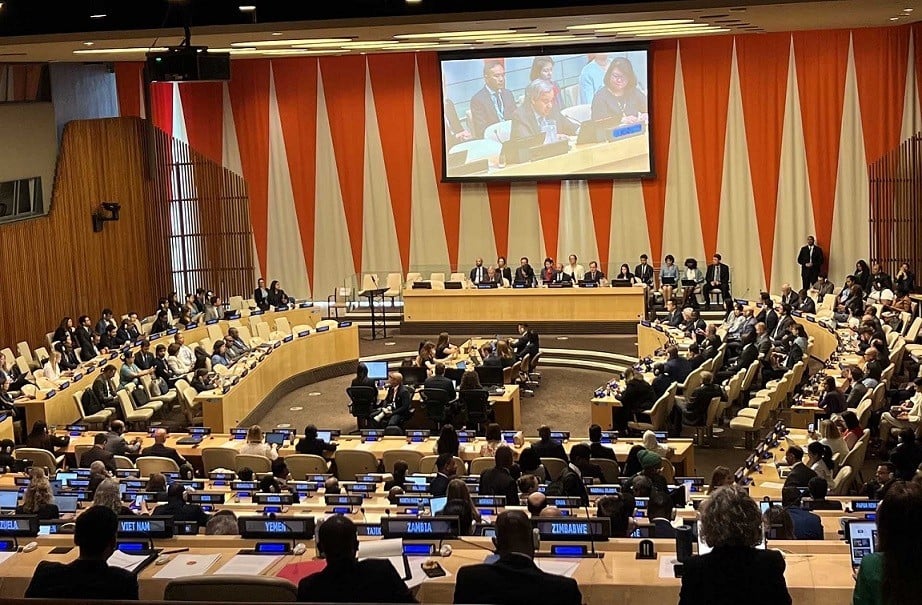 |
| The intergovernmental conference adopted the Agreement within the framework of UNCLOS on the Conservation and Sustainable Use of Marine Biodiversity in Areas Beyond National Jurisdiction (BBNJ Agreement) on September 16, 2023. (Source: Vietnamese Delegation to the UN) |
A historical milestone
Located beyond 200 nautical miles and not under the jurisdiction of any single nation, international waters encompass two-thirds of the world's oceans and cover nearly 50% of the Earth's surface. This area is home to a wealth of diverse natural resources, both biological and non-biological, providing immense benefits to humankind.
International waters play a crucial role not only in transportation and shipping but also in national, regional, and global economic development, contributing to the sustainable development of coastal communities.
| In an interview with the World and Vietnam Newspaper, Australian Ambassador to Vietnam Andrew Goledzinowski stated: "The adoption of the Agreement on the Conservation and Sustainable Use of Biodiversity in the Sea Beyond National Jurisdiction (BBNJ) last year demonstrated that the international community is capable of supplementing rather than undermining UNCLOS. That is a significant difference." |
However, this is also an area that remains largely unexplored by humans. Only a select few countries and organizations with advanced science and technology have the capacity to explore and investigate these remote and deep ocean regions.
The 1982 United Nations Convention on the Law of the Sea (UNCLOS), considered the constitution of the seas and oceans, sets out regulations on freedom of navigation, freedom of fishing, and freedom of scientific research at sea in areas outside the exclusive economic zone... However, UNCLOS does not contain any provisions specifically addressing access to, use of, and sharing of benefits from marine biodiversity resources outside national jurisdiction, nor does it have a mechanism to coordinate and control maritime activities to protect genetic resources from decline and depletion.
Recognizing the importance and urgency of conserving and sustainably utilizing marine biodiversity in areas beyond national jurisdiction, the international community is striving for collective action, especially in the context of increasing risks of marine environmental degradation and the serious impacts of climate change on the seas and oceans.
Negotiations for a legally binding instrument on marine biodiversity in areas outside national jurisdiction have been ongoing for nearly 20 years.
On March 4, 2023, in New York (USA), the UN Intergovernmental Conference completed negotiations on an international legal instrument concerning marine biodiversity in areas beyond national jurisdiction.
Subsequently, on June 19, 2023, the Intergovernmental Conference unanimously adopted the Agreement within the framework of UNCLOS on the Conservation and Sustainable Use of Marine Biodiversity in Areas Beyond National Jurisdiction (BBNJ Agreement).
On August 1, 2023, the UN General Assembly, in its plenary session, adopted a resolution on the BBNJ Agreement with the support of 150 out of 193 member states. From September 20, 2023, the Agreement was open for signature for a period of two years and will enter into force 120 days after at least 60 member states have submitted their ratifications, approvals, acceptances, or accession.
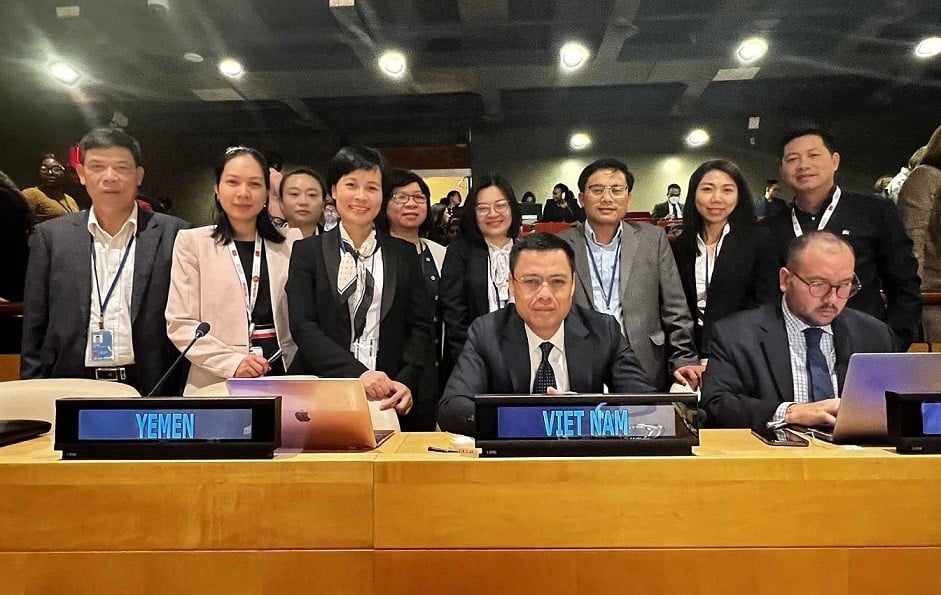 |
| The Vietnamese inter-ministerial delegation attended the intergovernmental conference through the BBNJ. (Source: Vietnamese Delegation to the UN) |
Strengthening the vitality of multilateralism
The BBNJ Agreement is the third agreement to implement UNCLOS (after the Agreement on Migratory Fish Stocks and the Agreement to Implement Part XI of UNCLOS), further strengthening UNCLOS – the comprehensive legal framework for all activities at sea.
Furthermore, the BBNJ Agreement contributes to strengthening multilateralism, marks a new milestone in the development of international law, and contributes to the implementation of the UN Decade on Marine Science for Sustainable Development and the realization of Development Goal 14 on the conservation and sustainable use of oceans, seas and marine resources for sustainable development.
UN Secretary-General Antonio Guterres once emphasized that the negotiation and adoption of the BBNJ demonstrated the strength of multilateralism, built on the spirit of UNCLOS, reflecting a commitment to addressing global challenges and ensuring sustainability in areas outside national jurisdiction.
Furthermore, BBNJ promises to open new doors of opportunity for international cooperation in fields requiring high scientific and technological capabilities such as marine genetic resources, regional management tools, marine environmental impact assessment, capacity building, and marine technology transfer.
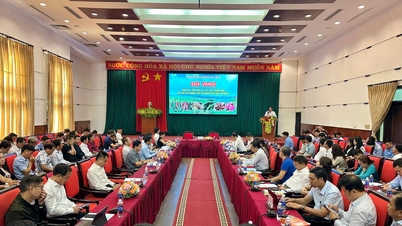
| Within the framework of the 13th South China Sea Dialogue organized by the Diplomatic Academy (Ministry of Foreign Affairs) in Can Tho (November 14), prestigious domestic and international scholars will focus on exchanging and clarifying the basic contents of the BBNJ; and also discuss how this Agreement can be applied in accordance with other existing legal instruments. |
Many officials from various countries have offered assessments of the significance of the BBNJ agreement. Singapore's Foreign Minister, Vivian Balakrishnan, emphasized that the document represents another victory for international law and multilateralism, having been adopted at a time when the world is fraught with instability. The agreement demonstrates what UN members can achieve through cooperation.
Maldives Foreign Minister Abdulla Shahid welcomed the significant milestone in the collective effort to protect and sustainably manage invaluable marine resources that exist beyond national jurisdiction.
Meanwhile, Chilean Foreign Minister Alberto van Klaveren affirmed Chile's readiness to participate in the BBNJ Secretariat in the most constructive spirit, aiming to work with the world to achieve even greater progress in protecting the oceans.
If 60 countries join, ratify, approve, or accept the BBNJ Agreement, it will formally enter into force. Within one year of the Agreement entering into force, the UN Secretary-General will convene the first conference of the Parties to the instrument.
Vietnam participates proactively and responsibly.
As a maritime nation, Vietnam actively participated in the BBNJ negotiations from the very beginning; offering substantive proposals and contributions, and was also one of the first countries to sign the BBNJ on the first day the Agreement was open for signing.
Speaking to the press, Ambassador Dang Hoang Giang, Head of the Vietnamese Delegation to the UN, emphasized that Vietnam aspires to "become a strong maritime nation, developing sustainably, prosperously, and safely... actively and responsibly participating in resolving international and regional issues concerning the sea and oceans" (Vietnam's Sustainable Maritime Economic Development Strategy to 2030, Vision to 2045).
Therefore, according to Ambassador Dang Hoang Giang, Vietnam needs to leverage capacity-building measures and technology transfer, as well as financial resources from the benefit-sharing fund for marine genetic resources outside national jurisdiction, to "access and maximize the use of advanced scientific and technological achievements," "train and develop marine human resources, and form a team of highly capable and qualified marine science and technology personnel," thereby "sustainably developing the marine economy on the foundation of green growth and biodiversity conservation," as set out in the Vietnam Marine Economic Sustainable Development Strategy to 2030, with a vision to 2045.
Ambassador Dang Hoang Giang emphasized that with the correct policies and guidelines of the Party and State on the sea as well as on international integration, with the motto "proactive and active deep integration," "being a friend, a reliable partner, and a responsible member of the international community," Vietnam will participate increasingly in activities in the sea areas beyond national jurisdiction, in Southeast Asia, as well as other regions of the world.
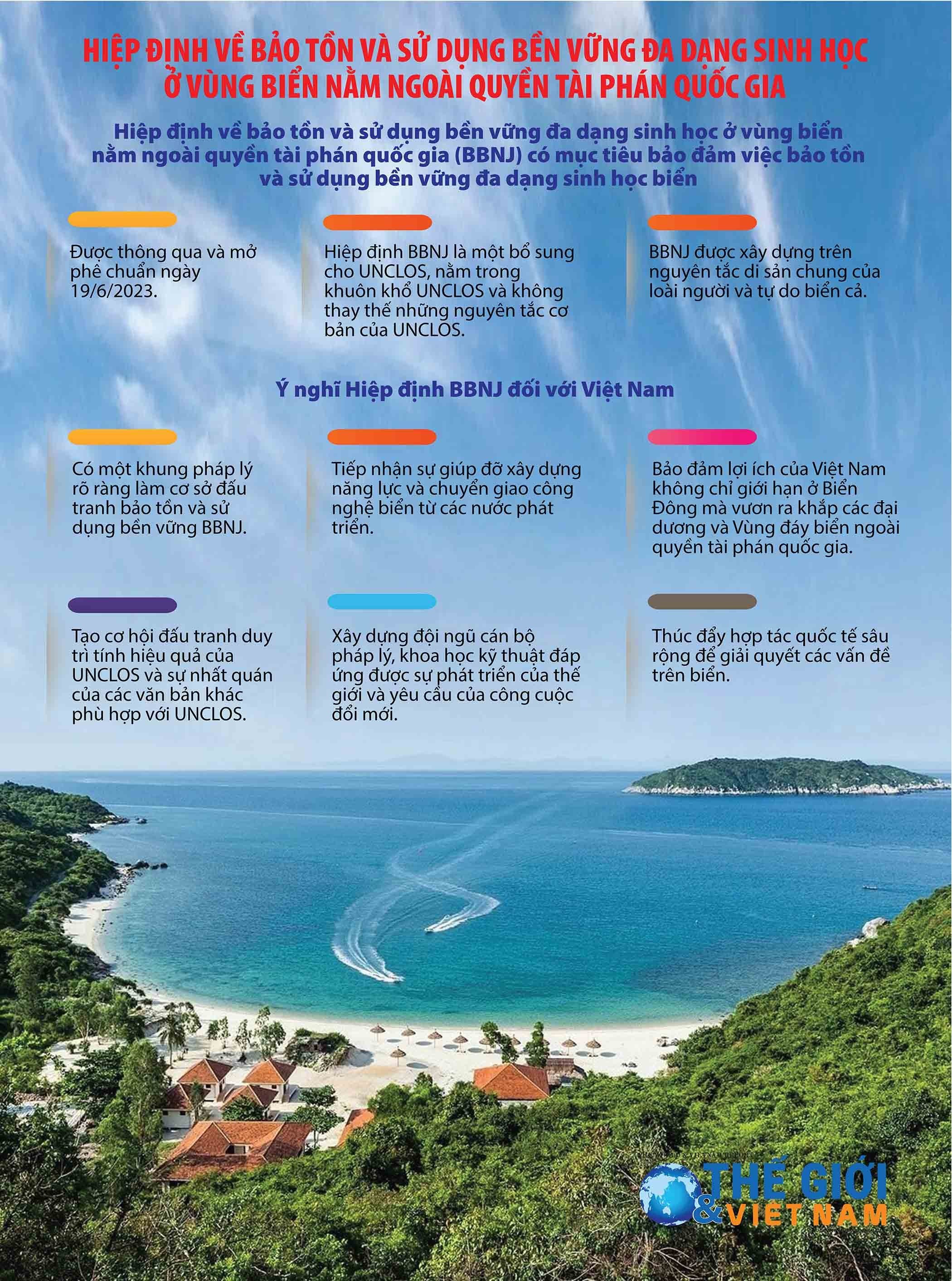
The BBNJ Agreement, comprising an Introduction, 12 Parts with 76 articles, and two Annexes, aims to ensure the conservation and sustainable use of marine biodiversity for the present and the long term, through the effective implementation of the provisions of UNCLOS 1982 and enhanced international cooperation. The BBNJ Agreement stipulates four key issues in ensuring marine biodiversity: marine genetic resources; area-based management measures and tools (ABMT), including marine protected areas (MPAs); marine environmental impact assessment (EIA); and capacity building and marine technology transfer. |
 |
 | Vietnam actively upholds the values of UNCLOS and promotes cooperation on maritime and ocean issues. The 34th Conference of States Parties to the United Nations Convention on the Law of the Sea (SPLOS) was held from June 10-14. |
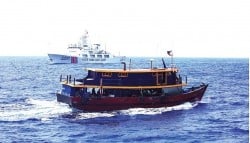 | The Philippines rejects US offer of assistance in the South China Sea, asserting that the Mutual Defense Treaty is 'a long way from being implemented'. Despite escalating tensions with China in the South China Sea, the Philippines insists it does not yet need direct assistance... |
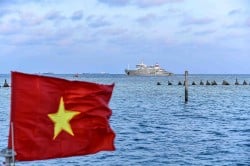 | 14th Annual International Conference on the South China Sea: Vietnam Emphasizes Adherence to International Law and Highlights the Responsibility of All Parties Involved. Recently, the Center for Strategic and International Studies (CSIS), based in Washington D.C., organized a seminar... |
 | 30 years since UNCLOS came into effect: The role of ITLOS in maintaining legal order at sea. By resolving more than 30 maritime disputes over the past nearly 30 years, the International Tribunal for the Law of the Sea (ITLOS) has made a significant contribution... |
 | International law serves as a compass for the South China Sea issue; while many burdens remain, ASEAN's role is fundamental. Security in the South China Sea is a matter of concern for many countries; therefore, we must take responsibility for security based on international law... |
Source: https://baoquocte.vn/hiep-dinh-ve-bien-ca-bbnj-moc-dau-moi-cua-luat-phap-quoc-te-canh-tay-noi-dai-cua-unclos-293364.html






























































































Comment (0)