Put an end to the "oil spill" pattern of spatial development.
The Department of Planning and Architecture of Ho Chi Minh City has recently sent a document to the People's Committee of Ho Chi Minh City to report on the proposal to implement the Project to form an urban industrial, service, and logistics belt along the Ring Road 3, 4 corridors and inter-regional expressways.
According to the Department of Planning and Architecture, these are vital, strategic transportation arteries connecting cities, industrial centers, and service hubs in the Southeast region. They play a role in promoting multimodal regional connectivity and enhancing Ho Chi Minh City's role as a core urban center in relation to the Southeast region. The investment in the construction of Ring Roads 3 and 4, and the upcoming development of expressways, will expand development space, create new impetus for growth, and promote the formation of important industrial, service, and logistics belts in the region.
Furthermore, Ho Chi Minh City is a centrally-governed city, a special urban area with the largest population and economic scale in Vietnam, strategically located in the heart of the Southeast region with a strong multimodal transportation network. In practice, effectively exploiting the city's development potential, especially in the high-tech industrial, service, and logistics sectors, is crucial for promoting socio-economic development in the Southeast region and the entire country.
Therefore, the accelerated progress of inter-regional ring roads and expressways necessitates research and assessment of the current situation, identifying opportunities and challenges… in order to develop strategies, programs, and plans for the development of industrial, urban, service, and logistics belts along these vital transportation corridors. This will provide a basis for proposing policy solutions to attract investment, create a favorable and sustainable investment environment, and contribute to the socio-economic development of the region.
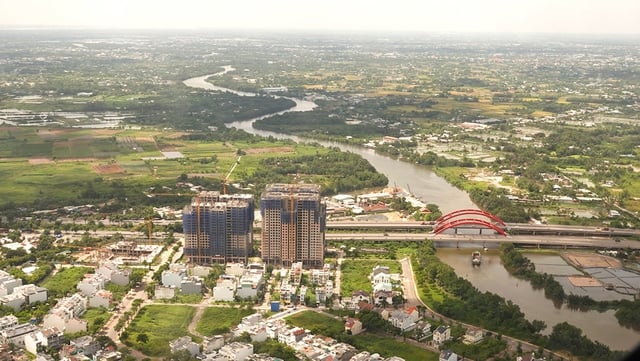
Experts emphasize that Ho Chi Minh City needs to expand its connectivity to maximize its advantages. (Sy Dong)
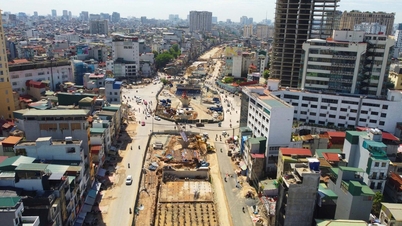
The idea of forming a regional industrial and service belt was previously mentioned in the draft revised master plan for Ho Chi Minh City until 2040, with a vision to 2060. The "task" set by the Chairman of the People's Committee of Ho Chi Minh City, Phan Van Mai, emphasized the need to study the "dynamism" and "openness" of regional linkages. Mr. Phan Van Mai stated that previously, the orientation of the Ho Chi Minh City master plan until 2025, according to Decision 24/2010 of the Prime Minister , identified Ho Chi Minh City as developing according to a multi-polar concentrated model (also known as a megacity). However, reality shows that this model is difficult to implement. Firstly, this is due to the current population distribution, which is gradually decreasing in the central area and rapidly increasing in the surrounding areas. Furthermore, Ho Chi Minh City has not yet clearly formed major centers, while urban development in the suburban areas is mainly spreading out. In many areas, development is still spontaneous, like an "oil stain," lacking synchronized infrastructure connections.
Therefore, Ho Chi Minh City is studying a transformation into a multi-center model (multi-polar combined with secondary centers). New planning research projects need to be more complete and clearer regarding the city's multi-center urban model. From there, the consulting unit has proposed several solutions to connect the city with major cities in the region, such as building axes connecting Ho Chi Minh City with major cities in the region; forming industrial-urban-service belts along Ring Road 3 and Ring Road 4; and constructing the Can Gio international transshipment port…
Opening up connections, creating economic breakthroughs across the region.
Urban planning expert and architect Ngo Viet Nam Son believes that, in the context of regional linkages between Ho Chi Minh City and other localities in the southern key economic region, the connection between Ho Chi Minh City and the provinces of Binh Duong, Dong Nai , and Ba Ria-Vung Tau is the most important and should be prioritized. This is because these localities contribute the most to the national budget, but have long developed in a fragmented manner, with each province acting independently, and the linkages and connections remain quite weak.
Specifically, the interconnected transportation system, including ring roads, radial expressways, railways, and air transport, is still under construction and expansion, and is not yet complete. The railway runs from Saigon Station, connecting to Song Than and Di An stations in Dong Nai and Binh Duong provinces, but has not yet connected to Ba Ria-Vung Tau. Air transport is also weak due to the overload at Tan Son Nhat Airport and the lack of development at Long Thanh Airport. Water transport is also unstable; the Cai Mep-Thi Vai and Cat Lai port clusters along the Saigon and Dong Nai rivers lack interconnectedness and cooperation in warehousing and infrastructure. This loose connectivity prevents the region's economic development from reaching its full potential.
“If we can build a system of corridors connecting logistics, services, and industry between these four localities, it will certainly create a breakthrough, boosting the GRDP of each locality as well as the national economy to a higher level. Currently, the Ring Road 3, Ring Road 4, and the system of expressways in the Southeast region are being actively promoted and are expected to be completed soon, creating very good conditions to strengthen the linkages and connections of this key region,” architect Ngo Viet Nam Son commented.
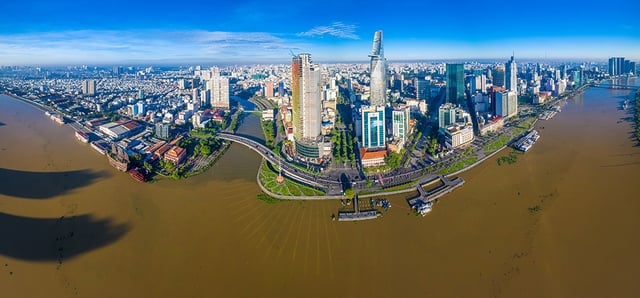
Ho Chi Minh City is studying a transformation into a multi-center model. (Nguyen Minh Tu)

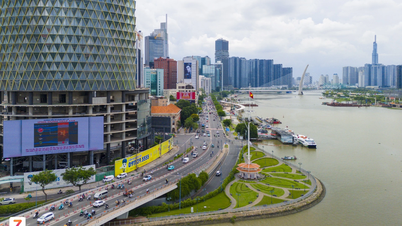
![[Image] Bridges and roads connecting the eastern part of Ho Chi Minh City](https://vphoto.vietnam.vn/thumb/192x108/vietnam/resource/IMAGE/2026/04/16/1776328595108_ndo_br_bh-vt5-jpg.webp)
Dr. Truong Minh Huy Vu, Deputy Director of the Ho Chi Minh City Development Research Institute, also affirmed that organizing industrial development space in conjunction with regional linkages will create a very good impetus for Ho Chi Minh City to reposition its industrial sector and core strategy. According to Dr. Vu, while identified as playing a crucial role in the economy, contributing significantly to the budget, and creating a ripple effect to promote the development of other sectors, Ho Chi Minh City's industrial sector is showing signs of slowing down, declining competitiveness, and facing many major challenges that weaken its role as the industrial center of the southern key economic region and the entire country.
Ho Chi Minh City aims to become a modern industrial city by 2030; a high-tech industrial center, a research and development center, and a center for startups and innovation for the whole country and the Southeast Asian region. High-tech industrial products will account for an increasing proportion of the added value of the industrial sector; developing supporting industrial products to participate in global supply chains; gradually shifting towards self-sufficiency in raw material production, design, and manufacturing. By 2050, Ho Chi Minh City aims to become a city with a modern industrial base on par with major cities in the region, reaching continental prominence.
"With that goal in mind, Ho Chi Minh City needs to identify concentrated industrial production areas linked to the network of industrial parks and clusters, as well as industrial production areas located outside of industrial parks and clusters, in order to ensure infrastructure for industrial development in the next phase. The industrial development space should be arranged and organized in conjunction with regional linkages," Mr. Vu emphasized.
Accordingly, projects producing supporting industrial products should be developed within industry clusters in Ho Chi Minh City and the Southeast region; some of the city's industries can expand investment into the Southeast region, the Mekong Delta, and other localities. Furthermore, Ho Chi Minh City is the nucleus and growth pole of the southern dynamic region, linking with the urban-industrial-service corridor of Binh Duong, Dong Nai, and Ba Ria-Vung Tau provinces. With the goal of achieving deep international integration and a prominent position in Southeast Asia, the city needs to expand its linkages to maximize its advantages.
Ho Chi Minh City must maintain its central and guiding role.
Although recognizing the importance and significance of the project, the Ho Chi Minh City Department of Planning and Architecture believes that, given its nature and scale, the study on building an urban industrial belt would encompass a vast area, spanning across all provinces in the Southeast region; requiring close coordination among the People's Committees of the provinces and cities in the region. The Department and experts found that conducting research and developing a project covering the entire region in such a short time (only about 3-4 months; by around October-November this year) is not feasible; especially for content requiring discussion and consensus from all provincial governments in the region.
Architect Ngo Viet Nam Son agrees that negotiations with provinces and cities will take a long time because regional linkages require signing agreements that demand discussion and consensus to balance the interests of all parties. However, regarding how to orient regional linkages and develop the ring road system, Ho Chi Minh City still needs to conduct research on the entire region and then proactively do its part within its own scope first.
“We can't just sit and wait; whatever can be done must be started immediately, but planning still needs to be considered in the context of inter-local linkages. If the urban, industrial, service, and logistics belt isn't placed within a regional linkage framework, it will become a meaningless project. Moreover, without a holistic view, it's impossible to identify potential risks that need to be anticipated, especially regarding land for regional linkages,” Mr. Ngo Viet Nam Son stated, emphasizing that without comprehensive planning, especially for transportation projects where neighboring properties are in close proximity, future development will be very difficult.
A typical example is the Ho Chi Minh City – Long Thanh – Dau Giay expressway. The design at the Ho Chi Minh City end lacked foresight, resulting in a uniform road width from Long Thanh to Ho Chi Minh City. It failed to account for the need to widen the road at 100 km/h on the highway to 40-50 km/h at the end sections, which would require 1.5-2 times the original width to avoid congestion. As a result, the access roads have become bottlenecks on the expressway, making future expansion difficult because houses on either side are already built close together, making land acquisition extremely challenging. "Without specific direction and a long-term vision, what is done first can sometimes hinder what is done later," this expert warned.
Therefore, architect Ngo Viet Nam Son emphasized that the project to form an industrial, urban, service, and logistics belt along the Ring Road 3, 4, and inter-regional expressways of Ho Chi Minh City needs to be placed within the overall regional planning framework, divided into detailed implementation phases. Phase 1 involves studying the scale of the city itself, as proposed by the Department of Planning and Architecture; Phase 2 discusses how to link localities in the region and how agreements should be signed; Phase 3 focuses on construction methods and investment sources; Phase 4 addresses management issues, clearly defining which parts are under Ho Chi Minh City's management and which belong to other localities; and Phase 5 involves learning from experience and coordinating regional planning with Ho Chi Minh City… All five phases must have a clear roadmap. Even small projects must fit within the larger overall plan to demonstrate Ho Chi Minh City's pivotal and guiding role.
Several solutions for connecting Ho Chi Minh City with major cities in the region.
– Focus on expanding and upgrading Tan Son Nhat International Airport; attract investment and strongly develop concentrated information technology zones; build and upgrade national performing arts facilities to meet the requirements for organizing national and international art events; establish and develop a national innovation and startup support center.


– Regarding transportation connectivity, the city will extend the southern arterial axis parallel to National Highway 50 and connect with the coastal road in Tien Giang; and add a connecting route to Long Thanh Airport from the center of Ho Chi Minh City via Phu My 2 Bridge.
– Supplementing the eastern connection with Dong Nai to National Highway 20 to alleviate congestion on National Highway 1 and the Long Thanh – Dau Giay Expressway; connecting the coastal road from Go Cong (Tien Giang) through the Soai Rap river mouth to Can Gio and extending to the Ben Luc – Long Thanh Expressway.
– Regarding railways, the Ho Chi Minh City – Can Tho railway line will be connected to the Ho Chi Minh City – Nha Trang railway line via an elevated section along Nguyen Van Linh Street and the Hanoi Highway – Ring Road 2. In the future, the Hoa Hung – Binh Trieu – An Binh section will be converted into an urban railway.
(Revised master plan for Ho Chi Minh City until 2040, with a vision to 2060)
Nearly 134 trillion VND invested in 4 ports and 10 urban areas along Ring Road 4.
The People's Committee of Binh Duong province has approved the urban development area along Ring Road 4 – Zone 1, Ben Cat City. Accordingly, by 2040, this area will have 4 ports and 10 urban areas with a total investment of nearly 133,728 billion VND. The urban development area along Ring Road 4 – Zone 1 covers an area of approximately 2,702 hectares, including parts of An Tay Ward, An Dien Ward and Phu An Commune; its northern boundary borders Thanh Tuyen Commune, Dau Tieng District; its southern and western boundaries border the Saigon River, Cu Chi District, Ho Chi Minh City; and its eastern boundary borders Highway 609, Provincial Road 744, Provincial Road 748 and Thi Tinh River, Thoi Hoa Ward, Ben Cat City. The main nature and function of the area is a port – logistics – service urban area. As a key transportation hub of the province, it serves as a gateway connecting to Ho Chi Minh City via the Ring Road 4. Binh Duong province stated that the proposed investment resources for urban development will come from the state budget, socialized capital, bonds; capital mobilized by investors for urban development projects; and other legitimate sources of funding.
Source: https://thanhnien.vn/hinh-thanh-vanh-dai-lien-ket-kinh-te-toan-vung-phia-nam-18524071422212311.htm
![[Photo] Prime Minister Le Minh Hung presides over the thematic session on promoting science and technology development and innovation.](https://vphoto.vietnam.vn/thumb/1200x675/vietnam/resource/IMAGE/2026/06/23/1782207872934_ndo_br_dsc-1724-jpg.webp)