In mid-June, a delegation of French experts on history and museums spent four significant days in Dien Bien , visiting key historical sites such as Hill A1, the Dien Bien Phu Victory Museum, the Dien Bien Phu Victory Monument, the Hill A1 National Martyrs' Cemetery, and the De Castries Bunker.
This initiative is part of a partnership that was launched following French President Emmanuel Macron's visit to Vietnam in May 2025.

French historians and museum experts visit the Dien Bien Phu Victory Museum.
One prime example is the visit to Dien Bien Phu by French Minister of the Armed Forces Sébastien Lecornu on May 7, 2024, to commemorate the 70th anniversary of the Dien Bien Phu Victory.
And next is the collaboration between the Caen War Memorial Museum and the Dien Bien Phu Victory Museum, where French museum experts and historians share their experience in museology, design, exhibition system organization, and conveying history to future generations.

The group visits the panoramic painting depicting the Dien Bien Phu campaign.
Associate Professor Clément Fabre, a senior lecturer in contemporary history at the University of Paris-Est Créteil and an expert on colonial and imperial history, shared that since his first visit to Vietnam and Dien Bien province in March 2025, he has spent considerable time researching the Dien Bien Phu Victory Museum.
“We found the museum to have many strengths. The museum's exhibition design clearly reflects its identity with diverse artifacts, especially the very large panoramic painting. All members of the delegation were impressed by everything about the museum. The artifacts were truly amazing, wondrous, and abundant. But the point I want to emphasize most is the history and the story the museum is telling.”

Associate Professor Clément Fabre
Not every museum has a unique story to tell. The victory at Dien Bien Phu was a pivotal moment in history, not only for Vietnam and its relationship with France, but also for the world . The victory on May 7, 1954, at Dien Bien Phu was the "opening salvo" signaling the start of the colonial liberation movement worldwide. Therefore, the French expert believes this story attracts the public in Vietnam, France, and many other countries.
However, Associate Professor Clément Fabre argues that innovation should not be seen as a unique story of the Dien Bien Phu Victory Museum, but as a common reality for all museums. Even the War Remnants Museum (CAE) annually rearranges its spatial layout, exhibition content, landscape, artistic arrangement, lighting, and sound systems.
This will contribute to creating something new for visitors and providing them with different historical experiences each time.
"Life is constantly changing. Museums, as cultural, artistic, and historical institutions, also need continuous innovation to keep pace with contemporary life," shared Clément Fabre.

You may also like
An exhibition of priceless paintings by King Hàm Nghi:Following its resounding success at Kien Trung Palace, Hue Imperial Citadel last March, the exhibition “Sky, Mountains, Water | Allusive Panorama” – showcasing 20 precious paintings by King Ham Nghi – will continue to be presented to the public in Hanoi at the Temple of Literature - National University at the end of April. People viewing the artifacts.
The figure of 400,000 visitors per year shows that the Dien Bien Phu Victory Museum has been very successful with the Vietnamese public, as these are people who already have a certain understanding of history and want to visit and experience it.
A French historian noted that, in its development strategy, the museum needs to expand its target audience to include French tourists and visitors from around the world. To achieve this, the museum will have to renovate and reorganize its exhibits to meet international standards in design. This is also the spirit behind the Dien Bien Phu Victory Museum's collaboration with the Caen War Memorial Museum.
For foreign visitors who are not fully aware of the event and its international impact, experts offer suggestions for museum revisions to provide more information about the significance of the event.

Currently, the challenge is not the lack of historical value, but rather how to organize, connect, and convey those values to the people.
"Of course, museums have many elements of identity that need to be preserved, such as the large-scale Panorama painting. Museums must balance and reconcile two goals: maintaining and protecting their unique identity while simultaneously meeting international standards in museum technology and professional practices," the expert commented.
"A REMEDY" FOR HEALING PAST WOUNDS
Meanwhile, Damien Palomba, Director of Development and Operations at the Caen War Memorial Museum, said that the French expert team had surveyed and assessed the permanent exhibition area and discussed with the museum's management and specialized departments to understand the needs, direction, and renovation plans.
The Dien Bien Phu Victory Museum also "commissioned" the French side to carry out several tasks, prioritizing a suggestion for reorganizing an exhibition area related to the French army. The French side also received a request for assistance in searching for supplementary documents and artifacts in France.
Damien Palomba stated that for young people, it's necessary to incorporate more recreational and experiential activities to easily create a lasting emotional impact on younger tourists.

Damien Palomba, Director of Development and Operations at the Caen War Memorial Museum.
"Emotion is key to connecting young people with history. We shouldn't just focus on statistics, but instead tell real historical stories, through the personal accounts and shared experiences of veterans who participated in the war. These everyday stories will evoke more genuine emotions and deeper empathy," analyzed Damien Palomba.
Tour guides need to be flexible and perceptive to help students connect historical knowledge from textbooks with the images and artifacts present right in front of them during each tour.
French experts also argue that many people can simply look at their phones to know what's on display inside a museum and what the content is like. However, excessive digitization of spaces, stories, and historical artifacts could lead to negative reactions. The true strength of a museum lies in the presence of original artifacts and the firsthand experience.

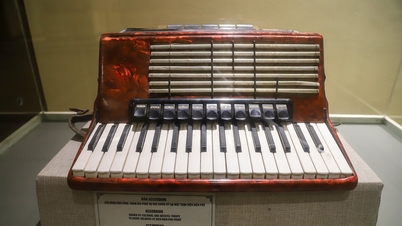
The accordion is on display at the museum.
Each artifact can tell its own story, but the emotions it evokes come from the tour guide's explanation and presentation. To illustrate this, Associate Professor Clément Fabre suggested that an artifact like the accordion used by a performing arts troupe to entertain soldiers at the Dien Bien Phu front could be displayed along with musical scores played on this instrument or stories about witnesses who witnessed the artifact.
At a meeting with the French expert delegation, the Secretary of the Dien Bien Provincial Party Committee, Tran Tien Dung, received a proposal outlining the exhibition plan for the Dien Bien Phu Victory Museum. Mr. Dung stated that the plan includes a larger, more prominent project, reflecting the province's policy of developing the cultural industry.
"If the museum only displays artifacts, you'll see everything in a short time. I really like the images in the report about French self-propelled artillery and Jeeps. If they could recreate the artifacts, weapons, and equipment that France used at that time, which showed modernity, it would be very fascinating," the Provincial Party Secretary suggested.

The French historian presented his exhibition suggestions to the staff of the Dien Bien Phu Victory Museum.
The Secretary of the Dien Bien Provincial Party Committee stated that the cooperation activities being implemented between the two museums not only have professional significance but also contribute to promoting the image of Dien Bien to international friends, bringing the historical values of the Dien Bien Phu battlefield closer to the public both domestically and internationally through research, education, culture, and tourism activities.
History is the common heritage of all humanity, and historical museums are repositories of this shared memory. Therefore, cooperation among historical museums is of paramount importance. Working together to recount history, to research history, including its most painful periods, is the most effective "remedy" for healing the wounds of the past and the most solid path towards a peaceful future.
Source: https://vietnamnet.vn/tu-chiec-dan-accordion-trong-bao-tang-den-chia-khoa-ket-noi-voi-lich-su-2528148.html




![[Photo] Prime Minister Le Minh Hung presides over the thematic session on promoting science and technology development and innovation.](https://vphoto.vietnam.vn/thumb/1200x675/vietnam/resource/IMAGE/2026/06/23/1782207872934_ndo_br_dsc-1724-jpg.webp)